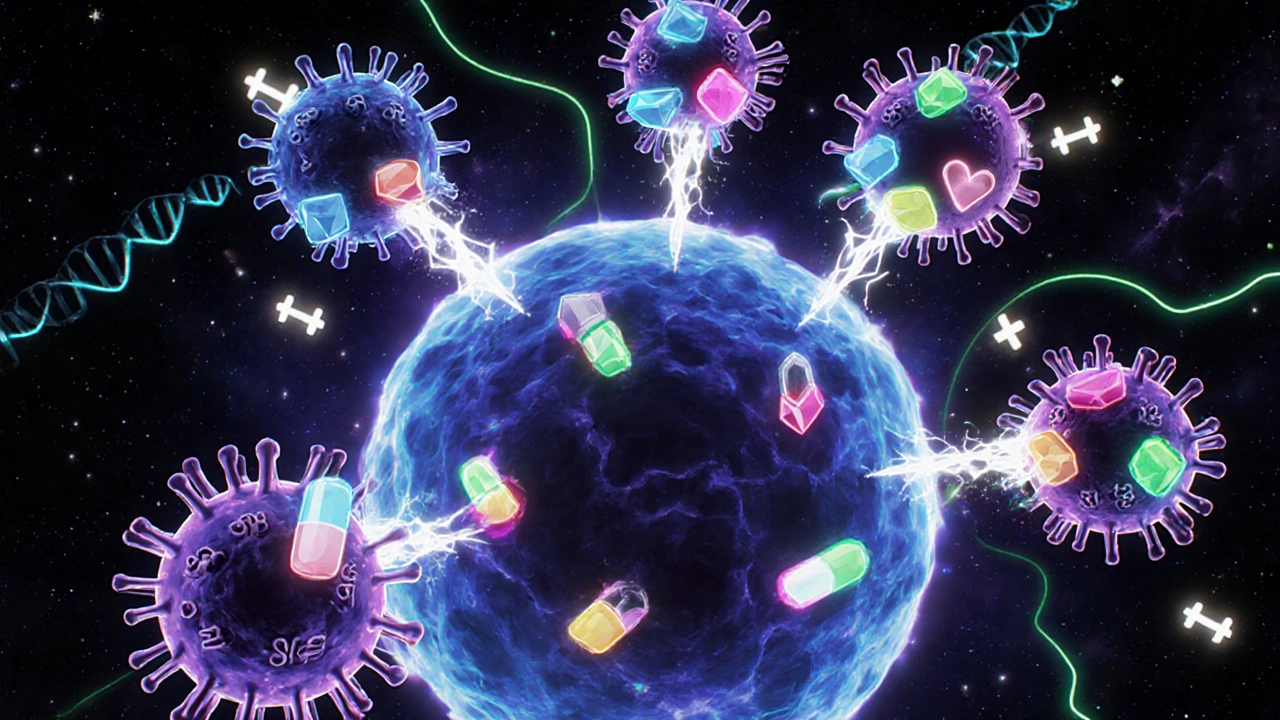
When HIV first emerged as a global health crisis, a diagnosis often meant a death sentence. Today, thanks to antiretroviral therapy (ART), people living with HIV can expect to live long, healthy lives - as long as they stay on treatment. But behind the simplicity of popping a daily pill lies a complex battlefield: viruses that evolve faster than our drugs, medications that clash with each other, and resistance patterns that can turn a once-effective regimen into a useless one. This isn’t just about taking medicine. It’s about understanding how these drugs work, how they fight back, and what happens when they fail.
How Antiretroviral Drugs Stop HIV in Its Tracks
HIV doesn’t just float around in your blood. It sneaks into your immune cells, copies itself, and spreads. Antiretroviral drugs block this process at different stages. There are six main classes, each targeting a specific step in the virus’s life cycle.- NRTIs (like tenofovir and lamivudine) act as fake building blocks. When HIV tries to copy its RNA into DNA, it grabs these imposters instead of real ones, and the chain breaks.
- NNRTIs (like doravirine and efavirenz) stick to the reverse transcriptase enzyme like glue, making it useless.
- Protease inhibitors (like darunavir) stop the virus from cutting its proteins into usable pieces, so new viruses can’t mature.
- INSTIs (like dolutegravir and bictegravir) block the integrase enzyme, preventing HIV from inserting its DNA into your cells.
- Fusion inhibitors and CCR5 antagonists stop the virus from even entering the cell in the first place.
Modern treatment almost always combines two NRTIs with a third drug - usually an INSTI - because using just one lets HIV adapt too easily. This combo approach is why most people today achieve an undetectable viral load, meaning the virus is so low it can’t be measured or transmitted.
Why Resistance Is the Silent Threat
HIV mutates constantly. Every time it copies itself, it makes mistakes. Most of these errors don’t help the virus. But sometimes, one gives it a shield against a drug. That’s resistance.Some drugs are more vulnerable than others. For example, efavirenz (an NNRTI) can be knocked out by just one mutation - K103N. That’s why it’s rarely used as a first-line drug anymore. Newer drugs like dolutegravir (an INSTI) require multiple mutations to lose effectiveness. In fact, only 0.4% of people starting dolutegravir develop resistance after two years, compared to over 3% with efavirenz.
But resistance isn’t always from poor adherence. About 16.7% of new HIV diagnoses in the U.S. already involve drug-resistant strains - meaning the person was infected with a virus that was already resistant before they even started treatment. That’s why resistance testing is now mandatory at diagnosis. Without it, you could be starting a regimen that’s already doomed.
Drug Interactions: When Your HIV Meds Clash With Everything Else
People with HIV often take other medications - for cholesterol, depression, diabetes, or even just pain. Many antiretrovirals interact dangerously with these.Boosted protease inhibitors - like darunavir with ritonavir - are especially risky. They can spike levels of common drugs like simvastatin (a cholesterol med), leading to muscle damage or even kidney failure. Midazolam, a sedative used during procedures, becomes 8 times more potent when taken with these drugs, risking overdose.
Even over-the-counter stuff matters. St. John’s wort, often used for mild depression, can slash levels of dolutegravir and other ARVs by up to 60%, causing viral rebound. Calcium supplements can interfere with absorption of some drugs if taken at the same time.
There are over 120 known interactions listed in the Liverpool HIV Drug Interactions Database. That’s why doctors now rely on tools like the NIH’s HIV Drug Interaction Checker - a free, real-time resource used over a million times a year. Skipping this step isn’t just risky - it’s negligent.
What Happens When Resistance Takes Hold
When resistance develops, the virus starts multiplying again. Viral load climbs. CD4 counts drop. The immune system weakens. But here’s the catch: resistance doesn’t always mean you’re doomed.Take dolutegravir. Even if someone has resistance to older INSTIs like raltegravir, dolutegravir often still works. That’s why it’s the backbone of first-line therapy. But newer resistance mutations - like R263K plus G118R - are starting to appear in people who’ve failed multiple regimens.
That’s where new drugs come in. Lenacapavir, approved in 2022, works differently than anything before it. It blocks the virus at multiple points and remains active against strains resistant to nearly all other drugs. In clinical trials, 83% of heavily treatment-experienced patients achieved viral suppression after 26 weeks.
Even more promising is VH-184, a next-generation INSTI tested in early 2025. In a small trial of 22 people with dolutegravir-resistant HIV, it dropped viral loads by nearly 2 logs in just 10 days. That’s a 99% reduction. It’s not yet approved, but it signals a future where resistance might be outmaneuvered before it spreads.
Long-Acting Injectables: A Double-Edged Sword
For many, daily pills are hard to stick with. Side effects, stigma, or simple forgetfulness can derail treatment. That’s why long-acting injectables like Cabenuva (cabotegravir + rilpivirine) have become popular. You get two shots every month instead of a pill every day.94% of users in trials prefer them. But here’s the risk: if you miss an injection, drug levels drop slowly - over weeks. That creates a window where the virus can replicate at low levels, picking up resistance mutations. And once resistance builds, it’s harder to fix than with pills, where levels drop fast.
That’s why experts like Dr. Sharon Lewin warn: long-acting therapies demand perfect adherence. Miss one shot, and you might not just lose control - you might lose future options.

Prevention and Resistance: When PrEP Fails
Pre-exposure prophylaxis (PrEP), like Truvada or Descovy, has revolutionized HIV prevention. But even PrEP isn’t foolproof. In rare cases, people on daily PrEP still get infected - and sometimes with drug-resistant strains.One documented case from early 2025 involved someone on Truvada who tested positive for HIV carrying the M184V mutation - the same one that causes resistance to lamivudine and emtricitabine. That means the virus they caught was already resistant to the very drugs meant to protect them.
It’s rare - less than 1% of PrEP failures - but it’s real. And it’s why testing for resistance is now part of the standard protocol after a PrEP failure. It’s not just about treating the person. It’s about stopping the spread of resistant strains.
What’s Next? AI, Implants, and Cures
The fight against resistance isn’t slowing. Researchers are testing implants that release drugs for a full year - though one candidate, islatravir, was put on hold in early 2025 after causing unexpected drops in CD4 cells. Safety first.Meanwhile, AI tools like HIV-TRACE are being integrated into clinics to predict which strains are likely to spread based on genetic data. This helps public health teams target outbreaks before they grow.
And then there’s the ultimate goal: a cure. The NIH’s Martin Delaney Collaboratories are using CRISPR gene editing to remove HIV DNA from infected cells. In animal models, they’ve cleared 95% of the virus. Human trials are still years away, but the direction is clear - we’re moving beyond suppression to elimination.
Real-World Challenges: Access, Cost, and Equity
In the U.S., most people have access to the latest drugs. But globally, the picture is different. In sub-Saharan Africa, nearly 30% of new HIV cases involve drug-resistant strains - more than double the rate in the U.S. Why? Limited testing, inconsistent supply chains, and delays in switching regimens.Even in wealthy countries, cost matters. Brand-name Biktarvy can cost over $3,000 a month. Generic tenofovir? Around $60. But switching isn’t always safe. People with resistance history can’t just drop to generics. They need the right combo - and the right testing to know what it is.
And then there’s the human side. One Reddit user shared how insomnia from Atripla made him miss doses - and led to viral rebound. Another described bone pain from tenofovir that forced a switch. Side effects aren’t just inconvenient. They’re treatment killers.
That’s why the best drug isn’t always the most powerful one. It’s the one you can take, every day, without fear.
Can HIV become resistant to all antiretroviral drugs?
Yes, but it’s rare. Most people with multi-drug resistance still have at least one effective option - like lenacapavir or newer INSTIs. Complete resistance to every drug is extremely uncommon, especially with modern resistance testing and access to salvage therapies. The goal isn’t to find a cure-all, but to always have a next step.
How often should I get tested for HIV drug resistance?
At diagnosis, always. Then again if your viral load rebounds while on treatment. If you’re stable and undetectable, you don’t need routine testing. But if you miss doses, switch meds, or have a new partner with unknown status, testing is critical. Most guidelines recommend resistance testing anytime treatment fails.
Can I switch from a daily pill to an injectable if I’m doing well?
Yes - if you’ve been undetectable for at least six months and have no history of resistance to the injectable drugs. But you must commit to monthly shots. Missing one increases your risk of resistance. Talk to your provider about your lifestyle, side effects, and ability to stick with the schedule before switching.
Are generic HIV drugs as effective as brand names?
For first-line treatment in people with no resistance history, yes - generics like tenofovir and lamivudine are just as effective. But if you’ve had prior treatment failures or known resistance, generics may not be safe. The combination matters more than the brand. Always use resistance testing to guide your choice.
Do HIV medications cause long-term side effects?
Yes - but they’ve improved dramatically. Older drugs like tenofovir DF could weaken bones and kidneys. Newer versions like tenofovir alafenamide (TAF) cut those risks by over 90%. Some drugs still cause weight gain, mood changes, or liver stress. The key is choosing a regimen that fits your health history and monitoring regularly. Most side effects are manageable - and far less dangerous than uncontrolled HIV.
Is it safe to take HIV meds with alcohol or recreational drugs?
Moderate alcohol is usually fine, but heavy drinking can harm your liver and make adherence harder. Recreational drugs are riskier - especially poppers (amyl nitrite), which can dangerously interact with PIs. Marijuana and psychedelics don’t have major interactions, but they can affect judgment and lead to missed doses. Always tell your provider what you’re using - they need the full picture to keep you safe.
If you’re on ART, your goal isn’t just to survive - it’s to thrive. That means staying informed, asking questions, and never assuming your regimen is set in stone. Resistance and interactions are real, but they’re not inevitable. With the right tools, support, and awareness, you can stay one step ahead - every day.
Tom Shepherd
November 27, 2025 AT 14:52Just read this and my brain hurt in the best way. HIV is basically a master hacker that keeps changing its password every time we think we’ve locked it out.
marie HUREL
November 29, 2025 AT 01:38I’ve been on ART for 11 years. The shift from six pills a day to one pill? Life-changing. But I still panic when I miss a dose-even though I know the science says it’s not always catastrophic. Still, better safe than sorry.
archana das
November 30, 2025 AT 14:25In India, we don’t have access to the newest drugs. We get generics. But if your viral load rebounds, there’s no test to know why. No backup plan. Just silence. This article is a luxury many of us can’t afford.
shawn monroe
November 30, 2025 AT 19:05Lenacapavir is the new black. It’s a long-acting capsid inhibitor that binds to the viral capsid protein, disrupting both nuclear import and assembly-essentially a molecular crowbar that pries apart HIV’s entire lifecycle. It’s not just effective-it’s elegant. And yes, I geek out over this stuff.
Asha Jijen
December 2, 2025 AT 06:19So basically if you’re poor and brown you get to live with the side effects while rich white folks get the fancy shots? Cool. Cool cool cool. No cap.
Jebari Lewis
December 3, 2025 AT 03:31While the clinical data on INSTI resistance is robust, the real-world implications of pharmacokinetic variability-particularly in patients with comorbidities like hepatic impairment or those on polypharmacy regimens-are grossly underrepresented in peer-reviewed literature. The Liverpool database, while invaluable, does not account for metabolic polymorphisms in CYP3A4 or UGT1A1, which can drastically alter drug exposure. This gap in translational research is alarming.
Jonah Thunderbolt
December 4, 2025 AT 18:03So let me get this straight... we’ve got a $3,000/month pill that keeps me alive... but if I’m poor, I get to risk resistance because the system won’t let me switch? 😔💔 I mean... wow. Just wow. This isn’t medicine. It’s a rigged game. 🤬
Rebecca Price
December 4, 2025 AT 20:18Let’s be real: the idea that ‘you just need to take your pills’ is a cruel myth. I had a friend who lost her job, then her insurance, then her mind from Atripla’s insomnia. She didn’t ‘fail’ treatment. The system failed her. And now she’s on a waiting list for a new regimen. This isn’t about adherence. It’s about equity.
Emma Dovener
December 5, 2025 AT 04:29St. John’s wort is a silent killer in HIV care. I’ve seen three patients bounce back with detectable viral loads because they thought ‘natural’ meant ‘safe.’ No. It’s a CYP3A4 inducer. It will drop your dolutegravir levels faster than your ex texts you after New Year’s.
Jauregui Goudy
December 6, 2025 AT 00:28Long-acting injectables? I love them. But I also know people who miss shots because they’re homeless, or scared of needles, or just plain tired. The medical community acts like it’s a choice. It’s not. It’s survival. We need more than drugs-we need housing, food, and dignity.
Frances Melendez
December 7, 2025 AT 14:20People who don’t take their meds deserve what they get. If you can’t follow basic instructions, why should the system bend over backward for you? This isn’t kindergarten. It’s life or death-and you chose death.
laura lauraa
December 7, 2025 AT 23:39It’s fascinating how we’ve turned a biological phenomenon into a moral litmus test. Resistance? It’s not a failure of will-it’s a failure of capitalism. We’ve weaponized access to medicine, then blamed the sick for their own demise. How poetic. How tragic. How very, very human.
reshmi mahi
December 9, 2025 AT 03:10Why do Americans always think their drugs are the best? In India we’ve been using generics for decades. No fancy shots. No $3000 pills. Just science. And guess what? We’re still here. Maybe you should stop being so dramatic and just take your damn pills.
Lauren Zableckis
December 9, 2025 AT 10:54I’ve been on the same regimen for 8 years. Undetectable. No side effects. But I still get anxious every time I refill. What if it stops working? What if they stop making it? What if I lose my job? I don’t talk about this with anyone. Not even my doctor.
Sue Haskett
December 11, 2025 AT 05:12Let me just say this: if you’re on ART, and you’re not getting resistance testing at diagnosis, you’re not being treated-you’re being gambled with. And if you’re a provider not using the NIH interaction checker? You’re not just negligent-you’re dangerous. Please, for the love of everything holy, test. Check. Confirm. Don’t guess.