When you or a loved one is prescribed a generic drug, you want to know exactly what you’re taking - not just the name, but how it works, what it interacts with, and whether it’s truly the same as the brand version. With over 78% of all prescriptions in the U.S. now filled with generics, getting accurate information isn’t just helpful - it’s critical for safety.
Why Generic Drug Info Matters More Than You Think
Generic drugs save patients and the healthcare system billions each year. But not all generics are created equal. Some are exact copies of the brand-name drug. Others may have slight differences in how quickly they’re absorbed - and for drugs with a narrow therapeutic index like levothyroxine, warfarin, or lithium, even small changes can cause serious side effects.
The Institute for Safe Medication Practices found that 7.4% of medication errors reported in 2022 were linked to confusion over generic drugs - especially around substitution rules and therapeutic equivalence. That’s why relying on trusted, up-to-date sources isn’t optional. It’s a safety habit.
DailyMed: The Official Source for FDA Drug Labels
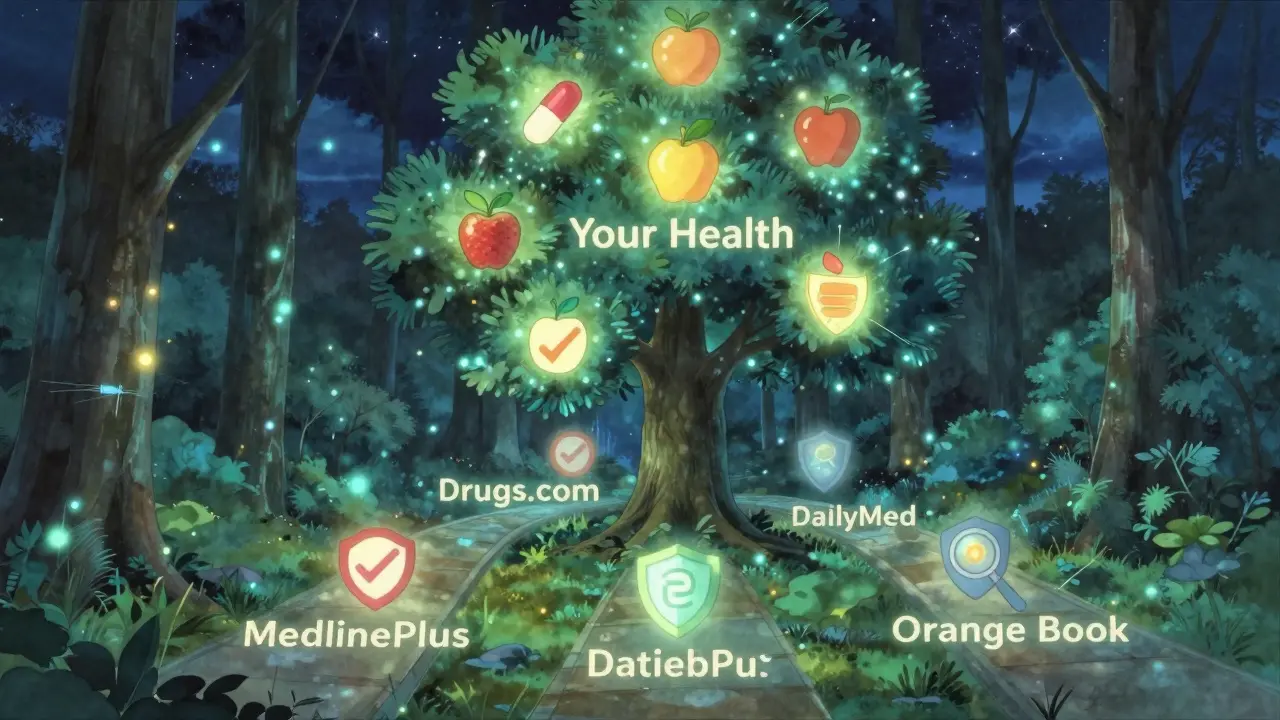
If you need the exact wording from the FDA-approved drug label - the same one pharmacists and doctors use for legal and clinical decisions - DailyMed is your go-to. Run by the National Library of Medicine and updated within 72 hours of any FDA change, it’s the only free site that gives you the full, official prescribing information.
It includes details like dosage forms, inactive ingredients, storage instructions, and boxed warnings. As of October 2023, it had over 92,000 drug entries. Pharmacists use it daily - 89% of them rely on it for regulatory compliance, according to the American Pharmacists Association.
But here’s the catch: DailyMed is designed for professionals. The language is technical, the layout is dense, and the mobile experience is clunky. If you’re a patient looking for simple answers, this isn’t the place to start. But if you’re checking whether a generic version contains a dye you’re allergic to, or confirming the exact dosage strength listed on the label, DailyMed is unmatched.
MedlinePlus: Patient-Friendly Drug Info You Can Trust
For patients, caregivers, and anyone who wants clear, easy-to-understand drug info, MedlinePlus is the gold standard. It’s run by the same team behind DailyMed - the National Library of Medicine - but written for people, not doctors.
Its 17,500+ drug monographs are written at a 6th to 8th grade reading level, with plain-language explanations of uses, side effects, and what to do if you miss a dose. It’s available in both English and Spanish, and updated 15 to 20 times a day.
Patients give it a 4.7 out of 5 stars across more than 1,200 reviews. Common praises include: “I finally understood what my pill was for,” and “No ads, no sales pitches - just facts.”
Its biggest limitation? It doesn’t cover every specialty generic. About 35% of newer or niche generics aren’t listed, while DailyMed has them all. But for common medications - antibiotics, blood pressure pills, diabetes drugs - MedlinePlus is the best free resource for patient education.
Drugs.com: The Fast, All-in-One Tool for Quick Checks
If you need to know if your blood pressure pill interacts with your new supplement, or if you found a random pill and want to identify it, Drugs.com is your best bet. It’s a commercial site, but it’s free to use and packed with tools.
Its pill identifier works with 89.3% accuracy - just enter color, shape, and imprint, and it matches the drug. Its interaction checker caught 92.4% of significant drug-drug interactions in a Johns Hopkins study, outperforming most free alternatives.
It pulls data from multiple trusted sources: FDA labels, AHFS DI, and Micromedex. That’s why 57% of community pharmacists use it daily, according to the National Community Pharmacists Association. And with its mobile app rated 4.6 out of 5 on the App Store, it’s the fastest way to get answers on the go.
The downside? It’s ad-supported. You’ll see banners and sponsored links. Some users say it feels cluttered. But if you’re looking for quick, reliable info without signing up or paying, it’s hard to beat.

The FDA Orange Book: Knowing Which Generics Are Truly Interchangeable
Not all generics are rated as “therapeutically equivalent.” That’s where the FDA’s Orange Book comes in. Officially titled Approved Drug Products with Therapeutic Equivalence Evaluations, it lists every approved generic and assigns a code - like “AB” - meaning it’s considered interchangeable with the brand.
As of November 2023, it covered 20,143 generic products across 14,852 brand-name drugs. If your pharmacist switches your medication and you’re unsure whether it’s safe, check the Orange Book. An “AB” rating means it’s safe to substitute. An “BX” rating means it’s not recommended - often because of bioavailability issues.
It’s updated monthly and free to access. The 2023 modernization update made search faster and added API access, so EHR systems can now pull this data directly. But like DailyMed, it’s not user-friendly for patients. It’s best used by pharmacists or anyone who needs to verify substitution rules.
What the Experts Say - And What They Don’t
Dr. Lucinda Maine of the American Association of Colleges of Pharmacy says: “DailyMed should be the first stop for any medication question requiring regulatory accuracy.”
Dr. Matthew Grissinger of ISMP adds: “MedlinePlus is the only consumer resource we consistently recommend to patients.”
But here’s the nuance: none of them say to rely on just one. Hospital pharmacists use a combination - DailyMed for labeling, MedlinePlus for patient explanations, and paid tools like Lexicomp for complex cases. Community pharmacists, especially in small shops, lean on free tools: DailyMed, MedlinePlus, and Drugs.com.
Experts agree: if you’re dealing with a narrow therapeutic index drug like thyroid medication, anticoagulants, or seizure drugs, don’t just trust a generic label. Check the Orange Book. Talk to your pharmacist. Use multiple sources.
How to Use These Resources Together
Here’s a simple workflow for anyone managing their own meds:
- Start with MedlinePlus to understand what the drug does and common side effects.
- Check Drugs.com for interactions with other meds or supplements you take.
- Look up the exact generic name in the FDA Orange Book to confirm it has an “AB” rating.
- If you need legal or clinical proof - like for insurance disputes or pharmacy questions - pull the full label from DailyMed.
For example: Your doctor switches you from brand-name Lipitor to a generic atorvastatin. You’re worried it won’t work as well. Here’s what to do:
- Search “atorvastatin” on MedlinePlus → learn it’s used for lowering cholesterol.
- Check Drugs.com → see if it interacts with grapefruit juice (it does).
- Go to the Orange Book → confirm the generic has an “AB” rating.
- Visit DailyMed → download the full label to check for inactive ingredients like lactose, if you’re sensitive.
That’s how you take control - without paying a dime.
What’s Missing From Free Resources
Free tools are excellent - but they’re not perfect. They don’t offer:
- Real-time alerts for new safety warnings (Lexicomp and Clinical Pharmacology do)
- Pharmacogenomic data (how your genes affect drug response)
- Customizable reminders or dose trackers
For most people, that’s fine. But if you’re on multiple complex meds, have a chronic condition, or are a caregiver for someone who is, a paid subscription like Lexicomp or Micromedex might be worth considering - especially if your hospital or pharmacy offers free access.
And remember: if a site asks for payment to show you basic drug info, walk away. The government already pays for that. You shouldn’t have to.
What’s Coming Next
The FDA and NLM are making big moves. In 2024, the Orange Book will start using real-world data to improve therapeutic equivalence ratings. MedlinePlus is adding multilingual safety alerts in 15 languages by November 2024. DailyMed’s API is now integrated into most major electronic health records, so doctors and pharmacists get live updates.
But the core message hasn’t changed: reliable, free, evidence-based drug information exists - and it’s just a click away. You don’t need to pay. You don’t need to search through ads. You just need to know where to look.
Are generic drugs as safe as brand-name drugs?
Yes - if they’re rated as therapeutically equivalent by the FDA. The FDA requires generics to have the same active ingredient, strength, dosage form, and route of administration as the brand. They must also prove they’re absorbed into the body at the same rate and extent. The only differences allowed are in inactive ingredients like dyes or fillers, which rarely cause issues. Always check the Orange Book for the “AB” rating to confirm interchangeability.
Can I trust information from Drugs.com?
Yes, for most everyday use. Drugs.com pulls its data from FDA labels, AHFS DI, and Micromedex - all highly respected sources. Its interaction checker and pill identifier are among the most accurate free tools available. However, it’s not a substitute for professional advice. If you’re on multiple complex medications or have a serious condition, always double-check with your pharmacist or doctor.
Why does DailyMed look so hard to use?
DailyMed is designed for healthcare professionals, not patients. It shows the full FDA-approved label - including sections like “Clinical Pharmacology” and “Nonclinical Toxicology” - which are technical by nature. It’s not meant to be pretty; it’s meant to be complete. For patients, use MedlinePlus instead. For professionals, DailyMed is the gold standard for regulatory accuracy.
Is the FDA Orange Book easy for patients to understand?
Not really. The Orange Book uses codes like “AB,” “BX,” and “SN” that aren’t explained in plain language. It’s best used by pharmacists or with help from a healthcare provider. If you see a generic has an “AB” rating, that means it’s approved as interchangeable. If it’s “BX,” don’t substitute without talking to your doctor. MedlinePlus and Drugs.com can help you interpret these ratings in simpler terms.
Should I pay for a drug information app?
Most people don’t need to. Free tools like MedlinePlus, DailyMed, and Drugs.com cover the vast majority of needs - from understanding side effects to checking interactions. Paid apps like Lexicomp or Clinical Pharmacology are designed for hospitals and clinics managing complex cases. If you’re a patient or caregiver, stick with free, government-backed sources. They’re just as accurate and far more accessible.
Next Steps: What to Do Today
- If you’re taking a generic drug, go to MedlinePlus and search your medication. Read the patient summary.
- Check DailyMed for the full label - especially if you have allergies or sensitivities.
- Look up your drug in the FDA Orange Book to confirm it has an “AB” rating.
- Use Drugs.com to scan for interactions with your other meds or supplements.
- Share these resources with family members who take multiple medications. Knowledge is the best protection.
You don’t need to be a pharmacist to understand your meds. You just need the right tools - and now you know where to find them.
Bryan Wolfe
January 10, 2026 AT 13:29Sona Chandra
January 10, 2026 AT 14:43Rebekah Cobbson
January 10, 2026 AT 17:14Sumit Sharma
January 12, 2026 AT 08:10Katherine Carlock
January 14, 2026 AT 01:00Lauren Warner
January 14, 2026 AT 05:24Prachi Chauhan
January 14, 2026 AT 11:32Konika Choudhury
January 14, 2026 AT 17:23Darryl Perry
January 14, 2026 AT 18:16Lelia Battle
January 14, 2026 AT 18:33George Bridges
January 16, 2026 AT 05:58steve ker
January 17, 2026 AT 15:05Eileen Reilly
January 19, 2026 AT 12:48Craig Wright
January 21, 2026 AT 04:38