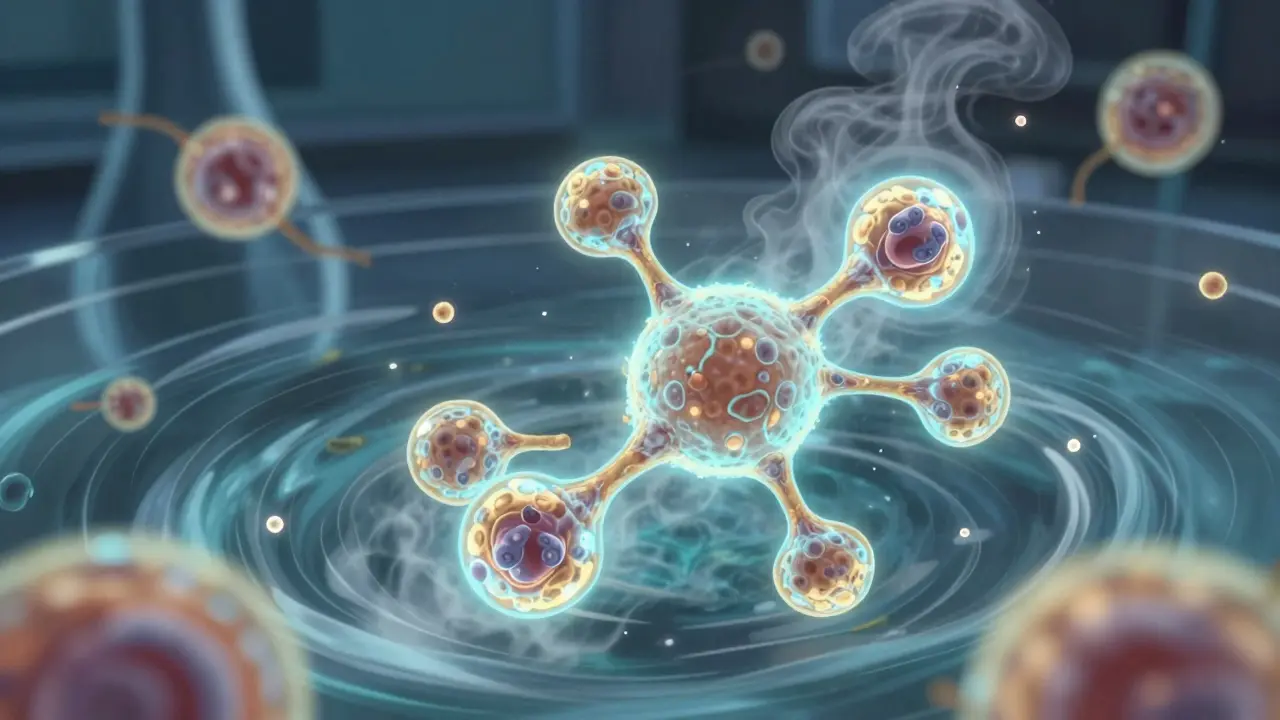
Have you ever wondered why you can't just buy a cheap copy of a biologic drug like you can with aspirin or blood pressure pills? The answer isn't about patents or corporate greed-it's about science. Biologic drugs are made from living cells, not chemicals. And because of that, biologic drugs can't have exact copies. Not even close.
Think of it like baking a cake. If you follow the same recipe every time, you get a similar cake. But what if the recipe required you to grow yeast in a custom-built lab, feed it a precise mix of nutrients, control the temperature to within 0.1°C, and then extract the flavor from millions of living cells? Even then, no two batches turn out exactly alike. That’s biologics. And that’s why regulators don’t call them "generics." They call them biosimilars.
What Makes Biologics So Different?
Most pills you take are small molecule drugs. They’re made in labs by mixing chemicals together. Aspirin? A single molecule with a weight of about 180 daltons. Easy to replicate. If Company A makes it, and Company B makes it, they’re chemically identical. The FDA approves them as generics because they’re the same thing.
Biologics? They’re huge. Think 100,000 to 1,000,000 daltons. That’s up to 1,000 times bigger than a small molecule. Humira, for example, is a monoclonal antibody made of over 1,300 amino acids folded into a precise 3D shape. That shape matters. If it folds wrong, the drug doesn’t work-or worse, it causes side effects.
These molecules aren’t synthesized. They’re grown. Scientists insert a human gene into a host cell-usually a hamster ovary cell or a yeast strain-and let the cell become a tiny drug factory. The cell eats nutrients, breathes oxygen, and produces the protein. Then, after days of careful feeding, the protein is harvested, purified, and packaged.
There’s no way to make two batches exactly the same. Even with identical equipment, the same temperature, and the same recipe, tiny differences creep in. A single sugar molecule attached to the protein might shift position. A few amino acids might fold differently. These aren’t errors. They’re natural variations. The FDA calls them "inherent variations." And they’re expected.
The Manufacturing Process: A 3-to-6-Month Marathon
Producing a single batch of a biologic takes months. Here’s how it breaks down:
- Cell line development: Scientists spend 6-12 months engineering a single cell line that reliably produces the right protein. This isn’t a one-time task. Every batch starts from this same cell line.
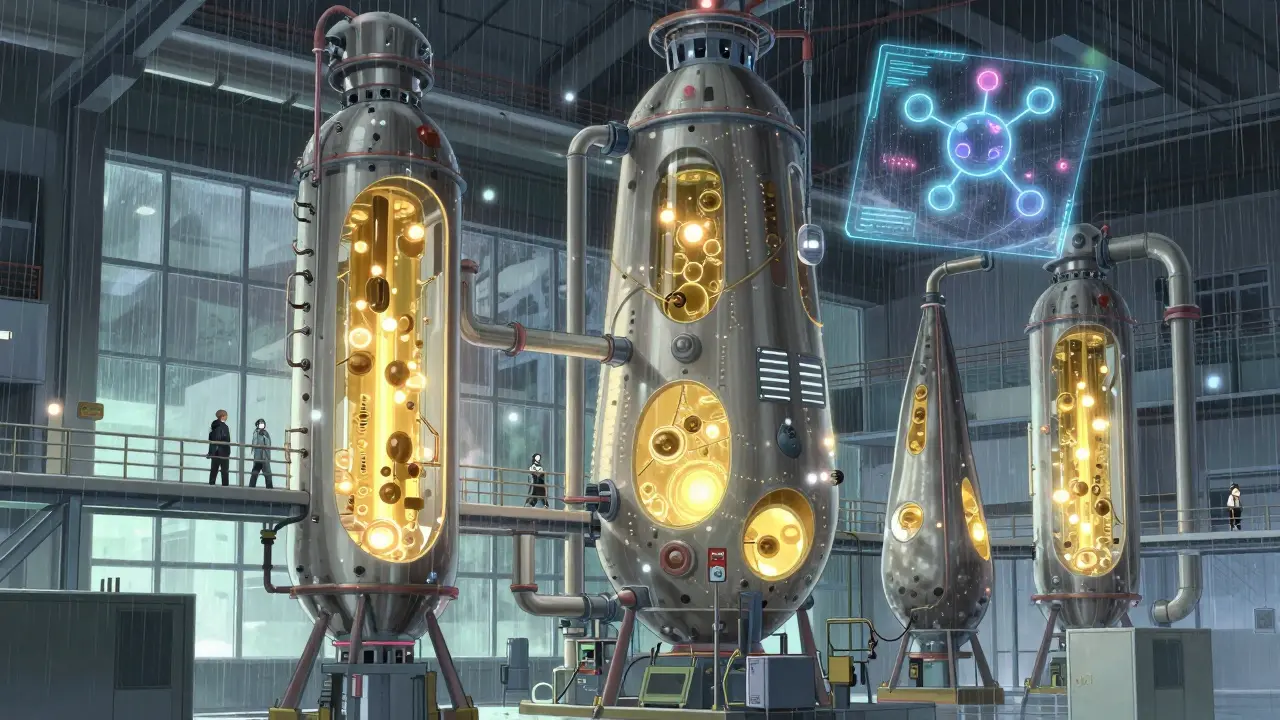
- Upstream processing: The cells are placed in bioreactors-steel tanks the size of small buses. They’re fed nutrients, kept at 36.5°C, and monitored every few minutes. This phase lasts 10-14 days. If the pH drops by 0.1 or oxygen levels dip, the cells stress out. Productivity drops. Contamination risks rise.
- Downstream purification: The broth from the bioreactor is a soup of proteins, cell debris, and leftover nutrients. It goes through a series of filters and chromatography columns. Protein A chromatography removes 95-98% of impurities. Viral filters catch any lingering viruses. Ultrafiltration concentrates the final product. Each step is tightly controlled.
- Formulation and filling: The purified protein is mixed with buffers, stabilizers, and preservatives. It’s then filled into vials or syringes under sterile conditions. This happens in cleanrooms classified as ISO Class 5-the same standard used for heart surgery.
From start to finish? 3 to 6 months. For a small molecule drug? 2 to 4 weeks. And during those months, every parameter is recorded. A single batch can generate over 10,000 pages of documentation. The FDA requires it. No exceptions.
Why You Can’t Just Copy a Biologic
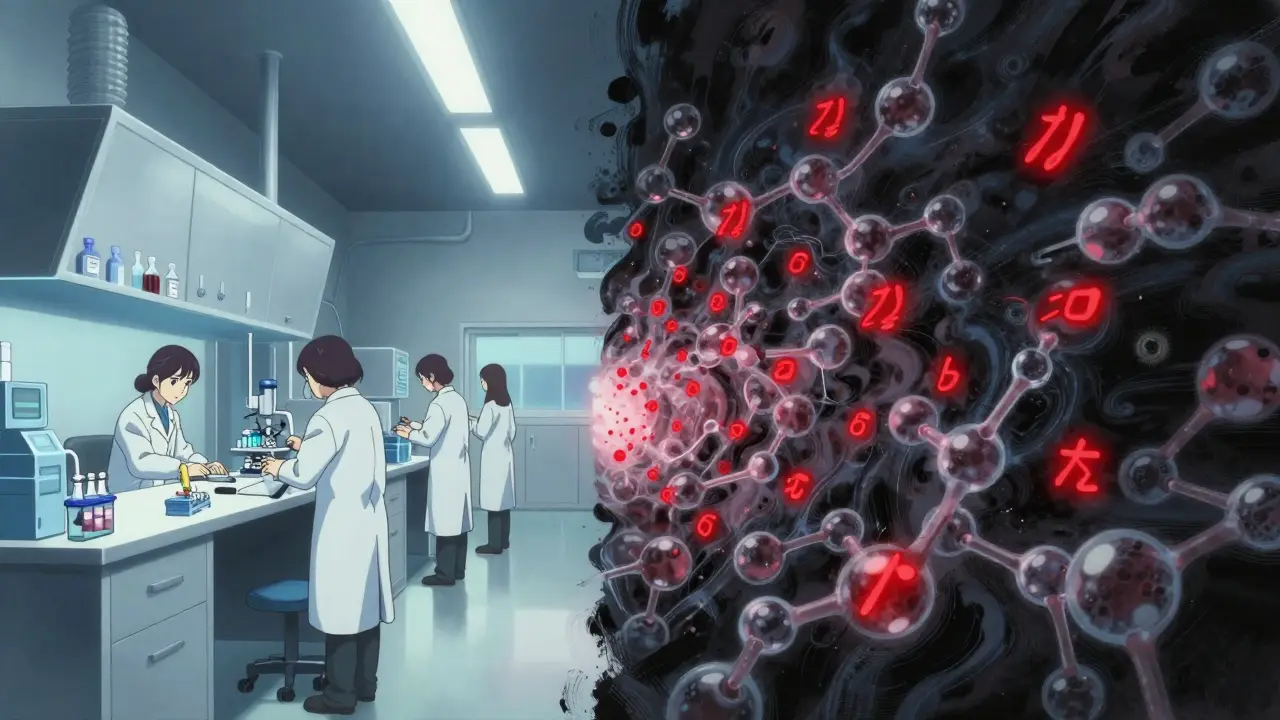
Here’s the hard truth: you can’t reverse-engineer a biologic. You can’t look at a vial of Humira, analyze its ingredients, and recreate it. Why? Because we don’t even know all the variables that make it work.
Current analytical tools can only characterize about 60-70% of a monoclonal antibody’s structure. The rest? We’re guessing. We know the amino acid sequence. We know the overall shape. But we can’t see every sugar molecule attached to it, every minor fold, every tiny change in charge. And those invisible details? They affect how the drug behaves in your body.
That’s why the FDA doesn’t approve "copies." It approves biosimilars. A biosimilar must be "highly similar" to the original. Not identical. It must show no clinically meaningful differences in safety, purity, or potency. That means:
- Thousands of lab tests comparing molecular structure
- Animal studies to check immune response
- Human clinical trials to prove it works the same way
And even then, the biosimilar manufacturer has to build its own factory, its own cell line, its own purification process. It can’t just copy the original company’s method. The process itself is part of the product.
The Cost of Precision
Building a biologics factory costs between $100 million and $500 million. Why so much?
- Single-use bioreactors and tubing (to prevent contamination) add 15-20% to material costs.
- Quality control takes up 30-40% of total manufacturing cost-compared to 5-10% for pills.
- One failed batch can cost over $500,000. A single temperature spike or microbial contamination can trash an entire run.
- Scaling up from 2,000 liters to 15,000 liters? One engineer at Amgen said it took 17 months and $22 million in lost revenue just to get it right.
And it’s not just money. It’s time. It takes 5-7 years to go from lab discovery to market. Compare that to a generic pill, which can hit shelves in 18 months.
Biosimilars: The Real Answer to High Prices
So if you can’t copy a biologic, how do we get cheaper versions? Enter biosimilars. Since 2015, over 60 biosimilars have been approved in the U.S. and Europe. They’re not generics. But they’re close enough to be safe and effective.
Take the biosimilar to Humira (adalimumab). It’s not identical. But clinical trials showed it works just as well for rheumatoid arthritis, Crohn’s disease, and psoriasis. Patients switching from Humira to its biosimilar saw no drop in effectiveness-and saved 15-35% on cost.
Global biosimilar sales hit $10.5 billion in 2023. By 2028, they’re expected to reach $30 billion. That’s not because manufacturers found a shortcut. It’s because they invested billions into building their own complex systems, proving similarity, and navigating hundreds of pages of regulatory rules.
The Future: AI, Continuous Manufacturing, and New Frontiers
The industry is changing. New facilities are using artificial intelligence to predict how small changes in temperature or nutrient flow will affect the final product. Some are moving from batch manufacturing to continuous production-where the process runs 24/7, like a pipeline instead of a factory line.
Single-use systems are cutting contamination risks by 60%. Modular plants are being designed to switch between different biologics without rebuilding entire lines. These innovations could cut costs and speed up production.
But the core truth remains: biologics are made by living cells. And living systems don’t make perfect copies. They make variations. And that’s okay-as long as those variations are understood, monitored, and controlled.
The next time you hear someone say "Why aren’t biologics cheaper?"-the answer isn’t about greed. It’s about biology. You can’t make a perfect copy of something that’s grown, not built.
Can biosimilars be used interchangeably with the original biologic?
In most cases, yes-but only if your doctor or pharmacist approves the switch. In the U.S., a biosimilar can be designated as "interchangeable" only after additional testing proves it can be switched with the original drug without increasing risk or reducing effectiveness. So far, only a handful of biosimilars have received this status. Most require a doctor’s explicit order to switch.
Why do biosimilars cost less if they’re so hard to make?
They cost less because they don’t need to repeat the full clinical trials the original drug went through. The original company spent billions on early research, animal testing, and large-scale human trials to prove safety and effectiveness. A biosimilar manufacturer only needs to prove similarity-no need to start from scratch. That cuts development costs by 60-70%, which translates into lower prices for patients and insurers.
Are biosimilars as safe as the original biologic?
Yes. Regulatory agencies like the FDA and EMA require biosimilars to meet the same high standards for safety and effectiveness. Over 60 biosimilars have been approved in the U.S. and Europe, with millions of doses administered. Real-world data shows no increase in side effects or loss of effectiveness compared to the originator product.
Why can’t we just make a generic version of Humira like we did for Lipitor?
Lipitor is a small molecule drug made of a single, simple chemical compound. You can analyze it, replicate it, and make an identical copy. Humira is a complex protein made by living cells. Its structure is too intricate to fully analyze or replicate. Even if you could, the manufacturing process would still introduce unavoidable variations. That’s why generics don’t exist for biologics-only biosimilars.
What happens if a biosimilar batch fails?
If a batch fails quality control, it’s destroyed. There’s no repurposing. No discounting. No selling it as "second quality." Every batch must meet exact specifications. A failed batch can cost hundreds of thousands of dollars and delay supply for months. That’s why manufacturers invest so heavily in monitoring and redundancy-because the margin for error is near zero.
Kal Lambert
March 20, 2026 AT 02:35Melissa Starks
March 21, 2026 AT 15:53Nicole Blain
March 21, 2026 AT 18:49cara s
March 22, 2026 AT 21:57Amadi Kenneth
March 24, 2026 AT 01:40Kal Lambert
March 25, 2026 AT 01:28Srividhya Srinivasan
March 25, 2026 AT 07:29Sanjana Rajan
March 26, 2026 AT 20:12Kathy Underhill
March 27, 2026 AT 16:42