
Taking a pill every day for years isn’t just a habit-it’s a lifestyle. For millions of people living with conditions like high blood pressure, diabetes, or rheumatoid arthritis, medication isn’t optional. It’s survival. But here’s the hard truth: chronic medication adherence is one of the biggest failures in modern healthcare. Studies show that nearly half of people stop taking their meds as prescribed within a year. Not because they’re lazy. Not because they don’t care. But because it’s exhausting. Overwhelming. Emotionally draining.
Why Taking Pills Every Day Gets Harder Over Time
At first, it’s manageable. You set a phone alarm. You keep your pills in a little box. You feel proud you’re doing the right thing. But after six months? A year? The novelty fades. Side effects creep in. The cost adds up. You start skipping doses when you’re traveling, when you’re tired, when you feel fine. And then, without realizing it, you’re no longer following your regimen.
This isn’t just about forgetting. It’s about coping. The brain doesn’t like constant reminders of illness. It wants to pretend everything’s normal. So it finds ways to avoid the truth-skip a dose, delay refills, ignore symptoms. That’s where coping strategies come in. Not as fancy techniques from a self-help book, but as real, practical ways people actually survive long-term treatment.
The Five Real Ways People Cope (And Which Ones Actually Help)
Research from a 2022 review of 15 studies shows five main coping styles people use when managing long-term meds. Not all of them work. Some even make things worse.
- Problem-solving / active coping: This is the gold standard. People who identify their barriers-like confusing pill schedules, side effects, or cost-and then actively fix them have the highest adherence rates. In 78% of studies, this approach led to better results. For example, someone with diabetes who can’t afford their insulin might work with a pharmacist to switch to a generic version, or sign up for a patient assistance program. They don’t just accept the problem. They solve it.
- Emotion-focused coping: This is about managing the stress, fear, or sadness that comes with being sick long-term. People who journal, meditate, talk to a counselor, or lean on support groups tend to stick with their meds better. In 69% of studies, this helped. It’s not about denying emotions-it’s about not letting them derail your routine.
- Seeking understanding: People who read up on their condition, ask their doctor questions, or watch educational videos are more likely to stay on track. Knowing why a drug matters makes it easier to take it. One study found that patients who understood how their meds lowered stroke risk were 40% more likely to refill prescriptions.
- Support-seeking: Talking to family, friends, or patient communities makes a difference. Someone with heart failure who checks in weekly with a friend who also takes blood thinners is far less likely to quit. Social accountability works.
- Problem avoidance: This is the trap. Ignoring side effects, pretending you’re fine, or avoiding doctor visits because it’s too stressful. Half the studies showed this led to worse adherence. It might feel easier in the moment, but it’s a slow path to hospital visits and complications.
The data is clear: active problem-solving and emotional support are your best tools. Avoidance? It’s a trap.
Team-Based Care: Why You Don’t Have to Do This Alone
One of the most powerful findings from the CDC? People who get team-based care are 15% more likely to stick with their meds. That’s not magic. That’s structure.
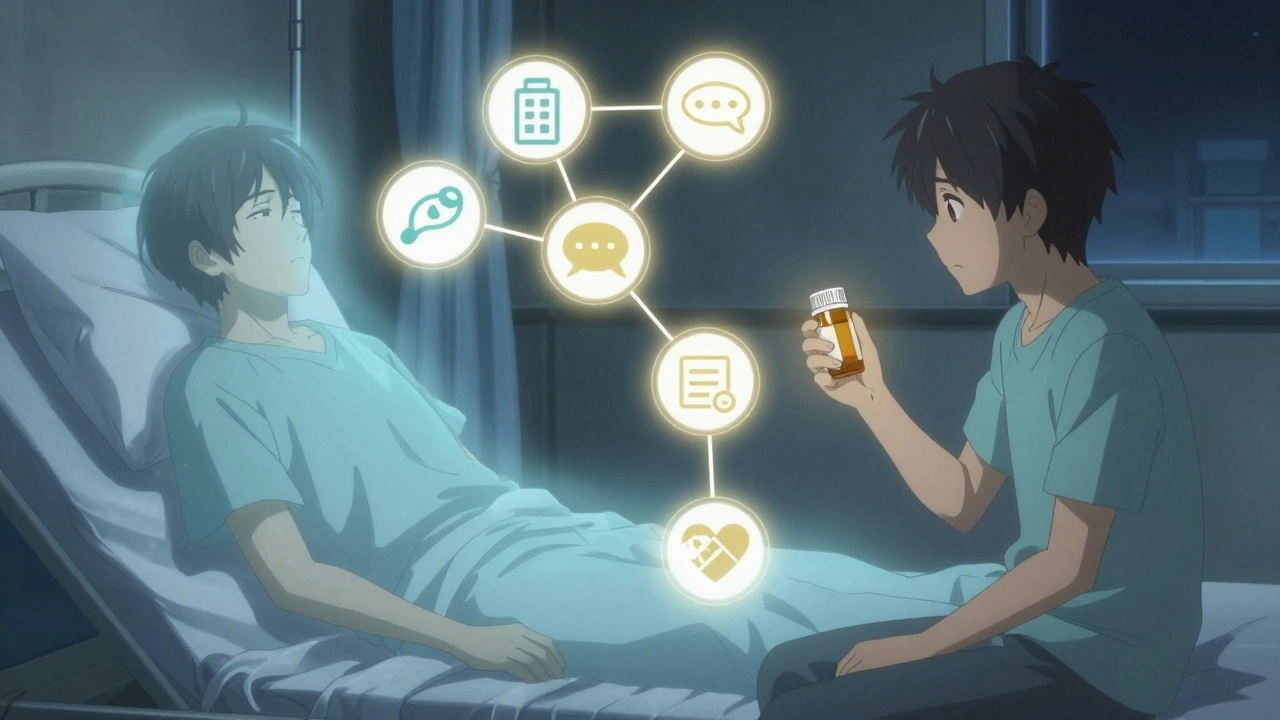
Team-based care means your doctor, pharmacist, nurse, and sometimes even a social worker are all on the same page. They don’t just hand you a prescription and say, “See you in six months.” They:
- Review your meds together to cut out duplicates or unnecessary pills
- Use your insurance formulary to pick cheaper, equally effective options
- Send automated refill reminders via phone or text
- Connect you with programs that help pay for meds (like RxAssist.org)
- Check in after hospital discharge to make sure you’re not overwhelmed
In one study, patients with heart conditions who got this kind of support hit 89% adherence after a year. Those who didn’t? Only 74%. That’s not a small gap. That’s life or death.
Real-Life Fixes That Actually Work
You don’t need a PhD to improve your adherence. You need simple, doable changes.
- Simplify your routine: Ask your doctor if you can switch to once-daily pills or combination meds. Two pills in the morning instead of four throughout the day? That’s a game-changer.
- Use tech, not guilt: Apps like Medisafe or MyTherapy send reminders. Pill dispensers with lights and alarms help too. Don’t rely on memory. Your brain is already overloaded.
- Plan for disruptions: Traveling? Sick? Change in schedule? Have a backup plan. Pack extra pills. Keep a list of your meds in your phone. Know where to refill if you’re away from home.
- Address cost early: If your med is too expensive, don’t wait until you skip a dose. Talk to your pharmacist. Ask about generics. Look up patient assistance programs. Many drug makers offer free or discounted meds if you qualify.
- Find your person: Who can you call when you’re frustrated? A friend? A support group? A nurse hotline? Having someone to vent to makes the burden lighter.
What Doesn’t Work (And Why You Should Stop Doing It)
Some habits people think help actually hurt.
- Skipping doses when you feel fine: High blood pressure doesn’t always cause symptoms. But it’s still damaging your arteries. Taking meds only when you “feel sick” is like only wearing a seatbelt when you think you might crash.
- Stopping meds because of side effects: Nausea? Dizziness? Talk to your doctor. There might be a different dose, timing, or alternative. Don’t quit without help.
- Using old prescriptions: Just because you have leftover pills doesn’t mean they’re right for you now. Conditions change. Doses change. Don’t self-prescribe.
- Feeling ashamed: If you missed a dose, don’t hide it. Admitting it is the first step to fixing it. Your provider has seen it a hundred times. They’re not judging you.

Demographics Matter-But Not the Way You Think
One study on rheumatoid arthritis found women were 4.5 times more likely to stick with their meds than men. Older adults and people with shorter disease duration also did better. Why? It’s not that men are less responsible. It’s that women are more likely to seek support, ask questions, and engage with their care. Men often avoid talking about health struggles until it’s too late.
Income matters too. People with lower incomes are more likely to skip doses because of cost. But even here, support programs can close the gap. The key isn’t blaming demographics-it’s designing systems that meet people where they are.
The Bigger Picture: Why This Isn’t Just About Pills
Nonadherence doesn’t just hurt individuals. It costs the U.S. healthcare system $100-300 billion a year. That’s billions in avoidable hospital visits, emergency care, and complications. It’s also wasted medicine-pills sitting in drawers, expired and unused.
But the real cost? The lost years. The preventable strokes. The avoidable amputations. The families who lose loved ones because a simple pill wasn’t taken every day.
Improving adherence isn’t about shaming people. It’s about removing barriers. It’s about listening. It’s about giving people the tools to take control-not just of their meds, but of their lives.
What Comes Next? The Future of Medication Support
Research is moving toward personalized adherence plans. Imagine a system that:
- Assesses your coping style during a routine visit
- Matches you with the right tools-app reminders if you’re tech-savvy, phone calls if you’re not
- Adjusts your regimen based on your lifestyle, not just your diagnosis
- Connects you with peer mentors who’ve been there
It’s already happening in pilot programs. But it won’t scale unless healthcare systems prioritize it. Until then, you have power. You can ask for help. You can ask for simpler meds. You can tell your doctor when you’re struggling. You’re not alone. And you don’t have to do this perfectly.
Just keep going.
James Kerr
December 2, 2025 AT 13:58Just took my blood pressure pill and remembered I forgot to refill my diabetes med last week-thanks for the reminder that it’s okay to mess up sometimes. 🙌
Albert Essel
December 4, 2025 AT 08:58The distinction between problem-solving and avoidance is critical-and under-discussed. Many patients aren't lazy; they're overwhelmed by systems that don't accommodate human behavior. Simplifying regimens isn't a favor-it's a medical necessity. Pharmacies should offer pre-sorted blister packs automatically for chronic conditions, not as a ‘special request.’
Also, cost isn't just a barrier-it's a moral failure when life-saving drugs are priced beyond reach. Generic alternatives exist, but formularies often exclude them without clinical justification. Transparency in pricing and automatic substitution protocols would reduce nonadherence more than any app ever could.
And while tech reminders help, they assume consistent access to smartphones, electricity, and digital literacy. For elderly or low-income populations, a simple phone call from a nurse is more effective than ten push notifications.
Team-based care isn't a luxury; it's the baseline standard. If your doctor doesn't coordinate with your pharmacist or refer you to social work, ask why. The system is broken, but individual advocacy can patch it.
Finally, shame has no place here. Missing a dose isn't a character flaw-it's a system flaw. We need to normalize saying, ‘I struggled this week,’ without fear of judgment.
Charles Moore
December 5, 2025 AT 19:38I’ve been on statins for 12 years and still forget sometimes. What helped me most was pairing the pill with my morning coffee-same time, same spot. No alarms, no apps. Just habit stacking. Also, my pharmacist printed a tiny card with my meds and why they matter-I keep it in my wallet. Simple, tactile, and always there.
And yes, talking to others who’ve been there? Huge. I joined a local heart health group. Didn’t fix my cholesterol, but it fixed my sense of isolation.
Jim Schultz
December 5, 2025 AT 22:35Ugh. Another ‘feel-good’ article that ignores the real issue: people are irresponsible. If you can’t remember to take a pill, maybe you shouldn’t be managing your own health. Apps? Reminder systems? That’s parenting, not medicine. Adults should be able to follow basic instructions. The fact that 50% fail says more about societal decline than healthcare failure.
And don’t get me started on ‘cost’-if you can afford a phone, you can afford $4 for a generic. Stop playing the victim card.
Katherine Gianelli
December 6, 2025 AT 22:29Jim, you’re so loud I can hear your typing from here-but you’re also so wrong it hurts. I’ve seen people skip meds because they lost their job, their insurance, their home. It’s not about laziness. It’s about surviving.
I’m a nurse. I’ve held hands while people cried because they had to choose between insulin and rent. No app fixes that. No ‘adulting lecture’ either. What fixes it? Compassion. Systems that care. People who show up.
You don’t fix human suffering by shaming it. You fix it by listening.
Makenzie Keely
December 8, 2025 AT 05:12Albert nailed it. But let’s not forget: the ‘problem-solving’ group? They’re usually the ones with high health literacy, stable housing, and access to transportation. That’s privilege, not virtue. The real win is when systems adapt to the least privileged-not when we expect them to become perfect patients.
My cousin with RA couldn’t refill her biologic because the pharmacy wouldn’t accept her Medicaid plan. She waited three weeks. Then she got sepsis. That’s not nonadherence. That’s systemic failure.
We need policy change. Not pep talks.
Francine Phillips
December 9, 2025 AT 17:42Yeah. I take my meds. Sometimes. Not a big deal. Whatever.
Chloe Madison
December 10, 2025 AT 11:40Chloe here-just wanted to say: if you're reading this and feeling guilty about missing a dose? Breathe. You're not failing. You're human. And you're not alone. I've been there. I still am sometimes. But here's what I learned: tiny wins matter. One pill today. One conversation with your doctor. One refill without panic. That's enough. Keep going. You're doing better than you think.
Joykrishna Banerjee
December 10, 2025 AT 12:31Let’s be real: the ‘support-seeking’ and ‘emotional coping’ frameworks are just neoliberal distractions. Real adherence requires pharmacoeconomic optimization, algorithm-driven adherence prediction models, and AI-integrated adherence monitoring via wearable biometrics. You’re all romanticizing compliance while ignoring the data-driven paradigm shift happening in precision medicine.
Also, generics? Pathetic. If you can’t afford branded meds, you shouldn’t be on them. Go to a clinic. Get a proper workup. Stop gaming the system.
And emoticons? 😂 Really?
Myson Jones
December 11, 2025 AT 09:24Joykrishna, your tone is… intense. But I hear you. The system is broken. Still, I think there’s room for both: yes, we need AI and data, but we also need humans who show up. Not everyone has a smartphone. Not everyone speaks English. Not everyone trusts algorithms. Sometimes, a phone call from a nurse who remembers your name? That’s the tech that saves lives.
Maybe we don’t have to choose between high-tech and high-touch. Maybe we need both.
Kidar Saleh
December 12, 2025 AT 07:41My father took warfarin for 17 years. He never missed a dose. Why? Because his GP, his pharmacist, and his daughter (me) had a shared spreadsheet. Every Friday, we’d check in. He’d say, ‘Feeling off?’ and we’d adjust. No apps. No guilt. Just consistency. And care.
Healthcare doesn’t need more gadgets. It needs more relationships.