When a generic drug company submits an application to the FDA, they’re not just asking for permission to sell a cheaper version of a brand-name drug. They’re asking for approval that their product is therapeutically identical-same active ingredient, same strength, same way it works in the body. But too often, that application comes back with a letter that stops everything: a deficiency letter.
These aren’t minor notes. They’re formal roadblocks. And according to FDA data from 2024, over 70% of major issues in Abbreviated New Drug Applications (ANDAs) are quality-related. That means the problem isn’t usually about marketing or pricing-it’s about science, manufacturing, and documentation. If your application gets flagged, you could be looking at 12 to 18 months of delays, hundreds of thousands of dollars in extra costs, and lost market opportunity.
What Exactly Is a Deficiency Letter?
A deficiency letter from the FDA is a detailed list of what’s missing, wrong, or unproven in your ANDA. It’s not a rejection. It’s a request for more evidence. The FDA says it clearly: the letter identifies "specific deficiencies that must be resolved before the application can be approved."
Think of it like a building inspection. You’ve built a house, submitted the plans, and the inspector says, "The foundation isn’t reinforced enough," or "The electrical wiring doesn’t meet code." You don’t get a certificate of occupancy until those issues are fixed. Same with drug applications.
The FDA doesn’t issue these letters lightly. They’re the result of a full review by scientists, chemists, pharmacologists, and manufacturing experts. And they’re not guessing-they’re pointing to specific sections of your application that don’t meet the standards laid out in the Bioequivalence Review Manual, ICH guidelines, or FDA’s own guidance documents.
The Top 5 Deficiency Categories (And Why They Keep Happening)
Not all deficiencies are created equal. Some are one-off mistakes. Others are systemic failures. Based on FDA’s FY2023-2024 analysis, here are the five most common reasons ANDAs get stuck:
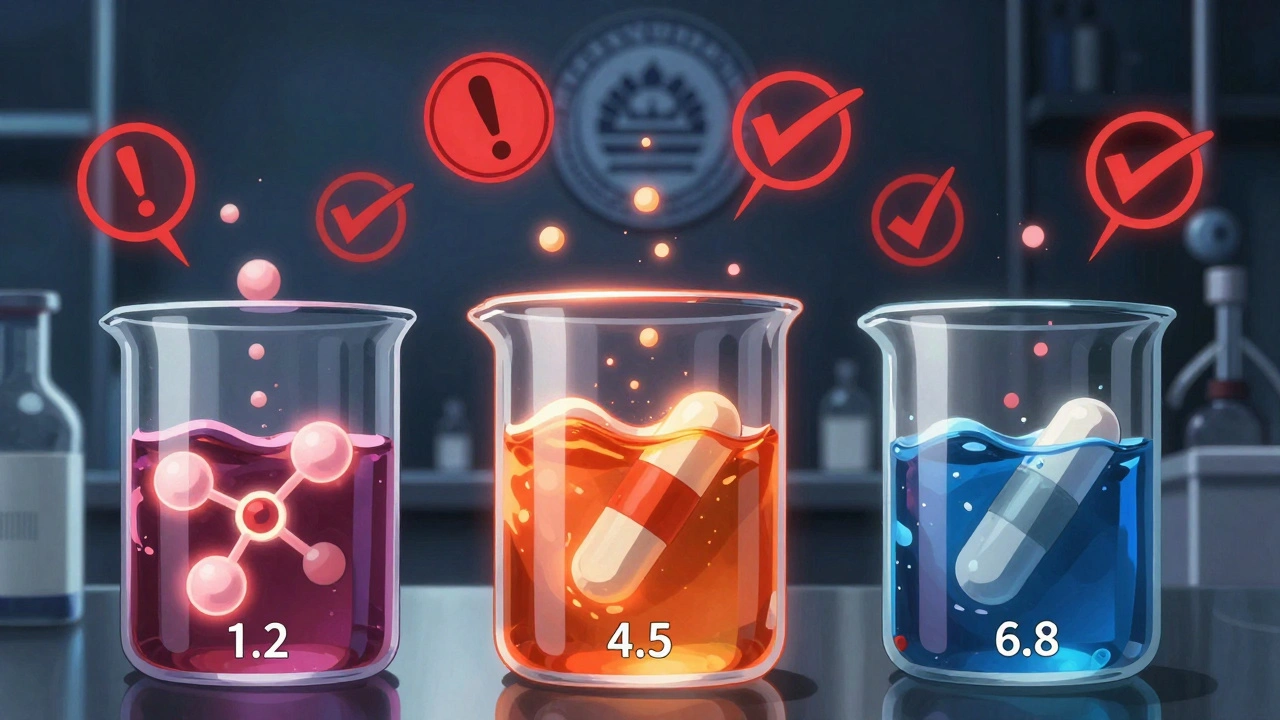
- Dissolution Issues (23.3% of cases) - This is the #1 problem. Dissolution testing shows how quickly the drug releases from its tablet or capsule in the body. If your method doesn’t match the reference drug under different pH conditions (1.2, 4.5, 6.8), or if you’re using outdated equipment like Apparatus 1 when Apparatus 2 is required, the FDA will flag it. Small companies often use compendial methods that were designed decades ago and don’t reflect how the drug behaves in real human digestive conditions.
- Drug Substance Sameness (19%) - Your active ingredient must be chemically and physically identical to the reference drug. For simple molecules, that’s straightforward. But for peptides, complex salts, or polymorphs, you need more than just an HPLC report. You need circular dichroism, FTIR, size-exclusion chromatography, and particle size distribution data. Many applicants think "same chemical name = same drug," but the FDA sees the difference between a crystalline form and an amorphous form as a major risk.
- Unqualified Impurities (20%) - Every drug has trace impurities. The issue isn’t their presence-it’s whether you’ve tested them properly. If you have a degradation product above the ICH qualification threshold and you haven’t run a mutagenicity assessment (like a (Q)SAR or Ames test), the FDA will require toxicology studies. One company reported this alone added 16 months to their timeline.
- Elemental Impurities (13%) - ICH Q3D requires you to assess heavy metals like lead, cadmium, mercury, and arsenic. Many applicants just say, "We used high-purity excipients," but the FDA wants actual testing data from your batches. If you didn’t test your final product for elemental impurities, or if your control strategy isn’t specific to your manufacturing process, you’ll get flagged.
- Manufacturing and Process Controls (18%) - The FDA doesn’t just want to know what you did-they want to know you can do it consistently at commercial scale. If your bioequivalence batches were made in a 50L reactor but your commercial line is 500L, and you didn’t prove the process scales the same way, that’s a problem. Same if your process parameters aren’t validated, or if you didn’t document how you controlled critical quality attributes (CQAs).
Why Do These Mistakes Keep Happening?
It’s not that companies are careless. It’s that the gap between academic development and commercial reality is wider than most realize.
Many small firms hire PhDs who’ve spent years in labs optimizing drug formulations for research-not for regulatory compliance. They focus on getting the drug to work in a mouse, not on proving it behaves the same as the brand-name drug in a dissolution apparatus. One regulatory consultant with 25 years of experience told me: "Nearly half of all DS sameness deficiencies come from developers who never worked in a GMP facility."
Another issue? Poor documentation. The FDA doesn’t need a novel. They need a clear, traceable, logical story. If your application says, "We used HPLC to test purity," but doesn’t show the method validation, the chromatograms, the system suitability data, or how you established the limit, it’s incomplete. Applications with detailed development reports have 27% fewer deficiencies.
And then there’s communication. A 2023 survey found 78% of companies felt there were "communication gaps" with FDA reviewers. They didn’t know what the reviewer was looking for until the letter came. That’s why pre-ANDA meetings are so powerful-companies that use them see deficiency rates 32% lower.

Complex Drugs Are the Biggest Challenge
Not all generics are the same. A simple 10mg tablet of amoxicillin? Low risk. A modified-release tablet that releases drug over 12 hours? High risk. A topical cream with nanoparticles? Even higher.
Complex generics-like peptides, inhalers, transdermal patches, and extended-release formulations-make up only 22% of ANDA submissions but account for 38% of deficiency letters. Why? Because they’re harder to characterize, harder to replicate, and harder to prove bioequivalence for.
Take peptides. You can’t just say "same amino acid sequence." You need to prove the 3D structure is the same. That means circular dichroism data to show secondary structure, and size-exclusion chromatography to prove aggregation levels match. If you don’t have that, you’re not just missing a test-you’re missing the science.
Modified-release tablets? The FDA looks at dissolution profiles across multiple pH levels, uses Apparatus 3 or 4 instead of the standard paddle, and requires proof that the formulation won’t change in the gut. One company spent 18 months fixing their dissolution method after their first deficiency letter. Their product was approved on the second try-but they lost their first-mover advantage.
Who Gets Hit the Hardest?
It’s not random. The data shows clear patterns:
- Companies with fewer than 10 approved ANDAs have deficiency rates 22% higher than those with 50+.
- Products with annual sales under $10 million have 18% more deficiencies than high-revenue ones.
- First-time applicants take 18-24 months to consistently avoid the top 5 deficiencies.
Why? Experience matters. Established companies have internal teams that know what the FDA expects. They’ve seen deficiency letters before. They’ve learned to write better applications. They know when to ask for a pre-submission meeting. They’ve built templates, checklists, and validation protocols that reduce risk.
Small companies often try to cut corners-hiring one regulatory consultant, skipping pre-meetings, using off-the-shelf methods. But in the world of ANDAs, cutting corners costs more in the long run.

How to Avoid a Deficiency Letter
You can’t eliminate risk entirely-but you can drastically reduce it. Here’s what works:
- Request a pre-ANDA meeting. The FDA will give you feedback on your proposed method, testing strategy, and data package. Use it. Don’t skip it. Companies that do this reduce deficiencies by 32%.
- Follow the Bioequivalence Review Manual. It’s not optional. If you’re testing dissolution, use the right apparatus. If you’re comparing profiles, use f2 similarity. Don’t assume you know better.
- Validate every method. Don’t just say "we used HPLC." Show the specificity, accuracy, precision, linearity, range, and robustness data. Include system suitability results for every batch.
- Test for impurities early. Run (Q)SAR assessments for mutagenicity on degradation products. Don’t wait until the FDA asks for it.
- Document everything. Your application isn’t a summary-it’s a scientific narrative. Explain why you chose your method, why you rejected alternatives, how you scaled up, and how you controlled quality.
- Use Quality by Design (QbD) principles. Define your critical quality attributes upfront. Link your process parameters to product performance. The FDA rewards this approach.
The FDA is also making changes. Their "First Cycle Generic Drug Approval Initiative" launched in 2023 and has already reduced dissolution-related deficiencies by 15%. New template responses for the 10 most common deficiencies were released in April 2025. And by 2026, they plan to use AI to catch errors before you even submit.
What Happens After a Deficiency Letter?
Getting a deficiency letter isn’t the end. It’s a chance to fix things.
Most companies respond within 60 days. But the response must be complete. A vague answer like "We’ve improved our method" won’t cut it. You need:
- Updated protocols
- New analytical data
- Revised sections of the application
- Clear cross-references to where the changes are
One company fixed their elemental impurity issue by submitting actual test results from 10 commercial batches. Another fixed their dissolution problem by switching to biorelevant media and showing f2 values above 50 across all pH levels. They got approved on the second cycle.
But if you ignore the letter, or send a half-baked response, the FDA will issue a Complete Response Letter-which means rejection. And restarting the process means starting over with a new application, new fees, and another 12-18 month wait.
The Bottom Line
Deficiency letters aren’t punishment. They’re feedback. The FDA doesn’t want to delay generics-they want to make sure they’re safe and effective. The problem isn’t the system. The problem is the preparation.
If you’re submitting an ANDA, don’t treat it like a formality. Treat it like a scientific audit. Every test, every page, every data point matters. The companies that win aren’t the ones with the biggest budgets-they’re the ones who understand the FDA’s expectations and plan for them from day one.
By 2027, first-cycle approval rates could rise from 52% to 68%. But that won’t happen by accident. It will happen because companies stopped guessing-and started preparing.
Rob Purvis
December 12, 2025 AT 10:22Wow, this is such a clear breakdown-seriously, the dissolution section alone could be its own white paper. I’ve seen so many startups skip the biorelevant media testing because it’s ‘expensive,’ but then they get hit with a deficiency letter and lose a year. The FDA isn’t being punitive; they’re just asking for proof that your drug behaves like the brand in real human conditions. It’s not magic, it’s science.
Also, the part about QbD? Game-changer. If you define your CQAs upfront and map your process parameters to them, you’re not just avoiding letters-you’re building a bulletproof system. I’ve worked with teams that treated QbD like a buzzword, and they kept failing. The ones who embraced it? Approved on the first try. No joke.
And honestly, pre-ANDA meetings are the secret weapon. I know people think it’s a waste of time to sit through a Zoom call with FDA reviewers, but I’ve seen companies go from 3 deficiencies to zero just because they asked, ‘What are you looking for?’ before submitting. Why guess when you can know?
Levi Cooper
December 13, 2025 AT 15:12Let’s be real-the FDA is just protecting Big Pharma’s profits. These deficiency letters are a slow-motion blockade to keep generics off the market. You think they care about ‘scientific rigor’? They care about keeping drug prices high. The same people who approve billion-dollar biologics with zero clinical data are nitpicking dissolution profiles for a $0.10 tablet. Hypocrites.
And don’t even get me started on ‘QbD’-it’s just corporate jargon to make small companies waste more money on consultants who don’t even know how to spell ‘amorphous.’
Adam Everitt
December 14, 2025 AT 14:14interesting post. i mean, the dissolution thing is huge. i worked on a project where they used apparatus 1 because ‘it was what the lab had.’ turns out, the FDA wants apparatus 2 for extended release. we lost 8 months. just… oof. also, impurities? yeah. we thought ‘if it’s under 1% it’s fine’ but nope. needed ames test. learned the hard way. still dont know why they care so much about particle size… but they do. lol
wendy b
December 15, 2025 AT 16:39While I appreciate the thoroughness of this analysis, I must point out that the term ‘bioequivalence’ is frequently misused in industry circles. True bioequivalence requires not only pharmacokinetic equivalence but also pharmacodynamic alignment-something that is rarely, if ever, assessed in ANDAs. The FDA’s reliance on dissolution profiles as a surrogate for in vivo performance is scientifically dubious at best. This entire regulatory framework is built on a foundation of convenience rather than clinical validity.
Furthermore, the notion that ‘experience reduces deficiencies’ is misleading. It merely indicates that large firms have more resources to game the system through regulatory lobbying and outsourced compliance teams. The system is rigged, and the so-called ‘best practices’ are merely the tactics of the well-funded.
Lawrence Armstrong
December 16, 2025 AT 04:58100% this. I’ve been in this game for 15 years, and the #1 thing I tell new teams: don’t skip the pre-meeting. Seriously. Just book it. Even if you think you’re ready. I had a client who skipped it, got a 12-point deficiency letter, and spent $200k fixing it. They came back to me after. I said, ‘I told you.’ 😅
Also-elemental impurities? If you’re not testing your final product batches, you’re just gambling. I had a company get flagged because they used a ‘high-purity’ excipient supplier… but didn’t test the actual final tablet. FDA doesn’t care what your supplier says. They care what your data says. 📊
And yes, QbD works. It’s not hype. It’s just… work. But it’s worth it. 🙌
Ashley Skipp
December 17, 2025 AT 07:11Why do they even make this so hard? Just approve it already
Robert Webb
December 19, 2025 AT 02:41One thing that’s rarely discussed is how the FDA’s internal review culture has shifted over the last five years. Back in 2018, reviewers would often leave vague comments like ‘insufficient data’-now they’re citing specific sections of ICH Q3D, Bioequivalence Review Manual Appendix C, and even pointing to the exact page in the 2023 Guidance on Particle Size. That’s not just stricter-it’s more transparent. And honestly, it’s better for applicants. You know exactly what to fix.
The real issue isn’t the FDA being unreasonable-it’s that too many companies treat the application like a checklist instead of a scientific narrative. If you can’t explain why you chose your dissolution method over another, or why you didn’t test for polymorphs, then you’re not ready. It’s not about having perfect data-it’s about having a logical, traceable story behind every decision.
And for the love of science, stop using old compendial methods because ‘that’s how we’ve always done it.’ The human GI tract doesn’t have a pH of 6.8 in the duodenum-it’s dynamic. If your method doesn’t reflect that, you’re not proving bioequivalence-you’re proving you didn’t bother to learn.
Also, I’ve seen companies spend six months trying to ‘fix’ a dissolution issue, only to realize they never validated their HPLC method properly. They had a perfect profile… but no system suitability data. The FDA doesn’t care how pretty your graph looks. They care if your instrument was calibrated. It’s that simple.
And don’t even get me started on the people who think ‘we’ll just submit the data and hope for the best.’ That’s not a strategy. That’s a suicide mission.
Pre-ANDA meetings aren’t optional. They’re your lifeline. And if you think you’re too small to get FDA attention? You’re wrong. They’ve reviewed applications from single-person startups. They don’t care how big you are-they care if you did your homework.
The bottom line: if you treat this like a regulatory hurdle, you’ll fail. If you treat it like a scientific challenge, you’ll win.
Audrey Crothers
December 20, 2025 AT 12:13OMG YES. I just helped a client fix their elemental impurity issue after getting a deficiency letter. They were like, ‘We used pure ingredients!’ and I was like… honey, the FDA wants your actual test results. Not your supplier’s certificate. 😅 We ran 10 batches, submitted the ICP-MS data, and boom-approved in 6 weeks. It’s not hard, it’s just… paperwork. But it’s worth it!
Also, pre-meetings? DO THEM. I had a friend skip it, got a 15-point letter, spent $180k fixing it. Then she went to a pre-meeting for her next drug? Got approved on first try. No joke. 😊
Stacy Foster
December 22, 2025 AT 00:59This is all a scam. The FDA is just another arm of the pharmaceutical cartel. They’re not ‘protecting patients’-they’re protecting profits. They’re deliberately slowing down generics so Big Pharma can keep charging $500 for a pill that costs $2 to make. The ‘deficiency letters’? Just a fancy word for extortion. And you people are falling for it like sheep.
Why do you think they’re suddenly pushing ‘AI to catch errors’? So they can control what gets approved. Next thing you know, they’ll charge you $100k just to submit. It’s all about control. Wake up.
Reshma Sinha
December 22, 2025 AT 09:40Love this breakdown! From a QbD standpoint, the real win is linking CQAs to CPPs-it transforms your application from a static document into a dynamic control strategy. When you map your critical process parameters (like mixing time, drying temp, granulation moisture) directly to dissolution profile or impurity levels, you’re not just compliant-you’re predictive. And that’s the future of generic manufacturing.
Also, the FDA’s new AI initiative? Huge. Imagine auto-flagging a missing system suitability run before submission. That’s efficiency. No more ‘oops, we forgot the chromatogram.’
And for small players: don’t fear the pre-ANDA. It’s not a test-it’s a gift. Use it to align with the reviewer’s expectations. That’s how you turn a deficiency into a ‘thank you’ letter.
Donna Anderson
December 23, 2025 AT 22:27i just submitted my first anda and got the deficiency letter… like… 3 days later 😭 but i used this post to fix it! switched to apparatus 2, added the ames test, and did the pre-meeting for next one. thanks for the tips!! 🙏