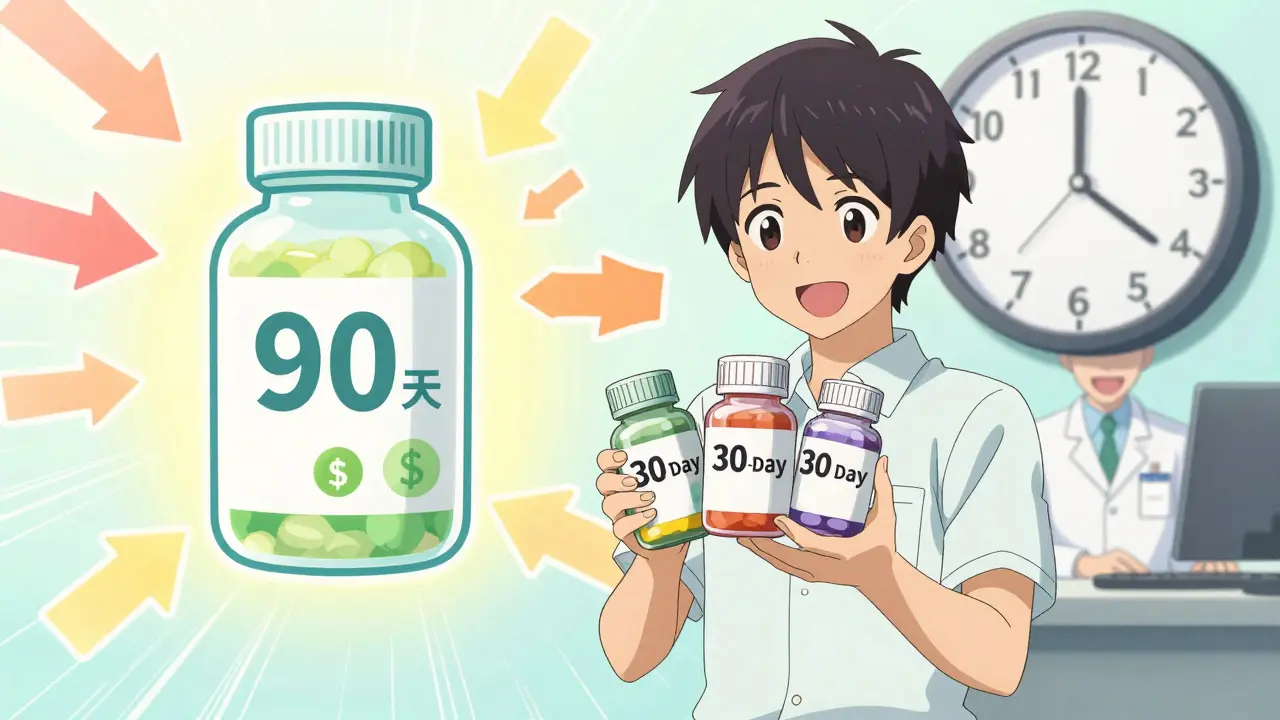
Getting a 90-day supply of your medication instead of a 30-day one isn’t just about fewer trips to the pharmacy-it’s about real money saved. If you’re taking medication for a long-term condition like high blood pressure, diabetes, or high cholesterol, switching to a 90-day fill could save you up to $39 a year per drug. That’s not a small amount. For someone on three or four maintenance meds, that adds up to hundreds in savings annually-without changing your treatment or buying anything extra.
Why 90-Day Fills Save You Money
Most insurance plans charge the same copay whether you get 30 days or 90 days of medication. That means if your copay is $4.90 for a 30-day supply, you pay the same $4.90 for 90 days. You’re getting three times the pills for the same price. That’s not a discount-it’s a direct savings. Over a year, instead of paying $14.70 for three separate 30-day fills, you pay just $4.90. That’s $9.80 saved per medication every three months, or nearly $40 a year per drug. Some plans even offer lower copays for 90-day supplies through mail-order pharmacies. For example, CVS Caremark and other pharmacy benefit managers often have special rates for home delivery. You’re not just saving on the drug cost-you’re also cutting out gas, time off work, and the hassle of remembering to refill every month.Who Qualifies for a 90-Day Fill
Not every medication qualifies, and not every patient automatically gets the option. To get a 90-day supply, you need to meet two basic criteria:- Your medication is for a chronic condition-something you take every day for months or years.
- You’ve already been taking it successfully for at least a few months, with no side effects or changes needed.
How to Get a 90-Day Prescription
There are two straightforward ways to get a 90-day supply, and neither requires special skills or paperwork.- Ask your doctor when you get your next prescription. Say: “Can you write this for a 90-day supply?” Most doctors are happy to do it-they know it helps patients stick to their treatment. If they say no, ask why. Sometimes it’s just a habit. Insurance rules don’t usually block it.
- Ask your pharmacy if they can fill your existing 30-day prescription as a 90-day supply. Many pharmacies can do this if your prescription has refills left and your insurance allows it. You don’t need a new script.
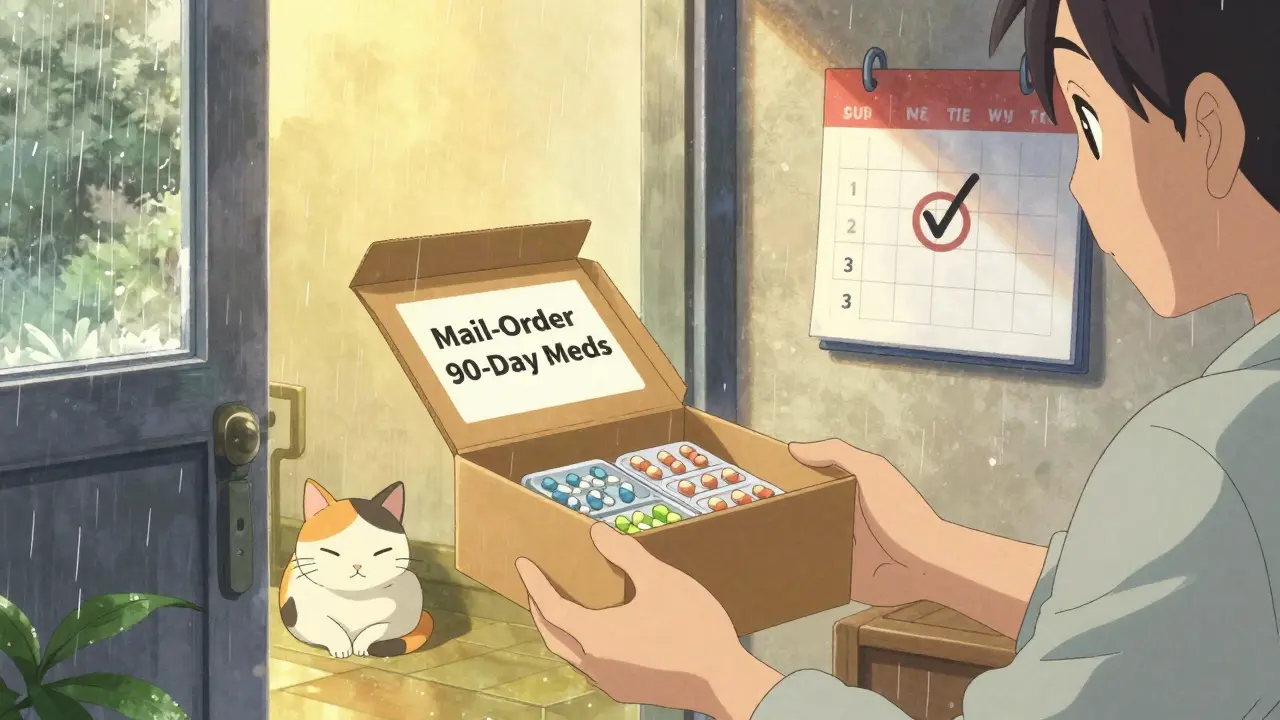
Mail-Order vs. Retail Pharmacy
You have two main choices: get your 90-day supply at your local pharmacy or through a mail-order service.| Feature | Mail-Order Pharmacy | Retail Pharmacy (In-Store) |
|---|---|---|
| Cost | Usually lowest copay | Sometimes same as mail-order, sometimes higher |
| Delivery | Free, shipped to your door | Pick up in person |
| Convenience | One order, three months of meds | Still need to visit pharmacy |
| Speed | 7-10 days to arrive | Usually same day |
| Best for | Stable, long-term meds | People who want immediate access |
What to Do If Your Insurance Won’t Cover It
Sometimes, your plan won’t approve a 90-day fill right away. That’s frustrating, but not the end of the road.- Call your insurance company. Ask: “Does my plan allow 90-day fills for this medication?” Some plans require prior authorization. That just means your doctor needs to send a note saying it’s medically appropriate.
- Ask your pharmacist to check. Pharmacists can often call your insurer on your behalf and get a quick answer.
- If your plan still says no, ask your doctor to write a letter of medical necessity. This isn’t complicated-just explain that the 90-day supply improves adherence and reduces risk of hospitalization.

Common Misconceptions
There are a few myths that keep people from using 90-day fills:- “I’ll run out if something changes.” If your doctor needs to adjust your dose, they can always write a new prescription. You’re not locked in.
- “It’s only for Medicare patients.” False. Most commercial plans, Medicaid, and even some employer plans offer it.
- “Pharmacies don’t like it.” Retail pharmacies may make less profit on 90-day fills because they get paid per dispensing, not per pill. But that doesn’t mean they won’t fill it. Most will, especially if you ask clearly.
Real Savings, Real Impact
A UnitedHealth Group report from June 2025 estimated that 90-day prescriptions already save consumers and employers $600 million a year. If adoption jumped from the current 12% to 70%, that number could hit $1.9 billion in just the first year. That’s not just a win for your wallet-it’s a win for the whole system. People who use 90-day fills are less likely to end up in the ER because they missed a dose. They’re less likely to have a heart attack or stroke from uncontrolled blood pressure. That’s why doctors and insurers are pushing for it.Next Steps
Here’s what to do right now:- Look at your current prescriptions. Which ones are for long-term conditions?
- Check your last refill date. If you’ve been taking it for over 30 days without issues, you’re eligible.
- Call your doctor’s office and ask: “Can I get a 90-day supply of [medication name]?”
- Ask your pharmacy if they offer 90-day fills in-store or through mail-order.
- If you get mail-order, sign up for automatic refills so you never run out.
Can I get a 90-day supply for any medication?
No, only medications for chronic conditions qualify. These include drugs for high blood pressure, diabetes, high cholesterol, thyroid disorders, asthma, and depression. Acute medications like antibiotics or pain relievers don’t qualify. Check with your pharmacy or insurer if you’re unsure.
Do I need a new prescription for a 90-day supply?
Not always. If your current prescription has refills left, your pharmacy can often fill it as a 90-day supply without a new script. But your doctor can also write a new prescription specifically for 90 days, which is the cleanest option. Just ask.
Is mail-order safe and reliable?
Yes. Mail-order pharmacies are licensed and regulated just like retail pharmacies. They use temperature-controlled packaging for sensitive medications and track shipments. Many, like CVS Caremark and Express Scripts, have been doing this for decades. If you’re worried about delays, ask about their delivery guarantees.
What if I miss a dose? Can I still get a 90-day fill?
Yes. Missing one or two doses doesn’t disqualify you. What matters is that you’ve been taking the medication consistently over the past few months. If you’ve had trouble sticking to your plan, talk to your doctor. They might help you adjust your routine or switch to a simpler regimen.
Will switching to 90-day fills affect my insurance deductible?
No. Your deductible is based on the total cost of your prescriptions, not how often you fill them. A 90-day supply counts as one claim, even though it’s three months of meds. That means you’re still working toward meeting your deductible, but you’re paying less out of pocket each time.
Can I switch back to 30-day fills later?
Absolutely. You can switch anytime. If your medication changes, your doctor adjusts your dose, or you just prefer the convenience of monthly refills, you can go back. There’s no penalty or lock-in.
How do I know if my pharmacy offers 90-day fills?
Call them. Ask: “Do you fill 90-day prescriptions for maintenance medications?” Most major chains like CVS, Walgreens, and Rite Aid do. Independent pharmacies might not, but they can usually refer you to a mail-order partner. You can also check your insurer’s website for a list of in-network pharmacies that offer 90-day fills.
Jhoantan Moreira
February 2, 2026 AT 21:22Just switched my statin to 90-day mail-order last month 😊 Saved me $12 this quarter alone and I didn’t even have to leave the house. Life’s too short for monthly pharmacy runs. Also, my cat finally stopped judging me for coming home with plastic bags every 30 days.
Joseph Cooksey
February 4, 2026 AT 13:23Let me break this down for you like you’re five, because apparently some people still think this is ‘news.’ If your insurance charges the same copay for 90 days as 30, you’re not ‘saving money’-you’re just not being gouged by the pharmacy’s arbitrary refill cycle. It’s basic arithmetic. The fact that this requires a 2,000-word explainer says everything about how broken our healthcare system is. And don’t get me started on how mail-order pharmacies are basically the only thing keeping people alive who can’t afford gas to drive to CVS. Also, if your doctor says ‘no,’ ask them if they’ve ever paid for their own meds. Probably not.
Justin Fauth
February 6, 2026 AT 06:33Y’all are letting Big Pharma and the insurance companies win. This isn’t some ‘hack’-it’s your RIGHT. We’re talking about people with diabetes, heart disease, hypertension-these aren’t optional meds. If your plan doesn’t let you get 90-day fills, call your congressman. Call your senator. Call your damn neighbor. This is about survival, not convenience. And if you’re still going to the pharmacy every month? You’re part of the problem. Get with the program, America.
Coy Huffman
February 6, 2026 AT 07:36so i just asked my doc for a 90-day script for my metformin and she was like ‘oh wow i didn’t even know you could do that’ 🤦♂️ turns out she’s been writing 30s by default for 15 years. i told her ‘if you’re not thinking about adherence, who is?’ and she actually laughed. we got it done same day. also, mail order delivered my pills in a box with a little ‘you got this!’ note. i cried a little. not even kidding.
Amit Jain
February 7, 2026 AT 13:00Very simple: if you take medicine every day, ask for 90 days. No need to overthink. Save money. Save time. No drama.
Keith Harris
February 8, 2026 AT 03:16Oh wow, you mean there’s a way to not get ripped off by the system? Shocking. And here I thought the only way to save money was to skip doses or sell my pills on the dark web. Also, who the hell wrote this article? A pharmaceutical rep? Mail-order? That’s just a Trojan horse for automated refills and data harvesting. Next they’ll be implanting trackers in your pill bottles. And don’t even get me started on how ‘convenient’ it is to wait 10 days for your heart med when you’re in a crisis. You people are naive.
Kunal Kaushik
February 9, 2026 AT 23:15My dad’s on 5 meds. Switched to 90-day mail-order last year. He says he feels like he’s got his life back. No more rushing to the pharmacy on weekends. No more forgetting. He even started gardening again 😊
Mandy Vodak-Marotta
February 10, 2026 AT 19:46Okay real talk-I did this for my blood pressure med and it changed my life. I used to panic every month when I was down to 3 pills. Now? I open my mailbox once every three months and there they are. I even signed up for automatic refills and now I get a text when they ship. I feel like a responsible adult for the first time in 10 years. Also, I’ve never been more excited to get mail. I used to hate mail. Now I’m like, ‘Is it my meds? Is it my meds?’ I’m not even ashamed.
Nathan King
February 11, 2026 AT 15:48While the economic rationale for 90-day fills is statistically sound, one must consider the broader sociomedical implications. The normalization of mail-order pharmaceutical distribution may inadvertently erode the patient-pharmacist relationship, a critical component of therapeutic adherence. Furthermore, the logistical latency inherent in postal delivery systems introduces a non-trivial risk for patients with pharmacokinetic vulnerabilities. While cost savings are undeniably appealing, the clinical integrity of the dispensing paradigm must not be sacrificed on the altar of convenience.