
Every year, thousands of children are given the wrong dose of medicine-not because a doctor made a bad call, but because a number got lost in translation. A weight of 22 pounds becomes 10 kilograms, then 10.5, then 11. And suddenly, a safe dose becomes dangerous. In pediatric care, weight-based verification isn’t just a best practice-it’s the line between recovery and harm.
Why Weight Matters More in Kids
Adults often get fixed doses: one pill, one teaspoon, one injection. Kids don’t. Their bodies are smaller, their metabolism changes faster, and their safety margins are razor-thin. A dose that’s perfect for a 40-pound child could be toxic for a 20-pound toddler. That’s why every pediatric medication dose is calculated by weight-usually in milligrams per kilogram (mg/kg). Get the weight wrong, and you get the dose wrong.According to the World Health Organization, children are three times more likely than adults to suffer a medication error. And nearly half of those errors come down to one thing: incorrect weight conversion. Think pounds to kilograms. Think rounding up. Think using an old weight from six months ago. These aren’t rare mistakes. They’re systemic.
A 2021 review of 63 studies found that over 32% of pediatric dispensing errors involved weight-based miscalculations. Of those, more than 8% led to actual harm-slow breathing, low blood pressure, seizures. Most of these errors happened before the medicine even reached the child’s mouth. They happened in the chart, in the pharmacy, in the EHR system.
The Three-Point Verification System
Experts agree: one check isn’t enough. You need three.First: Prescription Entry. When a doctor writes an order, the system must require an up-to-date weight in kilograms. No pounds. No estimates. No "I think she’s about 30 pounds." If the weight is missing, the system blocks the order. This isn’t optional. The American Society of Health-System Pharmacists (ASHP) made this mandatory in 2018. And it works. Hospitals that enforced this saw a 90% drop in weight-related prescribing errors.
Second: Pharmacy Verification. The pharmacist doesn’t just fill the script. They verify. They check the weight against the order. They run the math. They confirm the concentration-because a 5 mg/mL solution isn’t the same as a 10 mg/mL one. Many hospitals now use automated dispensing cabinets that won’t release the medicine unless the weight and dose match. One study showed this cut dispensing errors by nearly 70%.
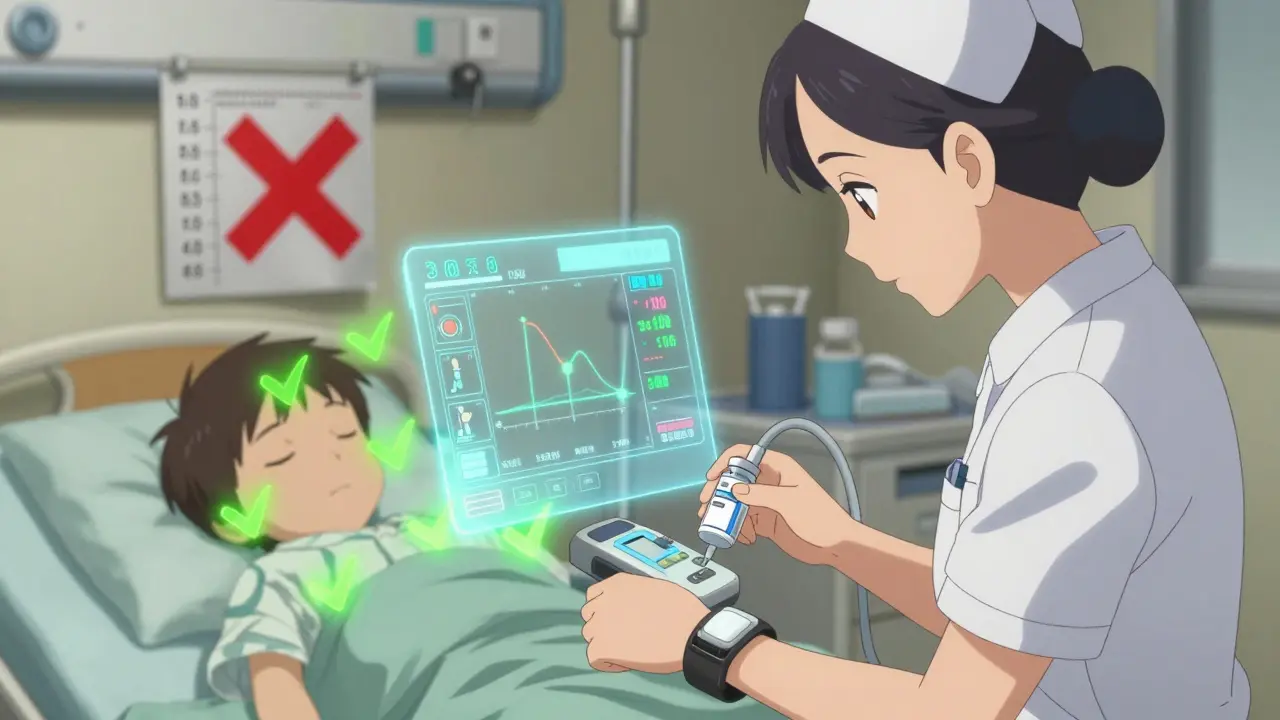
Third: Bedside Administration. Nurses don’t guess. They scan the patient’s wristband, scan the medication, and the system checks: Is this dose right for this weight? If not, it stops them. Barcode systems with weight integration have reduced administration errors by over 74%. This is the last line of defense. And it saves lives.
Technology That Actually Works
You can’t fix this with posters or training alone. You need smart systems.Electronic Health Records (EHRs) with built-in clinical decision support are the backbone. Systems like Epic’s Pediatric Safety Module 4.0, released in early 2024, don’t just use static weight limits. They use growth charts. If a 12-year-old weighs 110 pounds, but their last growth chart shows they’re in the 95th percentile, the system knows that’s normal. It won’t flag a dose as too high just because it’s over a fixed number. That cut false alerts by 63% in testing.
Some hospitals now use AI to predict a child’s expected weight based on age, height, and past records. If the current weight is way off, the system flags it. One pilot program caught 92% of outdated or missing weights before a dose was given.
But tech alone isn’t magic. A 2021 study found that 42% of weight-based alerts were ignored-because too many were wrong. Alert fatigue is real. The key isn’t more alerts. It’s smarter alerts. Less noise. More precision.
What Hospitals Are Getting Wrong
Many places still use scales that show pounds. Or they let staff enter weights manually without double-checking. Or they rely on parents to report weight-"I think he’s 40 pounds"-and don’t verify.The American Academy of Pediatrics says: all pediatric scales in hospitals must display only kilograms. Infants to 0.1 kg. Older kids to 0.5 kg. No exceptions. Why? Because every decimal matters. A 0.2 kg error in a 5 kg infant is a 4% dose error. That’s enough to cause harm.
Another big mistake: outdated weights. The Institute for Safe Medication Practices says: if a child hasn’t been weighed in 24 hours in acute care, or 30 days in outpatient, the weight is no longer valid. Yet many hospitals still use weights from months ago. A 2022 survey found that 63% of pediatric nurses had seen weight documentation errors in just one year. That’s not negligence. That’s a broken system.
And then there’s the rural gap. While 94% of children’s hospitals have full weight verification systems, only 33% of rural community hospitals do. That’s not just a tech issue. It’s a safety inequality. Kids in small towns are at higher risk.
Standardizing the Basics
One of the biggest fixes? Stop using teaspoons and tablespoons. Stop using "cc" or "mL" interchangeably. Stop letting parents guess.The AAP mandates: all pediatric liquid medications must be labeled in milliliters only. No more "give 1/2 teaspoon." That’s too easy to mess up. A teaspoon is 5 mL. But not all teaspoons are the same. A dosing syringe? That’s precise. A kitchen spoon? Not even close.
Also, standardize concentrations. If every hospital uses vancomycin at 5 mg/mL for kids, pharmacists don’t have to calculate different strengths for every drug. One standard. Fewer mistakes. A 2023 study showed this cut calculation errors by 72%.

Training and Culture
You can have the best tech in the world, but if staff don’t know how to use it-or fear being blamed for mistakes-it won’t work.Successful programs require 40 hours of training per clinician. Not a 10-minute video. Not a handout. Real, hands-on practice with real cases. Pharmacists need to know pediatric pharmacokinetics. Nurses need to know how to question a dose. Doctors need to know how to enter weight correctly.
And the culture? It must be non-punitive. If a nurse catches a wrong dose, they should be thanked-not written up. The most effective safety programs treat errors as system failures, not personal failures. That’s how you get people to speak up.
One hospital in Boston cut weight-related errors from 14 per 10,000 doses to less than 1 in 18 months. But it took 1.5 full-time pharmacists per 50 pediatric beds to make it happen. That’s the cost of safety. And it’s worth it.
What’s Next
The future is in real-time data. Wearable sensors that track weight changes in kids with chronic conditions. Blockchain systems that lock in weight entries so they can’t be altered. FDA draft guidelines now require EHRs to integrate growth charts and flag doses that don’t match expected patterns.But the biggest change won’t be technological. It’ll be cultural. When every nurse, pharmacist, and doctor treats weight verification like a seatbelt-something you don’t skip, no matter how rushed you are-then errors will drop. Not because of software. Because of habit.
Children don’t need fancy gadgets. They need consistency. Accuracy. A system that never lets a number slip through.
Why is weight so important in pediatric dosing?
Children’s bodies process medicine differently than adults. Doses are calculated by weight (mg/kg), not fixed amounts. Even a small error in weight-like mistaking 20 pounds for 10 kg instead of 9.1 kg-can lead to a 10% overdose. That’s enough to cause serious harm, especially in infants and toddlers.
What’s the most common cause of pediatric dosing errors?
The most common cause is incorrect weight conversion-especially when pounds are converted to kilograms manually. Studies show that 12.6% of pediatric dosing errors come from this single mistake. Other top causes include outdated weight records, using non-standard concentrations, and relying on caregiver-reported weights without verification.
Do all hospitals use weight-based verification systems?
No. While 87% of U.S. children’s hospitals have some form of weight-based verification, only 33% of rural community hospitals do. This creates a dangerous gap. Academic hospitals often use integrated EHRs with automated alerts, while smaller clinics may still rely on paper charts and manual calculations-making errors far more likely.
Can technology alone prevent these errors?
No. Technology reduces errors by up to 87% when properly used, but alert fatigue, poor training, and workflow disruptions can undermine it. A 2021 study found that 42% of weight-based alerts were overridden-and 18% of those overrides were actual errors. Safety requires both smart tech and a culture where staff feel safe speaking up.
What should parents do to help prevent dosing errors?
Parents should always know their child’s current weight in kilograms and bring it to every appointment. Ask: "Is this dose based on my child’s most recent weight?" Make sure liquid medications are labeled in milliliters only, and use a dosing syringe-not a kitchen spoon. If the dose seems too high or low, ask the pharmacist to double-check.
Are there regulations requiring weight-based verification?
Yes. The Leapfrog Group requires it for hospital "A" safety grades. CMS now requires weight verification documentation for all pediatric Medicare/Medicaid prescriptions. The ASHP and AAP have issued formal guidelines, and the FDA is moving toward mandatory standards for EHR systems to include pediatric weight checks.
What to Do Now
If you work in a hospital or clinic: audit your weight documentation process. Are weights entered in kilograms? Are they checked at least three times? Are outdated weights being used? If you’re a parent: always ask for your child’s weight in kilograms. Demand milliliter-only labeling. Don’t assume the system got it right.Medication safety isn’t about being perfect. It’s about building layers so one mistake doesn’t become a tragedy. Weight-based verification is the most proven, most effective layer we have. Use it. Enforce it. Never skip it.
Tarun Sharma
December 21, 2025 AT 19:28Weight-based dosing protocols must be standardized globally. The margin for error in pediatric pharmacology is not negotiable. Every decimal point matters, and systems that allow manual entry without verification are unacceptable.
Jim Brown
December 22, 2025 AT 04:24There is a metaphysical dimension to this issue: we treat children as miniature adults in our algorithms, yet their physiology is a symphony of flux, not a static equation. To reduce their care to a kilogram-to-milligram conversion is to mistake the map for the territory. The real crisis is not computational-it is epistemological. We have forgotten that medicine is not merely calculation, but custodianship.
Cara Hritz
December 24, 2025 AT 02:38omg i just read this and like… why do we still use pounds?? like i know its usa but like… whyyy?? also i think the part about the syringe vs spoon is sooo true my cousin gave her kid medicine with a tea spoon once and it was a disaster lol
Jamison Kissh
December 24, 2025 AT 10:44It’s fascinating how a single metric-weight-becomes the fulcrum of life and death in pediatrics. We build entire systems around it, yet we still let humans enter it manually. Isn’t that like trusting a sundial to time a rocket launch? The deeper question isn’t whether the tech works-it’s why we resist automating what we already know saves lives.
Johnnie R. Bailey
December 26, 2025 AT 04:26Having worked in rural clinics across the Midwest, I can tell you-the gap isn’t just tech. It’s time, staffing, and institutional inertia. A 30-bed hospital can’t afford a full-time pharmacist. But they can afford a $200 scale that displays kg only. They can afford to print out weight verification checklists and hang them above the med cart. Small wins matter. Start there. Don’t wait for Epic to fix it.
Also, parents need to be part of the team. Not just passive recipients. Teach them to say: ‘What’s the dose in mL? Is that based on today’s weight?’ That’s not nagging-that’s safety culture.
Nader Bsyouni
December 27, 2025 AT 22:22Everyone’s acting like this is some revolutionary insight when all you’re saying is ‘don’t mess up the math’… like duh. Also who cares if a rural hospital doesn’t have fancy EHRs? Maybe they don’t need them. Maybe the real problem is overmedicating kids in the first place
Herman Rousseau
December 29, 2025 AT 19:26THIS. IS. EVERYTHING. 🙌 I’ve seen a 2-year-old nearly go into cardiac arrest because someone used an old weight from 6 months ago. We fixed it by putting a big sign on every scale: ‘ENTER IN KG. NO EXCEPTIONS.’ No tech. No budget. Just clarity. If you’re not doing this, you’re gambling with a child’s life. Let’s get it done. 💪❤️
Vikrant Sura
December 30, 2025 AT 22:00Interesting. But where’s the ROI analysis? How much does this cost per avoided error? Seems like overkill for a problem that’s statistically rare.