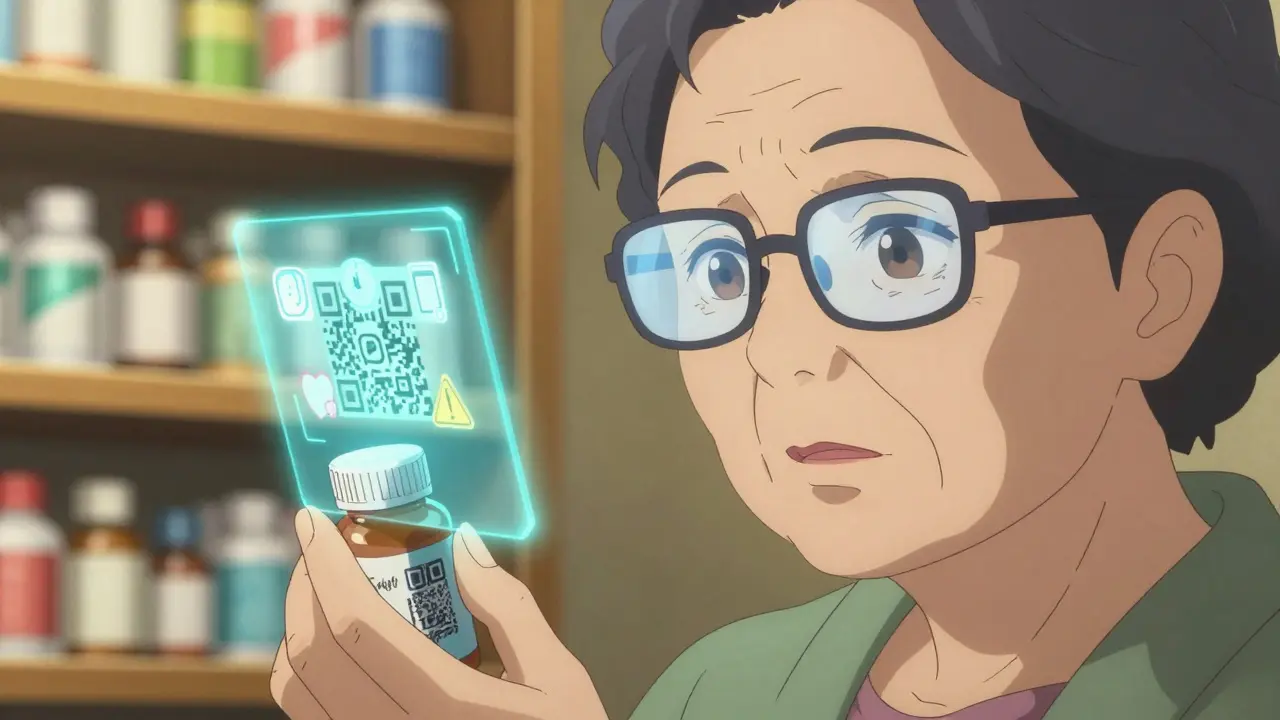
Imagine opening your medicine bottle and instantly seeing not just the name of your pill, but a video explaining how to take it, a list of foods to avoid, and a reminder that your next refill is due in three days. That’s not science fiction-it’s happening right now in pharmacies across the UK and beyond. QR codes on prescription labels are quietly transforming how patients get their meds, and how pharmacists keep them safe.
Why QR Codes on Prescription Labels Matter
For years, prescription labels have been small pieces of paper with tiny print. If you’re over 65, struggling with vision, or just in a rush, reading them can be a challenge. That’s where QR codes come in. Scan one, and you’re taken to a clean, readable digital page with everything you need: dosage instructions, side effects, drug interactions, and even video tutorials.
The numbers don’t lie. A 2023 study in the Journal of Medical Internet Research found that patients who used QR codes on their prescriptions were 28% more likely to take their meds correctly. Hospitals using them saw medication errors drop by 43%. That’s not just convenient-it’s life-saving.
It’s not just about convenience. Regulatory bodies like the FDA and the European Medicines Agency now support digital labeling. Singapore launched a full e-labeling pilot in April 2024, requiring all pharmacy-only medicines to include QR codes linking to full safety info. The EU is moving toward making them mandatory by 2026. This isn’t a trend-it’s the new standard.
Static vs. Dynamic QR Codes: What’s the Difference?
Not all QR codes are created equal. There are two types: static and dynamic. Static codes are like a printed sign-they point to one fixed URL and can’t be changed after printing. Dynamic codes are like a smart billboard. You can update where they point, track who scans them, and even change the language based on the user’s phone settings.
In pharma, 88% of QR codes are dynamic. Why? Because medicine information changes. A new warning gets added. A patient’s dosing schedule shifts. A drug recall happens. With static codes, you’d have to reprint every label. With dynamic ones, you update the link behind the code-no new labels needed.
Dynamic codes also give pharmacies real-time data. They can see how many people are scanning, where they’re scanning (home, clinic, pharmacy), and what time of day. That helps them spot patterns-like if a lot of scans happen late at night, maybe patients are forgetting to take meds in the morning.
How to Set Up a QR Code for a Prescription Label
Setting this up isn’t as complicated as it sounds. Here’s how it works in practice:
- Choose a reliable QR code generator that supports dynamic codes and compliance standards. Tools like Clappia, Sona QR, or sQR.me are designed for healthcare use.
- Build the landing page with clear, accessible content: indication, dosage, contraindications, warnings, drug interactions, and overdose info. Follow Singapore’s HSA guidelines-every single piece of safety info must match the printed Patient Information Leaflet (PIL).
- Integrate with your pharmacy system. The QR code should connect to your pharmacy software (like NCPDP SCRIPT) and ideally your EHR system via HL7 FHIR APIs. That way, if a patient’s meds change, the QR code updates automatically.
- Test the scan. Test it on at least 12 real-world conditions: glossy bottles under bright lights, curved vials, in dim rooms, from 10 feet away. ISO/IEC 18004:2015 says you need a 4-module quiet zone (clear border) and at least 70% contrast. Don’t skip this step.
- Print it right. Use a minimum 25x25 module size for reliable scanning. On curved surfaces like vials, make the code 30% larger than you would on a flat box. And never put it where the label folds or wrinkles.
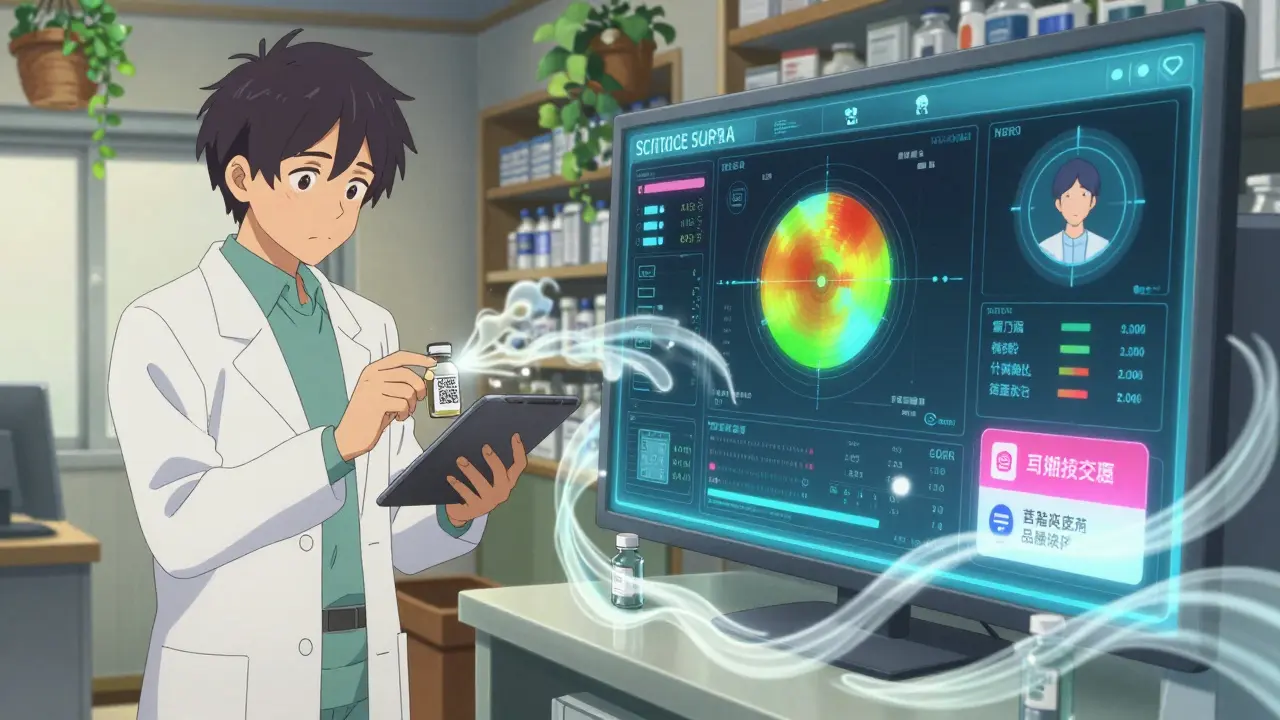
What Should the Digital Label Include?
The digital page behind the QR code isn’t just a copy of the paper label. It’s an upgrade. Here’s what it needs:
- Indication - What the medicine is for (e.g., “for high blood pressure”)
- Dosing instructions - How much, how often, with or without food
- Contraindications - When NOT to take it (e.g., “do not use if pregnant”)
- Warnings and precautions - Highlight critical risks like drowsiness or liver damage
- Drug interactions - List common medications or foods to avoid
- Overdose info - What to do if too much is taken
- Storage instructions - Keep refrigerated? Away from light?
- Expiration date - Automatically updated if the batch changes
- Video or audio guide - Especially helpful for elderly or visually impaired patients
- Refill reminder - Link to pharmacy portal or auto-schedule
Some systems now include AI-powered alerts. If you scan a code and the system detects you’re also taking another drug that interacts badly, it pops up a warning. Freyr Solutions rolled this out in May 2024. It’s not just reading info-it’s preventing mistakes before they happen.
Real-World Success Stories
Pharmacies are seeing real results:
- A community pharmacy in Bristol reported a 63% drop in patient calls asking, “How do I take this?” after adding QR codes.
- An ICU in London cut IV preparation errors by 41% using QR codes to verify medication vials before administration.
- DosePacker’s trial with heart failure patients showed adherence jumped from 62% to 89% when each dose cup had a QR code linking to a personalized reminder video.
- Saint Francis Hospital’s diabetes program mailed QR code postcards with medication info-83% of patients scanned them and reported better understanding.
But it’s not all smooth sailing. A Dialog Health survey found 29% of patients struggled to scan codes on small vials. And 38% of patients over 65 need help scanning-compared to just 12% of those under 45.
Addressing the Digital Divide
QR codes can’t replace human help. If you’re setting this up, you need a backup plan. Here’s how:
- Staff-assisted scanning - Train pharmacists to scan for patients who can’t do it themselves. Make it part of the dispensing process, not an afterthought.
- Printed summaries - Keep the most critical info (dosage, warnings) printed on the label. The QR code adds depth, doesn’t replace basics.
- Audio options - Offer a phone number to call for an automated voice explanation. The Access Board endorsed this in 2013-and it’s still vital.
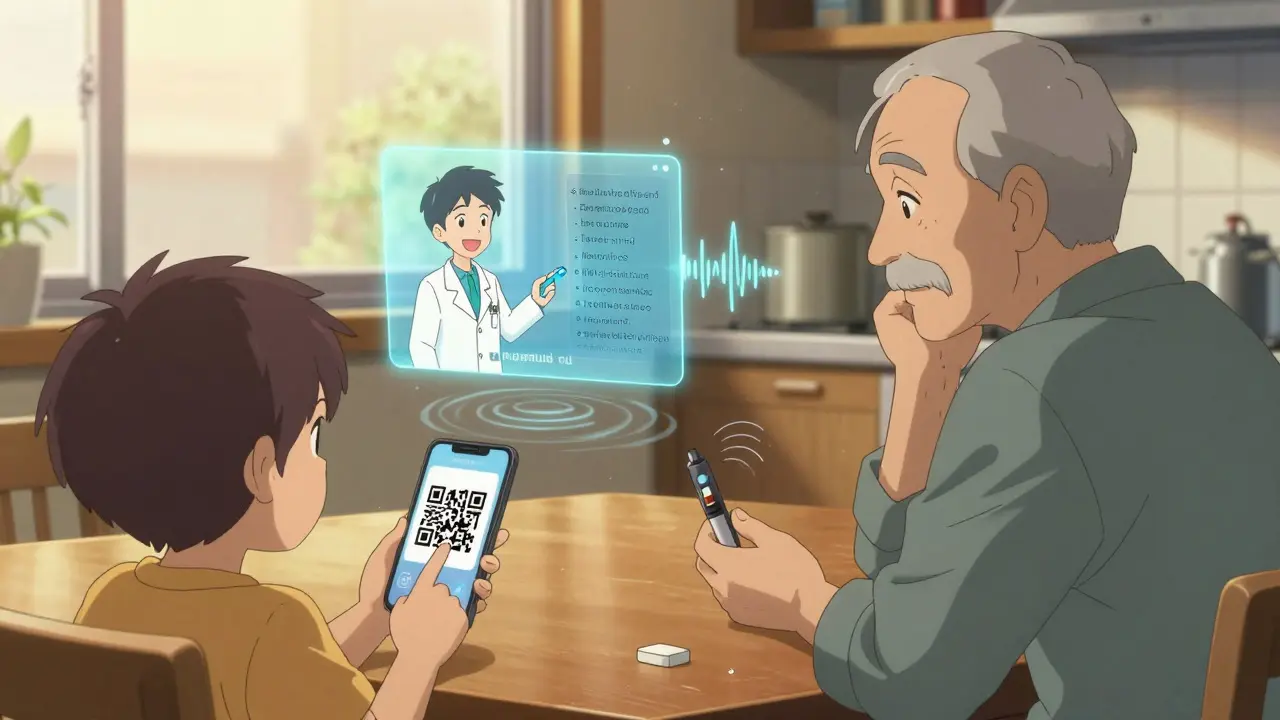
- Family access - Let patients share the digital label with caregivers via secure link. Many apps now support this with OAuth 2.0 authentication.
Don’t assume everyone has a smartphone. Don’t assume everyone knows how to use one. Design for inclusion, not just innovation.
Cost and ROI: Is It Worth It?
QR codes cost about $0.0003 per label. RFID tags? $0.08 to $0.50 each. That’s over 100 times more expensive. And QR codes work on any smartphone made after 2018-no special hardware needed.
ROI is clear:
- Reduced call center volume: 60%+ fewer patient questions
- Lower error rates: 40% fewer dispensing mistakes
- Higher adherence: 25-30% more patients taking meds correctly
- Regulatory compliance: Avoid fines and meet future EU mandates
Training staff takes time-about 40 to 80 hours per facility-but once it’s in place, maintenance is light. Just check scan analytics weekly and test accessibility every quarter.
What’s Next for Digital Prescription Labels?
The future is moving fast. By 2026, the EU may require QR codes on every prescription. The FDA is tying them to Universal Device Identifiers (UDIs) for medical devices. New platforms are adding multilingual content that auto-switches based on your phone’s language setting.
And it’s not just about pills. Imagine scanning a QR code on your insulin pen and getting real-time glucose trend data synced from your monitor. Or scanning a wound dressing that shows you how to change it with a video. The tech is here. The question is: are you ready to use it?
Start small. Pick one high-risk medication. Add a QR code. Track the results. Talk to your patients. If they’re scanning it and saying, “I finally understand,” you’ve done more than update a label-you’ve changed how care is delivered.
Can QR codes replace printed medication information?
No. Regulatory guidelines (including Singapore’s HSA and the FDA) require key safety information-like dosage, contraindications, and warnings-to remain printed on the label. QR codes are a supplement, not a replacement. They provide deeper access to full prescribing information, videos, and updates, but the physical label must still contain the most critical safety details.
Do I need a special app to scan a prescription QR code?
No. All modern smartphones (iPhone 7 and later, Android devices from 2018 onward) have built-in QR code scanners in the camera app. You don’t need to download anything. Just point your camera at the code-it will auto-detect and open the link in your browser.
What if I don’t have a smartphone or internet access?
Pharmacies must still provide printed Patient Information Leaflets (PILs) and offer verbal counseling. Many are adding toll-free phone lines where patients can call to hear their medication info in audio format. QR codes should never be the only option-accessibility is a legal and ethical requirement.
Are QR codes secure? Could someone hack the link?
The QR code itself is just a link-it doesn’t store data. The security lies in the landing page. Reputable systems use HTTPS encryption, require authentication for sensitive data, and are hosted on secure healthcare platforms. Always check that the URL starts with https:// and looks legitimate (e.g., from your pharmacy’s domain). Never enter personal details unless you’re sure of the site’s authenticity.
How often should the QR code content be updated?
The landing page should be updated immediately whenever there’s a change in safety info-like a new warning, recall, or dosage adjustment. Dynamic QR codes allow this without reprinting labels. Pharmacies should monitor scan analytics weekly and review content quarterly for clarity, accessibility, and accuracy.
Can QR codes help with medication adherence?
Yes. Studies show patients who scan QR codes on their prescriptions are 28% more likely to take their meds correctly. Digital labels can include refill reminders, video instructions, and personalized messages. DosePacker’s trial showed adherence rose from 62% to 89% in heart failure patients using QR-coded dose cups. The key is making the content engaging and easy to follow-not just text-heavy.
Why are dynamic QR codes better than static ones for prescriptions?
Dynamic QR codes let you change the destination link after printing. If a drug’s safety info changes, you update the webpage-not the label. Static codes are permanent. You’d have to reprint every bottle or box. Dynamic codes also track scans, show where patients are accessing info, and support multilingual content. For pharmacies, they’re the only practical option.
What’s the minimum size for a QR code on a prescription label?
For reliable scanning on flat surfaces, use at least a 25x25 module size (roughly 0.6 inches square). On curved surfaces like vials, increase it by 30% to 0.8 inches. Always leave a 4-module quiet zone (clear border) around the code. Smaller codes won’t scan reliably on older phones or in poor lighting.
Next Steps for Pharmacies and Patients
If you’re a pharmacist: Start with one high-risk medication. Add a dynamic QR code. Train your team. Ask patients for feedback. Track how many scan it and what they say. Scale from there.
If you’re a patient: Next time you get a prescription, look for the QR code. Scan it. See what’s there. If it’s helpful, tell your pharmacist. If it’s hard to use, say so. Your feedback shapes the future of safe medication use.
This isn’t about technology for technology’s sake. It’s about making sure people understand their meds-clearly, safely, and without confusion. QR codes are just the tool. The goal is better health.
Paul Barnes
January 20, 2026 AT 12:18QR codes on prescriptions? Sure. But let’s not pretend this is innovation-it’s just digitizing the same bureaucratic mess. The FDA’s ‘support’? That’s because they’re too lazy to fix the real problem: illegible handwriting on old paper scripts. This is a band-aid on a broken system.
And don’t get me started on ‘dynamic’ codes. Who’s maintaining these links? A 22-year-old intern at a third-party vendor? One typo, one expired SSL cert, and Grandma’s blood pressure med info vanishes. No one’s accountable. Just another tech solution that looks good on a PowerPoint.
Also, ‘ISO/IEC 18004:2015’? You’re quoting standards like it’s gospel. That’s not a feature-it’s a compliance checkbox. Real safety isn’t about module size. It’s about clear, printed instructions that don’t require a smartphone to read.
And yes, I checked the source. You cited a 2023 study. But did you mention the sample size? 120 patients? In one city? That’s not statistically significant. It’s anecdotal with a spreadsheet.
Stop selling tech as healthcare. We need better training for pharmacists, not QR codes that break when the Wi-Fi is down.
sagar sanadi
January 22, 2026 AT 00:21QR codes? LOL. Next they’ll put a tracker in your pill bottle. You think this is for safety? Nah. Big Pharma wants to know when you take your meds. They’re building a database on your body. Soon they’ll charge you extra if you scan too late. Or worse-sell your data to insurers.
Remember when you could just read the label? Now you gotta scan, wait for the page to load, and pray your phone doesn’t glitch. And what if your phone dies? You’re dead too. Literally.
They say it’s ‘life-saving.’ I say it’s surveillance with a smiley face. 😈
kumar kc
January 23, 2026 AT 05:32This is irresponsible. QR codes are not a substitute for clear, printed warnings. People die because they can’t read tiny text. Now we’re asking them to rely on a device they don’t understand. That’s not progress. That’s negligence.
Thomas Varner
January 25, 2026 AT 01:41Okay, so… QR codes on meds? I mean… yeah, I guess? 🤔
I scanned one last week on my blood thinner-actually, it was kind of cool? Like, it showed me a video of how not to eat grapefruit with it? I didn’t know that. I thought it was just a myth. Turns out, it’s real. 🍇
But also… my grandma cried because she couldn’t scan it. And the pharmacist was in a rush. So she just… took it anyway. Without knowing. That part? Not cool.
And the website? It loaded slow. Like… 12 seconds. On 5G. I mean… come on. Are we really ready for this? Maybe… but not yet. 🤷♂️
Art Gar
January 26, 2026 AT 01:32While the technological implementation of dynamic QR codes on pharmaceutical labeling represents a non-trivial advancement in information dissemination, one must not conflate technological novelty with clinical efficacy or regulatory compliance. The foundational principle of patient safety remains anchored in legible, unambiguous, and permanently affixed textual information. Digital adjuncts, however sophisticated, cannot supplant the statutory requirement for printed labeling under 21 CFR § 201.56. Furthermore, the assumption of universal smartphone access constitutes a fallacy in populations with limited digital literacy, particularly among the elderly and economically disadvantaged. Thus, while the utility of QR codes as a supplementary tool may be acknowledged, their deployment must be strictly circumscribed by ethical, legal, and accessibility imperatives.
clifford hoang
January 26, 2026 AT 21:31QR codes? 🤔 They’re not just tracking your meds-they’re tracking YOU. Every scan. Every location. Every time you’re awake. That’s how they know when you skip doses. And then… your insurance hikes your premiums. 😏
And who built the server? A contractor in Bangalore? With zero security audits? What if someone hacks the link and replaces your insulin info with ‘take 10x more’? 💉💀
They say ‘HTTPS.’ But HTTPS doesn’t mean safe. It means the hacker’s site looks legit. I’ve seen it. Fake FDA pages. Fake pharmacy portals. All with QR codes. 😈
This isn’t healthcare. It’s a data harvest disguised as a convenience. And you’re all just clicking ‘scan’ like sheep. 🐑
Nadia Watson
January 28, 2026 AT 05:14I’ve been working in community health for 18 years, and I’ve seen patients struggle with tiny print for decades. This QR code idea? It’s a step forward-but only if we do it right.
My biggest concern? Not the tech. It’s the people left behind. I had a woman last week-78, no smartphone, lives alone. She showed me her pill bottle. The QR code was there. She didn’t know what to do. I scanned it for her. The video was in English. She speaks only Spanish. 😔
We need auto-language switching. We need phone hotlines. We need staff trained to help. Tech is great-but it’s useless if it doesn’t meet people where they are.
Also, please, for the love of God, make sure the QR code isn’t on the bottom of a curved bottle. I’ve watched people drop their meds trying to scan it. We’re not making life easier. We’re making it harder.
Let’s build this with empathy. Not just efficiency.
Jacob Cathro
January 30, 2026 AT 03:02Okay so let me get this straight-pharmacies are slapping QR codes on bottles like it’s a TikTok trend and calling it ‘life-saving’? 🤡
Meanwhile, the actual problem? Pharmacists are overworked, underpaid, and rushing through counseling. You think a video is gonna fix that? Nah. It’s just a way to cut staff. ‘Oh, just scan the code!’
And ‘dynamic’ codes? Yeah, sure. Until the server goes down. Or the API breaks. Or the vendor gets bought by a Chinese company. Then your meds info? Gone. Poof. 💥
And don’t even get me started on ‘AI alerts.’ I scanned my blood pressure med and it popped up ‘you’re also taking ibuprofen-dangerous combo!’
…I don’t take ibuprofen.
So… why’d it say that? Did it pull data from my Fitbit? My Amazon purchase history? 🤔
This isn’t healthcare. It’s a glitchy, insecure, corporate fantasy with a fancy acronym.
Manoj Kumar Billigunta
February 1, 2026 AT 02:50QR codes can help, but only if we make them easy for everyone. I work with seniors in India-many don’t have smartphones. Some have them but can’t focus on the camera. So we train the pharmacy staff to scan for them. Simple. Kind. No tech required.
And we always print the dosage in big letters. Always. The QR code is just extra. Like a bonus. Not the main thing.
Also, if the video is too fast? Change it. If the language is wrong? Fix it. This isn’t a one-time setup. It’s a conversation. With people.
Technology should serve. Not replace.
Andy Thompson
February 1, 2026 AT 10:48QR codes? Cool. But only if we make them AMERICAN. Why are we copying the EU and Singapore? We don’t need their rules. We need OUR rules. Our system. Our way.
And why is every link pointing to some .eu domain? That’s not secure. That’s not patriotic. If you’re gonna put a QR code on my medicine? Make it .gov or .us. Otherwise, it’s a foreign spy tool. 🇺🇸
Also, I scanned mine. Took me to a site with a British accent. I don’t need British advice on my pills. I need AMERICAN advice. Made in America. By Americans. For Americans.
Stop outsourcing our safety.
Courtney Carra
February 2, 2026 AT 03:07It’s funny… I scanned my antidepressant’s QR code yesterday. It didn’t just give me dosage info. It gave me a breathing exercise. A journal prompt. A link to a free therapy chat. I cried. Not because I was sad. Because someone… cared enough to add that.
That’s the thing no one talks about. This isn’t just about avoiding drug interactions. It’s about reminding people they’re not alone.
Some of us are scared to take these pills. We’re ashamed. We feel broken.
That video? That gentle voice? That wasn’t tech. That was humanity. And it mattered more than any study.
❤️