
The Seven-Point Verification Checklist
Before you even look at the quantity, you need to ensure the prescription is legally valid. If one of these elements is missing or incorrect, the prescription is essentially a piece of scrap paper.- Prescriber Information: Full name and a physical address.
- Date of Issuance: For Schedule II drugs, the date must be current. For Schedules III-V, it must be within six months.
- Patient Identity: Full name and current address.
- Drug Specifics: The exact name and strength of the medication.
- Dosage Form: Whether it is a tablet, capsule, liquid, or transdermal patch.
- Quantity Prescribed: The total amount to be dispensed.
- Directions for Use: The "sig" or signa, which tells the patient how and when to take the drug.
Mastering Quantity and Direction Verification
Verifying the quantity isn't just about reading a number; it's about spotting discrepancies that suggest fraud or error. A common red flag is a mismatch between the numerical value and the written word. For example, if a script says "thirty (30) tablets," both must align. According to CMS data, a surprising number of Medicaid rejections happen simply because these two values don't match. When you hit the "directions" part of the check, you have to move from a legal mindset to a clinical one. Are the directions realistic? If a patient is prescribed a high-dose opioid, you should cross-reference the dose against CDC opioid conversion factors.| Drug Entity | Conversion Factor (Value) |
|---|---|
| Codeine | 0.15 |
| Hydrocodone | 1 |
| Hydromorphone | 4 |
| Fentanyl (transdermal) | 2.4 mcg/hr |
| Methadone | 4 to 12 (depending on daily dose) |
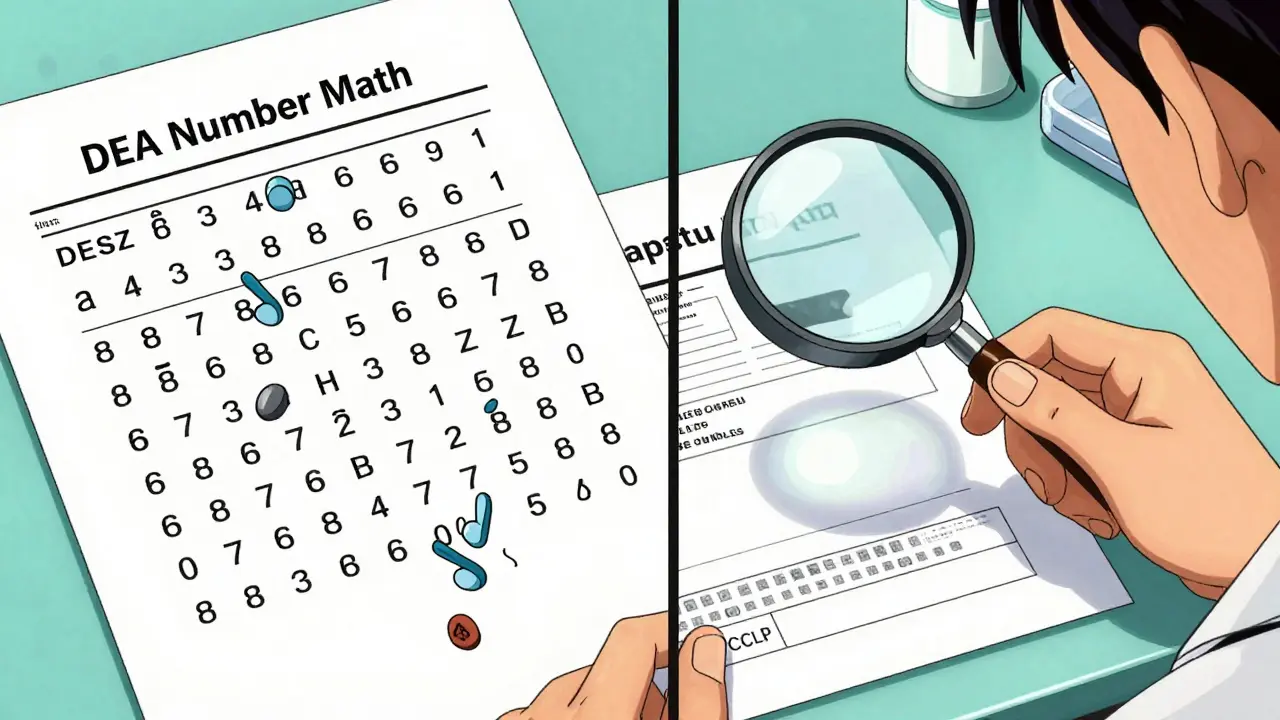
The DEA Number Math Trick
If you're staring at a handwritten script and the DEA Number looks fishy, you don't have to guess. There is a mathematical formula to validate these numbers that catches nearly 99% of invalid entries.- The Initial Check: Look at the second character of the DEA number. It must match the first letter of the prescriber's surname. If the doctor is Dr. Smith, that second character better be an 'S'.
- The Odd-Digit Sum: Add the 1st, 3rd, and 5th digits together.
- The Even-Digit Sum: Add the 2nd, 4th, and 6th digits together, then multiply that sum by 2.
- The Final Match: Add the results of Step 2 and Step 3. The last digit of this final total must match the 7th digit of the DEA number.
Comparing Verification Methods
Depending on where you work-a small independent shop or a giant chain-your tools will differ. Each method has a different failure rate.| Method | Common User | Error Rate | Main Advantage |
|---|---|---|---|
| Manual Review | Independent Pharmacies | High (~18.7%) | Direct physical examination |
| Electronic Systems | Chain Pharmacies | Very Low (<1%) | Speed and DSCSA integration |
| PDMP Review | State-mandated users | Variable | Real-time patient history |
Spotting Forgeries with Physical Cues
With the 2023 increase in forged scripts, you can't trust your eyes alone. Legitimate security paper has specific features that are hard to replicate. Look for microprinting that only becomes clear under a 10x magnifying glass. Check for the "Rx is void if more than ___ prescriptions" indicator and the specific asterisk-bordered fields for quantity and refills. If you see a prescription that looks like a photocopy or lacks these security markers, it's a major red flag. The DEA's 2023 National Drug Threat Assessment noted over 31,000 verified cases of forgeries, and most were caught by staff who noticed these small physical discrepancies.
The Multi-Factor Workflow
Industry experts, including former DEA directors, argue that relying on a single check is a recipe for disaster. Instead, use a "three-touchpoint" system:- Touchpoint 1: Technical validation (DEA number math and security paper check).
- Touchpoint 2: History check (PDMP review to ensure the patient isn't over-using).
- Touchpoint 3: Clinical validation (Checking quantities against CDC conversion factors and confirming the prescriber-patient relationship).
What happens if I dispense a controlled substance with the wrong quantity?
Beyond the immediate risk to the patient, you face severe legal consequences. Under 21 CFR § 1306.04, pharmacists are legally responsible for verification. This can lead to civil penalties of up to $758,574 per violation or criminal prosecution if the error is deemed a result of gross negligence or intentional diversion.
How do I handle illegible directions on a handwritten script?
Never guess. Roughly 68% of pharmacy staff report difficulty with handwritten scripts. The only safe protocol is to contact the prescriber's office directly for a verbal or electronic clarification. Document the conversation and the person who provided the clarification in your records.
Is the PDMP always up to date?
No. While 27 states have moved to "real-time" submission (under 5 minutes), many others allow 24-hour or even weekly windows. Always check your specific state's reporting requirements to know how much of a "blind spot" you might have in the patient's history.
What is the most reliable tool for verification?
The NABP's PMP InterConnect platform is highly rated for reducing verification time and consolidating data. However, no tool replaces a pharmacist's clinical judgment and the use of CDC conversion factors.
When are QR codes becoming mandatory for prescriptions?
The DEA announced in May 2024 that QR code verification will be required for all controlled substance prescriptions by 2026. This is part of a broader push toward interoperable electronic systems to eliminate forgeries.
Ken Baldridge
May 2, 2026 AT 07:07Man, that DEA math trick is an absolute lifesaver when you're staring at a script that looks like it was written by a toddler with a crayon
It's wild how some people just breeze through the verification and then panic when the DEA does a surprise audit and finds a discrepancy that could've been caught in ten seconds of basic arithmetic
Joel Bonstell
May 2, 2026 AT 10:50honestely the pressure is just insane these days... i've seen people literally shake while filling these scripts becuase they're so scared of one tiny mistake costing them there whole career. just take a breath and use the checklist
Kelly Feehely
May 3, 2026 AT 20:23Of course the DEA wants you using "electronic systems" now because it makes it way easier for the government to track every single pill in real-time and flag anyone they don't like
They tell you it's about "reducing errors" but it's actually just about total surveillance of the medical supply chain and squeezing pharmacists for every cent in fines
Andrew Hanssen
May 4, 2026 AT 07:03The insistence that a mathematical formula catches 99% of invalid entries is a statistically dubious claim that lacks a cited source in this text.
Spencer Farrell
May 5, 2026 AT 06:44One must contemplate the inherent fragility of a system that relies upon the meticulousness of a single human agent to prevent catastrophic legal failure
The dichotomy between the clinical necessity of the medication and the bureaucratic rigidity of the Federal Controlled Substances Act is truly a testament to the inefficiency of modern governance
Preety Singh
May 5, 2026 AT 22:30The lack of attention to the nuanced disparities between Schedule II and III scripts in the common discourse is simply exhausting
One would think the basic tenets of pharmaceutical jurisprudence would be common knowledge by now
princess lovearies
May 6, 2026 AT 20:46It's all about finding that balance between following the rules and actually caring for the patient's wellbeing
Seema Karanje
May 8, 2026 AT 19:41STOP MAKING EXCUSES FOR ERRORS! If you can't handle a simple seven-point checklist, get out of the pharmacy and let someone competent do the job! This is literally people's lives we are talking about!
Jimmy Crocker
May 9, 2026 AT 21:00I find it quite amusign that people think a mere table of conversion factors provides suffcient clinical oversight when in reality the pharmacological interaction profiles are far more complex than a simple numerical ratio as any truly erudite practitioner would realize though I spose most just follow the script without thinking
Kartik Agarwal
May 11, 2026 AT 01:39The MME (Morphine Milligram Equivalents) calculation is the real gold standard for clinical verification here
If you're not calculating the total daily MME, you're missing the bigger picture of opioid stewardship and risk stratification for the patient