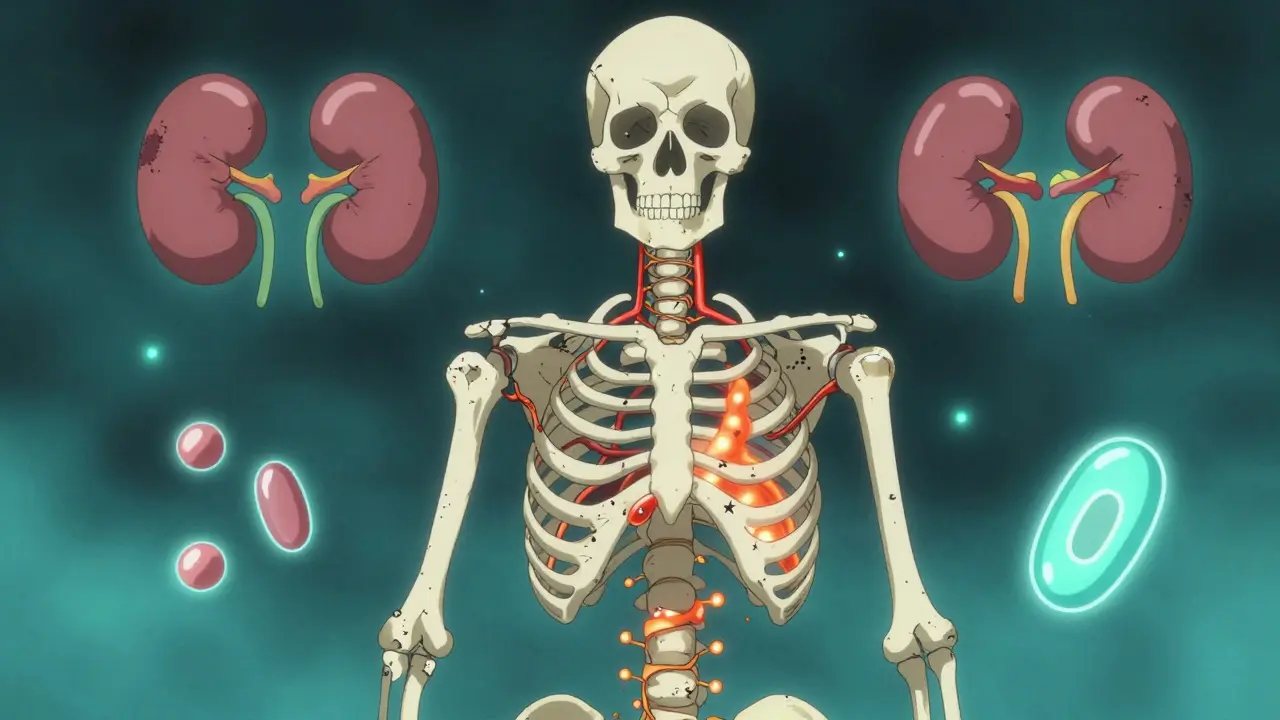
When your kidneys start to fail, they don’t just stop filtering waste. They also mess up your body’s balance of calcium, phosphate, and vitamin D - and that’s where things get dangerous. This isn’t just about bones. It’s about your heart, your blood vessels, and your entire skeleton. The condition is called CKD-MBD - Chronic Kidney Disease-Mineral and Bone Disorder. It affects 90% of people with Stage 3 to 5 kidney disease and nearly everyone on dialysis. And unlike simple osteoporosis, this isn’t just about getting older. It’s a system-wide breakdown that starts long before you feel any symptoms.
How Your Body Normally Manages Calcium and Phosphate
Your body keeps calcium and phosphate in perfect balance. Calcium builds bones and helps nerves and muscles work. Phosphate is needed for energy, cell repair, and bone strength. Normally, your kidneys help by filtering out extra phosphate. Your parathyroid glands (tiny organs in your neck) monitor blood calcium. If calcium drops, they release PTH - parathyroid hormone - which pulls calcium from bones and tells your kidneys to hold onto more of it. Your kidneys also turn vitamin D into its active form, calcitriol, which helps your gut absorb calcium from food.
But when kidney function drops below 60 mL/min (Stage 3 CKD), this system starts to unravel.
The Three-Part Breakdown: Phosphate, PTH, and Vitamin D
Here’s how CKD-MBD unfolds:
- Phosphate builds up. Your kidneys can’t flush it out. By Stage 4, most patients have phosphate levels above 4.5 mg/dL. High phosphate pulls calcium out of your blood, triggering more problems.
- Vitamin D activation fails. Damaged kidneys can’t convert vitamin D into calcitriol. Without it, your gut can’t absorb calcium - even if you eat enough. This leads to low blood calcium.
- PTH spikes. Low calcium and high phosphate tell your parathyroid glands to go into overdrive. They swell and pump out too much PTH. This is called secondary hyperparathyroidism. At first, it’s a fix - your body tries to restore calcium. But over time, it becomes part of the problem.
And here’s the twist: even with high PTH levels, your bones stop responding. This is called PTH resistance. Your bones don’t rebuild properly. Meanwhile, your arteries start to calcify - calcium deposits build up in your heart and blood vessels, making them stiff and brittle.
What Happens to Your Bones
CKD-MBD doesn’t just make bones weak - it changes how they’re made. Two main types show up in kidney patients:
- High turnover disease (osteitis fibrosa cystica): Seen in 20-30% of dialysis patients. PTH levels are sky-high (over 500 pg/mL). Bones are constantly being broken down and rebuilt, but unevenly. This leads to bone pain, fractures, and deformities.
- Low turnover disease (adynamic bone disease): Now the most common type - affecting 50-60% of dialysis patients. PTH is low (under 150 pg/mL). Bones aren’t being remodeled at all. They look fine on scans, but they’re brittle. Surprisingly, fracture risk is just as high.
And in 10-20% of cases, you get a mix of both. Bone biopsies are the gold standard to tell the difference - but they’re invasive. Most doctors rely on blood tests: PTH, bone-specific alkaline phosphatase (BSAP), and PINP (a marker of new bone formation) to guess what’s going on.

Why Your Heart Is at Risk
One of the scariest parts of CKD-MBD? It doesn’t stop at bone. Calcium and phosphate don’t just stick to your skeleton - they deposit in your arteries. By the time you’re on dialysis, 75-90% of patients have visible vascular calcification. Coronary artery calcification scores are 3-5 times higher than in healthy people. This isn’t just plaque. It’s actual hardening of the arteries.
Each 1 mg/dL rise in serum phosphate increases your risk of death by 18%. A 30% rise in PTH? That’s a 12% higher risk. And if your vitamin D level is below 20 ng/mL - which happens in 80-90% of CKD patients - your mortality risk jumps by 30%.
That’s why doctors don’t just look at one number. They look at the whole picture: calcium, phosphate, PTH, and vitamin D together. The calcium-phosphate product (Ca × P) is a key warning sign. If it’s over 55, your risk of calcification and death climbs sharply.
What Doctors Actually Do - And Don’t Do
Guidelines from KDIGO (Kidney Disease: Improving Global Outcomes) set clear targets:
- Calcium: 8.4-10.2 mg/dL
- Phosphate: 2.7-4.6 mg/dL (Stage 3-5), 3.5-5.5 mg/dL (dialysis)
- PTH: 2-9 times the upper limit of normal (varies by lab)
- Vitamin D (25-OH): At least 30 ng/mL
But here’s the catch: you can’t fix one without affecting the others.
Phosphate Control
Diet is the first line. Most patients need to limit phosphate to 800-1000 mg/day. That means avoiding processed foods, colas, and fast food - things with hidden phosphate additives. But it’s not enough. That’s where phosphate binders come in.
Calcium-based binders (like calcium carbonate or acetate) are cheap and common. But they can raise calcium levels too high - and make calcification worse. So doctors limit them to 1500 mg of elemental calcium per day. Non-calcium binders like sevelamer (800-7200 mg/day) or lanthanum carbonate (750-3000 mg/day) are safer for your arteries but cost more.
Vitamin D
Most CKD patients are deficient. But giving them active vitamin D (calcitriol or paricalcitol) is risky. It can spike calcium and phosphate. So doctors usually start with nutritional vitamin D - cholecalciferol (vitamin D3) at 1000-4000 IU/day. Studies show this lowers death risk by 15% without causing hypercalcemia. Active analogs are only used when PTH is over 500 pg/mL.
Calcimimetics - A Game Changer
For patients with severe hyperparathyroidism (PTH over 800 pg/mL), drugs like cinacalcet (30-180 mg/day) or the newer injectable etelcalcetide (15-45 mg weekly) can cut PTH by 30-45%. These drugs trick the parathyroid gland into thinking calcium is higher than it is - so it stops overproducing PTH. Crucially, they don’t raise calcium or phosphate like vitamin D analogs do.

The New Thinking: Start Early
Traditionally, doctors waited until Stage 4 or 5 to act. But new research shows CKD-MBD starts at Stage 3. FGF23 - a hormone made by bone cells - rises as early as GFR drops below 60 mL/min. It’s the body’s first warning sign. By Stage 4, FGF23 levels are 10-1000 times higher than normal. It suppresses vitamin D activation and makes your kidneys dump calcium. And as Klotho (a protein that helps FGF23 work) declines, the damage accelerates.
The 2024 KDIGO draft recommends annual vitamin D testing and phosphate checks every 6-12 months starting at Stage 3. That’s a major shift. We’re no longer treating a late-stage complication. We’re trying to stop it before it starts.
What’s on the Horizon
Researchers are now testing drugs that target the root causes:
- Anti-sclerostin antibodies (like romosozumab): These block a protein that stops bone formation. In early trials, they boosted bone density by 30-40% in Stage 3-4 CKD patients.
- Klotho supplementation: Animal studies show giving Klotho reduces artery calcification by 50-60% and improves bone strength. Human trials are coming.
- FGF23 inhibitors: Still experimental, but they could help break the cycle of phosphate retention and vitamin D suppression.
One thing’s clear: you can’t treat calcium without looking at phosphate. You can’t fix PTH without addressing vitamin D. And you can’t protect your bones without protecting your heart.
Is CKD-MBD the same as osteoporosis?
No. Osteoporosis is mainly about bone loss due to aging or hormonal changes. CKD-MBD is a systemic disorder caused by kidney failure. It affects not just bone turnover but also causes vascular calcification, abnormal bone mineralization, and resistance to parathyroid hormone. Fracture risk is higher in CKD-MBD, even when bone density looks normal.
Can I fix CKD-MBD by taking calcium supplements?
Not safely. Extra calcium can worsen vascular calcification, especially if phosphate is high. Calcium supplements are rarely recommended unless you have severe low calcium and no other options. Phosphate control and vitamin D correction come first. Always check with your nephrologist before taking any calcium-containing supplements.
Why do I need to avoid colas and processed foods?
Many processed foods and drinks - especially colas, energy drinks, and fast food - contain added phosphate (phosphoric acid or phosphate preservatives). These are absorbed almost completely by your gut, unlike phosphate in natural foods. Your kidneys can’t handle the extra load. Avoiding them is one of the most effective ways to control phosphate levels.
Does vitamin D supplementation help people on dialysis?
Yes - but only if it’s nutritional vitamin D (cholecalciferol), not active forms like calcitriol. Studies show that correcting low vitamin D levels (below 30 ng/mL) with daily cholecalciferol reduces death risk by 15% and doesn’t raise calcium or phosphate. Active vitamin D analogs are only used in severe cases of high PTH because they carry more risk.
How often should my calcium and phosphate be checked?
For Stage 3-4 CKD: every 6-12 months. For Stage 5 or dialysis: every 1-3 months. PTH and vitamin D should be checked at least twice a year. If you’re on phosphate binders or calcimimetics, your doctor may test more often. The goal isn’t to hit perfect numbers - it’s to avoid wild swings.
Bottom Line
CKD-MBD isn’t a single problem. It’s a cascade - phosphate rises, vitamin D drops, PTH surges, bones weaken, arteries harden. You can’t fix one piece without fixing the others. The best approach? Start early, monitor closely, and treat the whole system - not just the numbers. Diet, binders, vitamin D, and calcimimetics all have a role. But the real win? Keeping phosphate low, avoiding unnecessary calcium, and making sure vitamin D isn’t just normal - it’s sufficient. Because in kidney disease, what happens in your bones doesn’t stay in your bones.
Byron Boror
March 12, 2026 AT 10:36Lorna Brown
March 14, 2026 AT 05:00Rex Regum
March 14, 2026 AT 21:15Kelsey Vonk
March 15, 2026 AT 16:27Emma Nicolls
March 15, 2026 AT 16:27Jimmy V
March 16, 2026 AT 10:36Richard Harris
March 17, 2026 AT 09:22Kandace Bennett
March 18, 2026 AT 00:20Tim Schulz
March 19, 2026 AT 10:44Jinesh Jain
March 19, 2026 AT 19:46douglas martinez
March 20, 2026 AT 19:45Sabrina Sanches
March 21, 2026 AT 23:02