
Medication Decision Readiness Checker
Before starting a new medication, use this checklist to see if you and your provider have completed the Shared Decision-Making process. If you miss any points, you may want to ask for a Patient Decision Aid (PDA).
💡 Pro Tip:
If your score is below 100%, ask your doctor: "Is there a validated decision aid we can look at together to help me understand these options better?"
Imagine sitting in a doctor's office and being told you need to start a powerful new medication. The doctor explains the benefits and mentions some side effects, but as soon as you leave the room, the anxiety kicks in. Do you actually understand the risks? Is this the right choice for your specific lifestyle? For decades, this was the standard experience: a provider gives a recommendation, and the patient nods along, even if they are confused. This gap in communication is where many medication errors begin.
To bridge this gap, healthcare has shifted toward Patient Decision Aids is a set of evidence-based tools designed to help people make specific and deliberated choices between treatment options by providing balanced information on risks, benefits, and probabilities. Also known as PtDAs or PDAs, these tools move us away from the "doctor knows best" model and toward a partnership. When patients are truly informed, they don't just follow orders-they make choices that align with their own values, which drastically improves safety and adherence.
| Feature | Standard Care (Verbal/Brochures) | Patient Decision Aids (PDAs) |
|---|---|---|
| Information Balance | Often skewed toward provider preference | Strictly balanced via IPDAS standards |
| Patient Knowledge | Baseline understanding | Average increase of 13.28 points in tests |
| Decisional Conflict | Higher anxiety and uncertainty | Reduced by avg. 8.7 points on conflict scales |
| Value Clarification | Rarely addressed systematically | Structured exercises to define patient goals |
The Science of Shared Decision-Making
At the heart of these tools is Shared Decision-Making, a process where clinicians and patients work together to make healthcare choices. It's not just about giving a patient a pamphlet; it's about a structured dialogue. The framework for this is governed by the IPDAS Collaboration, which provides a global set of standards to ensure these aids aren't just marketing materials for a specific drug, but are scientifically neutral.
The impact on medication safety is measurable. According to research from the NCBI, patients using these aids show involvement scores that are over 22 points higher on the OPTION scale than those receiving usual care. Why does this matter for safety? When a patient understands exactly why they are taking a drug and what the "red flag" side effects are, they are far more likely to spot a problem early and report it, preventing a minor side effect from becoming a hospital visit.
How PDAs Actually Prevent Medication Errors
Medication errors aren't always about the wrong pill being dispensed; often, they are errors of "misalignment"-where a patient stops a life-saving drug because they weren't warned about a common side effect, or they take a drug they don't actually need because they misunderstood the risk. Medication Adherence is a primary target here. For example, in diabetes care, the use of decision aids has been linked to a 17.3% increase in adherence over six months.
Consider a real-world scenario: a patient is told they have a "high risk" of heart disease and should start a statin. Without a tool, the patient might feel pressured and start the medication, then quit two weeks later when they feel muscle aches, not knowing if this is normal or a danger sign. Using a tool like "Statin Choice," that same patient can see their actual 10-year cardiovascular disease (CVD) risk-perhaps it's actually 7.2%-and decide if the benefits outweigh the potential side effects. In fact, about 35% of patients change their initial preference after using such an aid, leading to a decision they are actually likely to stick with.
Digital Evolution and EHR Integration
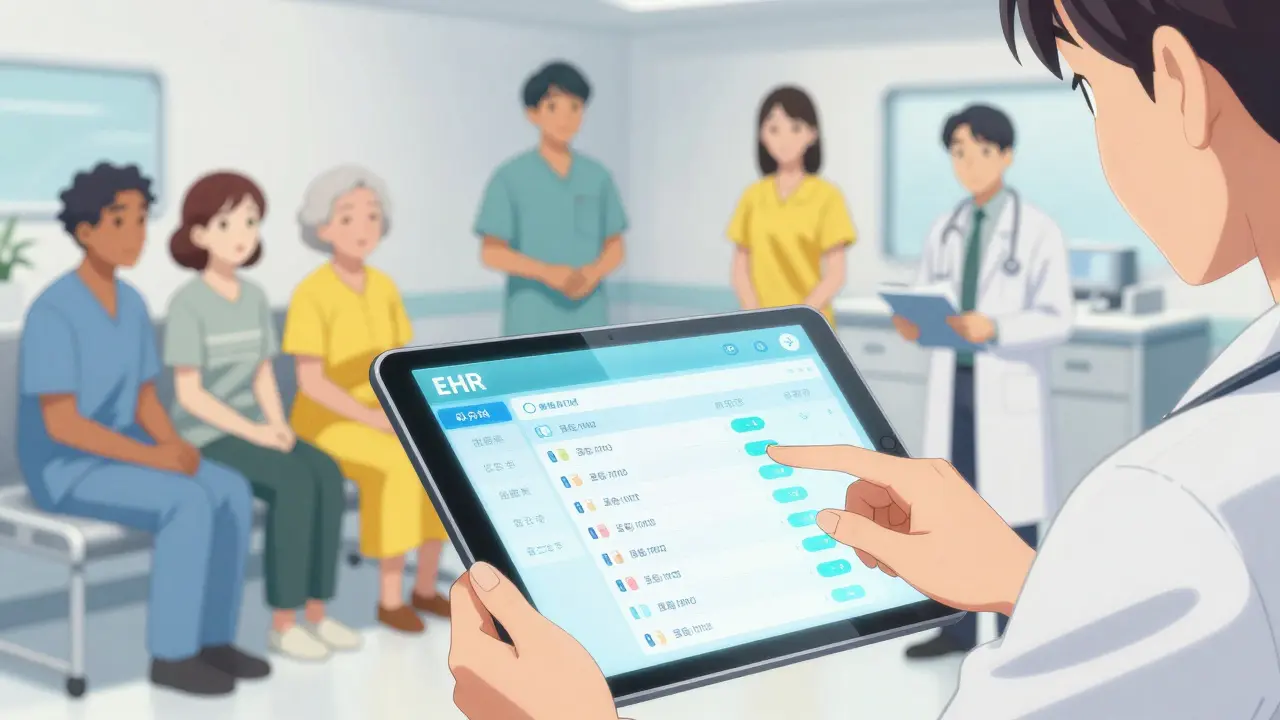
We've moved far beyond paper handouts. Modern PDAs are increasingly digital, with about 78% now featuring interactive risk calculators. The real game-changer, however, is the shift toward Electronic Health Records (EHR) integration. Since 2015, the number of aids designed to plug directly into a patient's digital chart via FHIR APIs has jumped from 22% to 65%.
This integration allows for a "personalized medication decision support system." Instead of a generic tool, the system can pull the patient's current labs, age, and comorbidities to suggest a tailored set of options. For the clinician, this means the data is already there; for the patient, it means the information is relevant to their specific body, not just a general population.

Overcoming the 'Time Crunch' in the Clinic
If these tools are so effective, why isn't every doctor using them? The biggest hurdle is time. A typical clinical trial (NCT01029288) found that using a PDA adds about 3 to 8 minutes to a consultation. In a world where some primary care visits are only 15 minutes long, that's a significant chunk of the appointment.
However, successful clinics have found a workaround: pre-visit distribution. By sending the digital decision aid to the patient via a portal before the appointment, the "homework" is done. The patient arrives with their values clarified and their questions written down. This transforms the appointment from an information-dumping session into a focused decision-making meeting. When implemented this way, the time burden on the doctor actually decreases because the patient is more prepared.
Addressing the Literacy Gap
One critical caveat is that not all patients benefit equally. There is a risk of "information overload," particularly for elderly patients or those with low health literacy. A tool that works for a tech-savvy 40-year-old might be intimidating for an 80-year-old with limited English proficiency. This is where the "human" element of shared decision-making is irreplaceable.
High-performing clinics mitigate this by using the "teach-back" method-asking the patient to explain the decision back to the provider in their own words. This ensures that the PDA served as a bridge to understanding, not a barrier of complex jargon. Without these adaptations, the most vulnerable populations can actually be left further behind, creating a gap in medication safety.
The Future of Informed Prescribing
We are seeing a massive shift in how healthcare is funded and regulated. In the U.S., 29 states have already enacted legislation supporting the use of decision aids. Even the CMS has started including shared decision-making as a quality metric for Medicare Advantage plans. This means that using these tools is moving from a "nice-to-have" to a standard of care.
By 2027, experts predict that 75% of high-stakes medication decisions will involve a validated decision aid. We are moving toward a future where the prescription pad is only the final step of a long, transparent process. When the patient owns the decision, the risk of error drops, and the quality of life improves.
What exactly makes a decision aid "validated"?
A validated aid typically follows the IPDAS (International Patient Decision Aids Standards) criteria. This means it doesn't just provide a list of drugs, but offers balanced information on benefits and risks, presents probabilities of outcomes, and includes exercises to help patients clarify their personal values. If it's not balanced, it's a brochure, not a decision aid.
Do these tools actually improve clinical outcomes like mortality?
This is a point of ongoing debate. While there is overwhelming evidence that PDAs improve knowledge, reduce anxiety, and increase medication adherence (e.g., a 17.3% boost in diabetes med adherence), some researchers note that we still lack definitive, large-scale data proving they consistently reduce hard clinical endpoints like mortality across all conditions. However, improving adherence and reducing errors are strong proxies for better health.
Can PDAs be used in emergency settings?
Generally, no. PDAs are designed for "preference-sensitive" decisions-situations where there is no single "right" answer and the patient's values should drive the choice. In emergency or acute distress settings, the priority is immediate stabilization, and the deliberative process required for a PDA isn't practical or appropriate.
Where can clinicians find a library of these tools?
The Ottawa Hospital Research Institute's Decision Aids Library is one of the most comprehensive resources, offering over 100 condition-specific tools that have been vetted for quality and neutrality.
How do digital PDAs protect patient privacy?
Professional-grade digital PDAs are built to meet HIPAA compliance standards for data protection. When integrated into EHRs, they use secure protocols like FHIR APIs to ensure that sensitive health information is transmitted and stored according to strict legal and medical privacy regulations.
Next Steps for Implementation
If you are a healthcare provider looking to integrate these tools, start small. Pick one preference-sensitive area-like statin therapy or diabetes management-and trial a validated aid for two weeks. To avoid the time-crunch, send the tool to your patients 48 hours before their visit.
For patients, don't be afraid to ask your provider: "Is there a decision aid or a tool we can use to look at the pros and cons of this medication together?" Your health literacy is a tool in itself; the more you ask for the data, the safer your treatment journey becomes.
Ajinkya Joshi
April 25, 2026 AT 10:28Oh sure, because giving a patient a fancy interactive calculator will definitely solve the issue of doctors being overworked and underpaid. I'm sure the 3-8 extra minutes per patient will be totally welcomed by the staff who are already drowning in paperwork. Pure fantasy.
Rick Brewster
April 27, 2026 AT 03:26one must ponder if the actual quantified data serves as a mere veil for the systemic erosion of clinical intuition which was once the bedrock of the healing arts though i suppose in this age of digital sterility we prefer the comfort of a chart over the nuance of a human gaze however the integration of fhir apis is simply a technocratic bandaid on a gaping wound of institutional apathy
Chidi Prosper
April 28, 2026 AT 04:38The shift to shared decision-making is absolutely the right move. If patients don't feel ownership of the treatment, they just won't stick with it. Integration into EHRs is the only way to make this scalable in the real world.
Sarah Watters
April 28, 2026 AT 10:51Balanced information? Please. These "validated" standards are just another way for big pharma to control the narrative through a digital interface. They just want us dependent on their software and their pills while pretending to give us a choice. It's all a scripted game to keep the profit margins high and the population compliant.
Anantha Lakshmi
April 29, 2026 AT 06:22What a wonderful way to bridge the gap between doctors and patients! 🌈 I really believe that when we lead with empathy and clear communication, everyone wins. This is exactly the kind of progress we need for global health equity! 🌸💪
Divyanshu Giri
April 30, 2026 AT 20:25totally awesome stuff this is just a win win for everyone involved and makes the whole process feel like a team effort instead of a lecture
Olayinka Ibukunoluwa Mercy
May 2, 2026 AT 02:50I completely agree that we must protect the most vulnerable!!! 💖 The teach-back method is so essential for ensuring no one is left behind in this digital transition... we must be mindful of our elders!!! 👵🙏✨
Dan Wizard
May 3, 2026 AT 12:32I find it quite fascinating how the transition to digital tools might actually reshape the psychological contract between a physician and their patient over time, especially considering that the pre-visit distribution of these aids effectively moves the cognitive load from the clinic to the home environment, which could potentially lead to more thoughtful discussions but might also alienate those who lack a stable home internet connection.
Ally Warren
May 4, 2026 AT 23:21The paradox of choice is ever-present here. While we strive for autonomy through these aids, we are essentially quantifying human suffering and recovery into percentage points. There is a certain irony in using a rigid, standardized tool to facilitate a 'personal' and 'flexible' decision process. It's an attempt to systematize the unsystematic nature of human values.