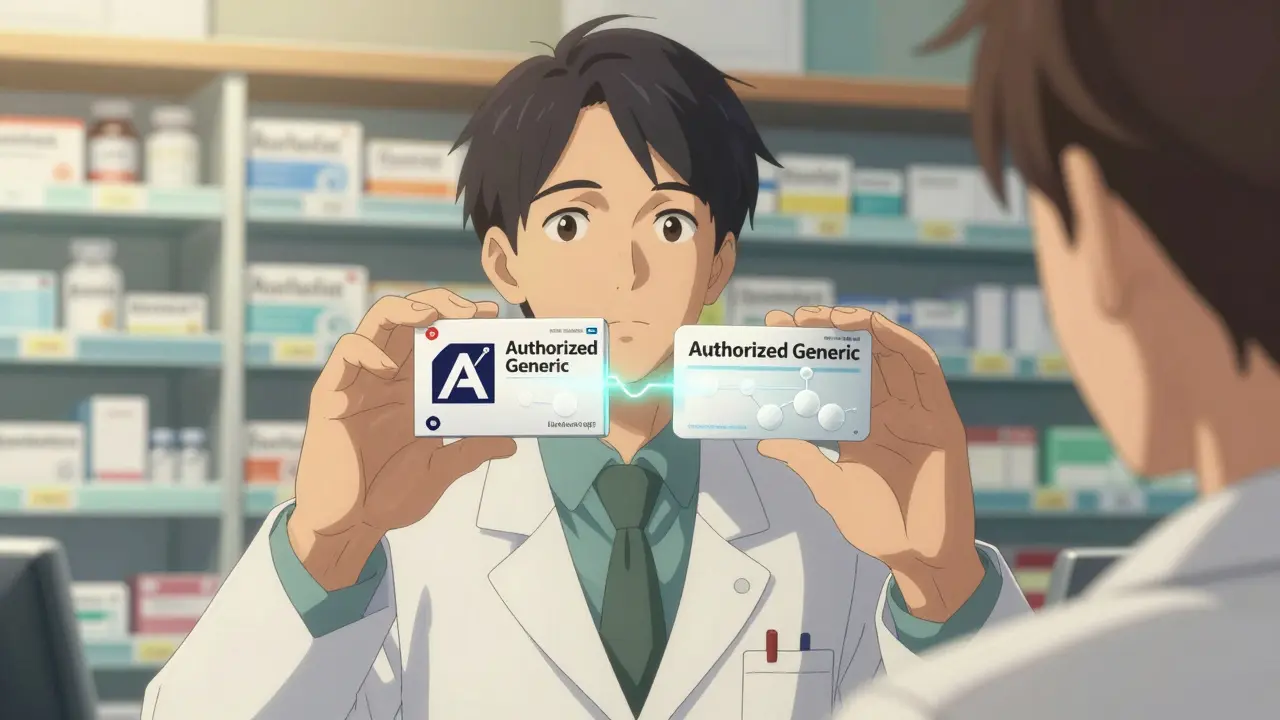
When a patient walks into your pharmacy with a prescription for a brand-name drug, you have more options than just the branded version or a regular generic. One of the most overlooked-but often safest-alternatives is the authorized generic. It’s not just another generic. It’s the exact same pill, made by the same company that made the brand, just without the fancy label. And knowing when to recommend it can make a real difference in patient safety, adherence, and cost.
What Exactly Is an Authorized Generic?
An authorized generic is not a copy. It’s the original drug, produced by the brand-name manufacturer, but sold under a different name and packaging. Think of it like a car made by Toyota, but sold under a different dealership brand-same factory, same parts, same quality. The FDA defines it clearly: it’s a listed drug approved under the same application as the brand, with identical active and inactive ingredients. The only differences? The color, shape, or markings on the pill, and the label on the bottle.
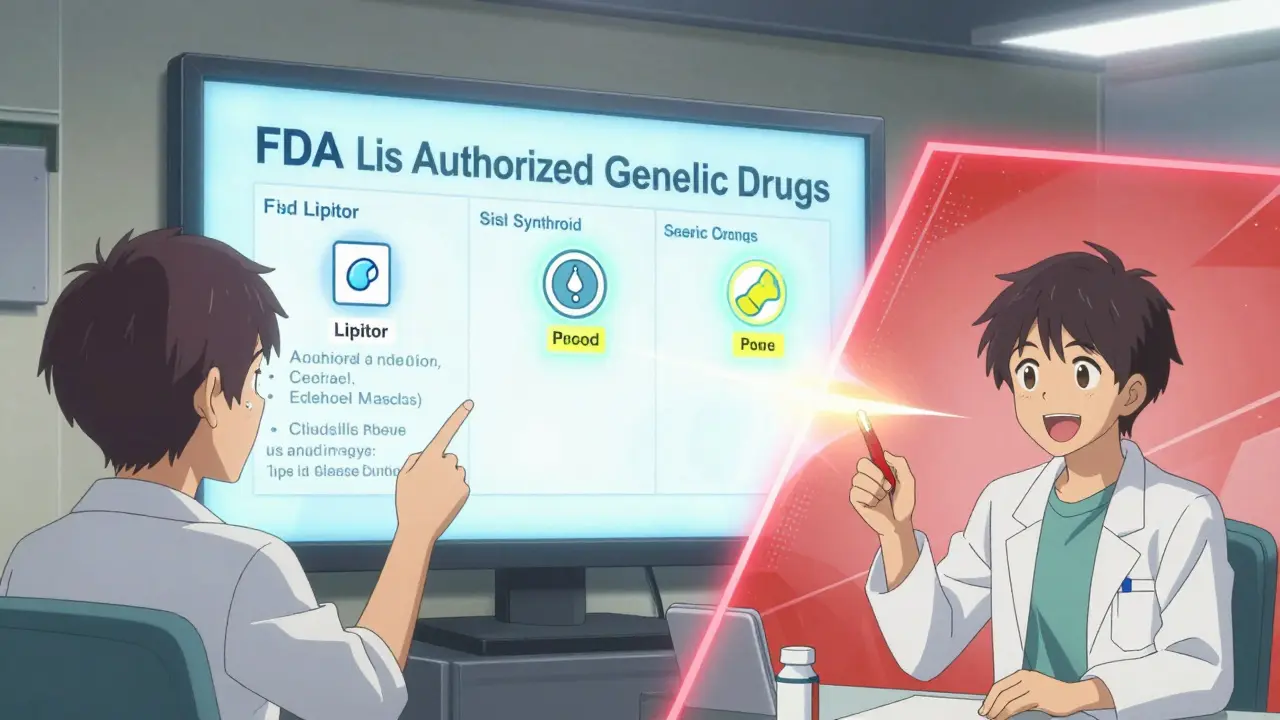
Unlike regular generics, which must prove bioequivalence through testing, authorized generics skip that step because they’re literally the same product. The FDA requires manufacturers to list these in a quarterly public database. As of September 2023, there were 257 authorized generics on the list-about 5% of all brand-name drugs with generic alternatives. Most are oral tablets or capsules, with common examples including versions of Lipitor, Synthroid, and Prozac.
When Should You Recommend an Authorized Generic?
Not every patient needs one. But there are three clear situations where an authorized generic isn’t just a good idea-it’s the best choice.
1. When the patient has allergies or dietary restrictions. Regular generics often use different fillers, binders, or coatings. A patient with celiac disease might be fine with the brand-name drug because it’s gluten-free, but the generic version could contain wheat starch. Same goes for lactose intolerance, gelatin (for vegans or those with religious restrictions), or dye allergies. Authorized generics avoid this risk entirely because they use the exact same inactive ingredients as the brand. If a patient says, “I’ve never had a problem with the blue pill,” and the authorized generic is the blue pill without the brand name, that’s your cue.
2. For narrow therapeutic index (NTI) drugs. These are medications where even tiny changes in blood levels can cause serious problems. Think warfarin, levothyroxine, phenytoin, or cyclosporine. Studies show that switching from brand to regular generic in these cases can lead to therapeutic failure or toxicity in 3-5% of patients. Why? Because bioequivalence testing doesn’t always capture real-world differences in absorption, especially with modified-release formulations. Authorized generics eliminate this uncertainty. They’re not just close-they’re identical. For patients on these drugs, the authorized generic is the only substitution you should consider.
3. When a patient reports side effects or reduced effectiveness after switching. A 2021 survey of 1,200 community pharmacists found that 12% of patients experienced unexpected issues after switching to a regular generic. These aren’t just placebo effects. Patients report new nausea, dizziness, or worsening symptoms. Often, it’s due to differences in inactive ingredients affecting how the drug is absorbed. In these cases, switching to the authorized generic can restore stability. Don’t dismiss the patient’s experience. Ask: “Was the pill you were taking before the same color and shape as the new one?” If yes, and the brand-name version was well tolerated, the authorized generic is the logical next step.
How to Spot an Authorized Generic
You can’t tell by looking at the pill. But you can find out with two simple tools.
First, check the FDA’s List of Authorized Generic Drugs, updated every three months. It lists the brand name, the manufacturer, and the authorized generic’s labeler code. If the labeler code matches Pfizer, Merck, or another brand-name company-not a generic-only firm like Teva or Mylan-it’s an authorized generic.
Second, look at the National Drug Code (NDC). The authorized generic will have the same active ingredient, strength, and dosage form as the brand. But the labeler code (the first part of the NDC) will be the same as the brand’s. For example, if the brand’s NDC starts with 00004 (Pfizer), the authorized version might start with 00004 too, not 00143 (a generic manufacturer).
Also, remember: authorized generics often launch after the first generic enters the market. So if the brand just lost exclusivity and you see a new generic version, wait a few months. The authorized version may appear soon after-and it’s more reliable.
What About Cost?
Authorized generics usually cost 20-80% less than the brand-name drug. That’s similar to the savings you’d get from a regular generic. But here’s the catch: insurance plans don’t always treat them like generics.
A 2022 study found that 63% of pharmacy benefit managers (PBMs) put authorized generics in the brand-name tier for billing purposes. That means a patient might pay more out-of-pocket for the authorized generic than for a regular generic-even though it’s the same medication. Always check the patient’s formulary. If the authorized generic is priced like a brand, it might not be worth the switch unless the patient has a medical reason to avoid regular generics.
Still, even if the cost isn’t lower, the safety advantage often makes it worth it. For patients on long-term meds, especially those with complex conditions, avoiding a potential reaction is priceless.
What You Need to Tell the Patient
Patients get confused when their pill looks different. A 2022 study showed that 27% of patients stopped taking their medication after a change in appearance-unless they were properly counseled. Only 8% stopped when the change was explained.
So here’s what to say: “This pill is made by the same company that makes [Brand Name]. It has the exact same ingredients, the same strength, and the same effect. The only difference is the label and the color. It’s cheaper, and it’s just as safe.”
For patients with chronic conditions, write it down. Give them a note: “This is the same medicine as your previous [Brand Name], just without the brand name on the bottle.”
And always confirm: “You were on [Brand Name] before, right? No issues? Then this is exactly what you’re used to.”
Legal and Documentation Notes
In most states, you can substitute an authorized generic without the prescriber’s permission-unless the script says “do not substitute.” But 18 states require you to notify the prescriber anytime you switch to any generic, including authorized ones. Check your state’s rules.
Document everything. Use the correct modifier code (like ‘DA’ for drug substitution) on claims. Keep a record of the NDC and labeler code. If there’s ever a question later, you’ll be covered.
Limitations to Keep in Mind
Not every drug has an authorized generic. Only about 5% of brand-name medications do. And while they’re generally safe, rare cases exist where the manufacturer made minor changes to the formulation when launching the authorized version. The FDA usually discloses these, so always double-check the list.
Also, packaging can vary. Some authorized generics come in blister packs, others in bottles. If the patient was used to a specific pill organizer or dosing system, make sure the new version fits.
And remember: authorized generics don’t appear in the Orange Book as separate entries. That means you can’t rely on the Orange Book’s therapeutic equivalence ratings. You need to go straight to the FDA’s authorized generic list.
The Future of Authorized Generics
More are coming. The number of authorized generics has grown by 18% per year since 2010. Consumer searches for them are up 47% since 2021. Pharmacists are starting to recognize their value, and professional groups like the American Pharmacists Association are preparing new guidelines for 2024.
As healthcare shifts toward value-based care, your role as a medication expert becomes even more critical. You’re not just filling prescriptions-you’re preventing avoidable hospitalizations, improving adherence, and cutting unnecessary costs. Recommending authorized generics when appropriate is one of the quietest, most powerful tools in your toolkit.
Are authorized generics the same as regular generics?
No. Regular generics contain the same active ingredient as the brand but may use different inactive ingredients like fillers, dyes, or coatings. Authorized generics are made by the original brand manufacturer and contain identical active and inactive ingredients. They’re not a copy-they’re the same drug, just sold under a different name.
Why do authorized generics cost less than brand-name drugs?
They cost less because they don’t carry the marketing, advertising, or R&D costs of the brand. The manufacturer already recouped those costs when the brand was sold. The authorized generic is simply a rebranded version of the same product, so the savings are passed on to the patient-usually 20-80% less than the brand.
Can I substitute an authorized generic without checking with the prescriber?
In most cases, yes-if the prescription doesn’t say “dispense as written” or “no substitution.” But 18 U.S. states require pharmacists to notify the prescriber whenever any generic substitution is made, including authorized generics. Always check your state’s pharmacy laws before substituting.
How do I know if a drug has an authorized generic?
Check the FDA’s quarterly updated List of Authorized Generic Drugs on their website. You can also look at the National Drug Code (NDC). If the labeler code matches the brand-name manufacturer (e.g., Pfizer, Merck), it’s an authorized generic. Regular generics will have a labeler code from a different company.
Why do some insurance plans charge more for authorized generics?
Some pharmacy benefit managers (PBMs) classify authorized generics under the brand-name tier in their formularies-even though the drug is identical. This means patients may pay more out-of-pocket than they would for a regular generic. Always verify the patient’s plan coverage before recommending an authorized generic to avoid unexpected costs.
Milad Jawabra
March 4, 2026 AT 16:03This is gold. Seriously, I’ve been pushing authorized generics for years and half the pharmacists I work with still think they’re just ‘another generic.’
Just last week, a 72-year-old with atrial fibrillation switched from brand-name warfarin to a regular generic and ended up in the ER with a bleeding ulcer. Turned out the generic had a different filler that messed with her absorption.
She’s on the authorized version now-same pill, same color, same damn thing. No more trips to the hospital. Saved her $120 a month too.
Stop treating them like second-class options. They’re not ‘alternatives.’ They’re the original. Period.
And yeah, I use emoticons sometimes. 😎
Mariah Carle
March 5, 2026 AT 21:27It’s funny how we treat medication like it’s a personality trait-‘I trust the blue pill.’
But here’s the truth: we’re not prescribing pills. We’re prescribing identity.
That blue pill? It’s not medicine. It’s a ritual. A daily anchor in a world that’s always changing.
So when we swap it out for something ‘identical’… we’re not changing a dosage. We’re breaking a covenant.
And yes, authorized generics are chemically the same.
But the soul of the medicine? That’s not in the NDC code.
It’s in the patient’s belief.
And belief? That’s not FDA-regulated. 😊
Raman Kapri
March 6, 2026 AT 15:29The premise of this article is fundamentally flawed.
It assumes that identical chemical composition equals identical clinical outcome.
But bioequivalence is not a binary condition-it’s a spectrum.
Even minute differences in dissolution profiles can alter pharmacokinetics in elderly patients with reduced gastric motility.
Furthermore, the FDA’s database is not comprehensive-many authorized generics are not listed due to regulatory loopholes.
Also, the claim that 12% of patients experience adverse effects after switching is statistically dubious without a control group.
And you cite a 2021 survey? That’s anecdotal, not evidence-based.
Pharmacists are not physicians. We should not be making therapeutic substitution decisions without clinical oversight.
End of discussion.
Tildi Fletes
March 7, 2026 AT 16:53As a clinical pharmacist with over 22 years of experience, I cannot overstate the importance of this topic.
Authorized generics represent one of the most underutilized tools in medication safety.
I routinely counsel patients on NTI drugs-particularly levothyroxine and phenytoin-and consistently see improved TDM (therapeutic drug monitoring) outcomes when switching from regular generics to authorized versions.
One case: a 68-year-old male with epilepsy. After switching to a regular generic, his phenytoin levels dropped from 14.8 to 9.2 mcg/mL. Switched to authorized generic-back to 14.5. No other changes.
Documentation is key. Always note the NDC and labeler code. Always confirm with the patient.
And yes-insurance misclassification remains a systemic issue. Advocate for your patient. They’re counting on you.
Siri Elena
March 9, 2026 AT 00:02Oh honey, you’re telling me the *same pill* with a different label costs less… and somehow insurance still charges brand prices?
That’s not a system. That’s a joke.
It’s like buying the exact same avocado from the same farm, but the one with the fancy sticker costs more.
And now I’m supposed to be impressed that we’re ‘saving lives’ by recommending the *unbranded* version of the *same thing*?
Meanwhile, Big Pharma is laughing all the way to the bank while we fight over pill colors.
Just give me the blue one. I’ll take the brand. I don’t care about the price-I care about not being gaslit by my pharmacy. 💅
Pankaj Gupta
March 9, 2026 AT 02:18I appreciate the thoroughness of this post and the emphasis on patient safety.
However, I would like to offer a nuanced perspective: while authorized generics are indeed chemically identical to brand-name products, the perception of difference among patients remains a significant barrier to adherence.
Studies in behavioral psychology consistently show that patients associate visual cues-such as pill color, size, and imprint-with therapeutic efficacy.
Therefore, even when substitution is clinically safe, the psychological impact must be addressed through clear, consistent, and empathetic communication.
Additionally, the FDA’s database, while authoritative, is not always accessible to frontline pharmacists due to technical barriers.
Perhaps a more integrated EHR-based alert system could help bridge this gap.
Thank you for raising awareness on this critical issue.
Alex Brad
March 9, 2026 AT 10:32Same pill. Different label. Cheaper. Recommend it. That’s it.
No fluff. No philosophy. Just do the right thing.
Patients don’t need a lecture. They need a clear explanation and a pill they can trust.
Do your job. Save money. Prevent harm.
Simple.
Renee Jackson
March 9, 2026 AT 21:54Thank you for this comprehensive and vital overview.
As a pharmacist serving a predominantly geriatric population, I can attest to the profound impact authorized generics have on adherence and clinical outcomes.
One of my patients, an 84-year-old widow with Parkinson’s, had been on a brand-name carbidopa-levodopa for over a decade. After switching to a regular generic, she began experiencing increased tremors and nausea-symptoms she had not experienced in years.
Upon switching to the authorized generic, her symptoms resolved within 72 hours.
She now carries a laminated card in her wallet that reads: ‘This is the same as my old pill. Just no brand name.’
Documentation, communication, and compassion are not optional-they are the foundation of pharmaceutical care.
Let us continue to elevate our profession through evidence, integrity, and unwavering patient advocacy.