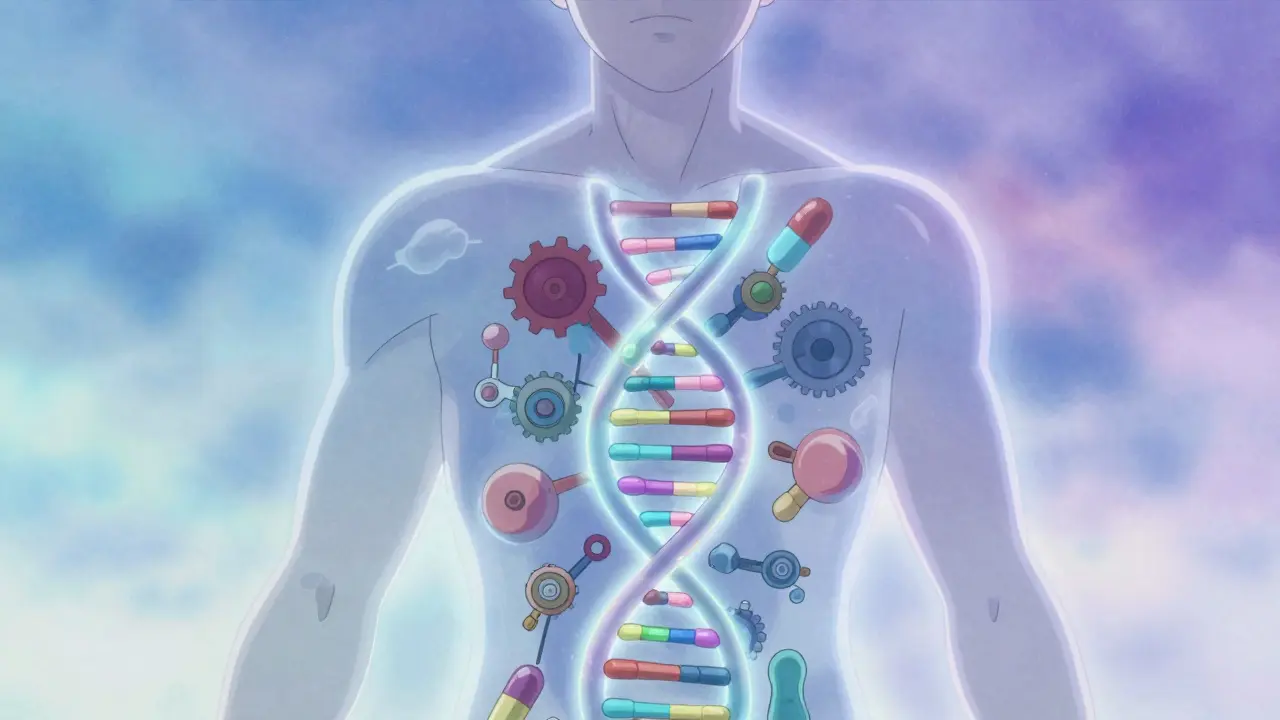
Pharmacogenomics Drug Metabolism Checker
CYP2D6
~25% of drugs
CYP3A4
Statins & immunosuppressants
CYP2C9/2C19
Blood thinners
TPMT
Chemotherapy drugs
Have you ever taken a medication that worked wonders for your friend but left you feeling sick or ineffective? You aren't imagining things. The 'one-size-fits-all' approach to prescribing drugs is failing millions of people every year. Approximately 70% of adverse drug reactions in the United States are preventable, yet they still cause 1.3 million emergency room visits annually. The reason often lies not in the drug itself, but in how your unique body processes it.
This is where pharmacogenomics comes in. It is the study of how an individual's genetic makeup affects their response to medications. By combining pharmacology and genomics, this field helps healthcare providers select medications and dosages predicted to work best for each person. It moves medicine away from trial-and-error guessing toward precise, evidence-based treatment.
How Your Genes Control Drug Metabolism
To understand why some drugs fail, we need to look at pharmacokinetics-how your body absorbs, distributes, metabolizes, and eliminates pharmaceuticals. Genetic variations in drug-metabolizing enzymes account for about 95% of clinically actionable findings in this field. Think of these enzymes as factory workers processing raw materials. If a worker is too slow, the material piles up (toxicity). If they are too fast, the material disappears before it can do its job (inefficacy).
The primary workers here are the cytochrome P450 enzyme family. These enzymes metabolize 70-80% of all clinically used medications. The most significant ones include:
- CYP3A4: Handles a vast array of drugs including statins and immunosuppressants.
- CYP2D6: Metabolizes approximately 25% of common drugs, including beta-blockers, antidepressants, and opioids.
- CYP2C9 and CYP2C19: Crucial for blood thinners like warfarin and antiplatelet drugs like clopidogrel.
Your DNA determines which version of these enzymes you have. For example, with CYP2D6, you might be classified as a poor metabolizer, extensive metabolizer, intermediate metabolizer, or ultra-rapid metabolizer. An ultra-rapid metabolizer of codeine converts it to morphine so quickly that it can lead to dangerous respiratory depression, even at standard doses. A poor metabolizer might take a painkiller and feel nothing because their body cannot activate the drug.
Beyond Enzymes: Transporters and Phase II Pathways
Enzymes are not the only players. Phase II enzymes also play critical roles in detoxification. One key example is TPMT (thiopurine S-methyltransferase). This enzyme processes thiopurine chemotherapy drugs. About 0.3% of Caucasians have a deficiency in TPMT. If a patient with this deficiency receives standard chemotherapy, they can suffer life-threatening toxicity, including severe bone marrow suppression. Genetic testing for TPMT before starting treatment prevents this entirely.
Drug transporters are another vital component. Proteins like OATP1B1 and BCRP control how medications move between different compartments in your body. Variants in the SLCO1B1 gene, which codes for OATP1B1, can increase the risk of simvastatin-induced muscle damage (myopathy) by 4.5 times in homozygous carriers. Understanding these transport mechanisms ensures that drugs reach their target tissues without accumulating in harmful places.

Clinical Impact: Real-World Benefits
The shift from traditional prescribing to pharmacogenomic-guided therapy offers measurable advantages. A 2022 meta-analysis published in JAMA involving 1,838 patients showed that using genetic data to guide antidepressant therapy increased remission rates by 26.9%. Patients went from a 39.3% chance of remission to 66.2%, while side effects dropped by nearly 30%.
In cardiology, the impact is equally stark. For patients taking warfarin, incorporating CYP2C9 and VKORC1 genotypes reduces the time to reach a therapeutic INR (blood clotting level) by 2.3 days. More importantly, it decreases major bleeding events by 31% during the first month of treatment. This is crucial because the first few weeks on blood thinners are when complications are most likely to occur.
| Feature | Traditional Approach | Pharmacogenomic Approach |
|---|---|---|
| Method | Trial and error | Genetic-based selection |
| Adverse Reactions | Higher risk (approx. 30% of patients) | Reduced by up to 30% |
| Time to Efficacy | Weeks to months | Days to weeks |
| Cost Efficiency | High due to failed trials | Savings of ~$1,200 per patient annually |

Barriers to Implementation
Despite the clear benefits, widespread adoption faces hurdles. Cost is a primary concern. Comprehensive pharmacogenomic testing costs between $250 and $500 in the United States. While insurance coverage is expanding-with 87% of Medicare Advantage plans covering at least one test in 2023-reimbursement policies remain inconsistent. Many patients face prior authorization delays exceeding two weeks.
Another major barrier is provider knowledge. Physicians need specialized training to interpret these results. Studies suggest doctors require 15-20 hours of education to confidently apply pharmacogenomic data. Furthermore, integrating these tests into Electronic Health Records (EHR) systems is complex. Healthcare systems report integration timelines of 6-9 months and costs ranging from $50,000 to $200,000. Without seamless EHR integration, genetic data sits in silos, unused by prescribers.
Equity is also a pressing issue. Over 90% of pharmacogenomic research has been conducted in populations of European ancestry. This creates significant gaps in clinical utility for diverse populations. Variants common in African, Asian, or Hispanic groups may not be included in current testing panels, leading to inaccurate predictions for those patients. Addressing this requires intentional inclusion in future research and broader variant databases.
The Future of Personalized Medicine
We are moving toward a future where preemptive testing becomes standard care. Programs like Vanderbilt’s PREDICT initiative have screened over 100,000 patients since 2012. They reported a 50% reduction in the time to effective antidepressant therapy and generated $1.9 million in annual cost savings by avoiding adverse drug reactions. The U.S. Department of Veterans Affairs has similarly implemented testing for over 100,000 veterans, resulting in 22% fewer hospitalizations among tested patients.
Technological advancements are accelerating this shift. Next-generation sequencing platforms now allow for the analysis of 50-100 pharmacogenes simultaneously. The FDA approved OneOme’s RightMed Comprehensive test in January 2023, which analyzes 27 genes and covers over 350 medications. As costs drop and turnaround times shrink to under 24 hours, pharmacogenomics will transition from a niche specialty to a routine part of primary care.
By 2030, experts predict that routine screening at age 18 could become commonplace. This would create a lifelong genetic profile that guides every prescription decision, preventing millions of adverse drug reactions worldwide. The goal is simple: ensure that every drug works for you, safely and effectively, the first time.
What is pharmacogenomics?
Pharmacogenomics is the study of how your genes affect your response to drugs. It combines pharmacology (the science of drugs) and genomics (the study of genes) to develop effective, safe medications tailored to a person's genetic profile. This helps doctors choose the right drug and dose for you, reducing side effects and improving outcomes.
How does genetic variation affect drug metabolism?
Genetic variations change how enzymes in your liver process drugs. For example, if you have a variant in the CYP2D6 gene, you might metabolize certain antidepressants or painkillers too slowly or too quickly. Slow metabolism can lead to toxic buildup, while fast metabolism can make the drug ineffective. This is why the same dose works differently for different people.
Is pharmacogenomic testing covered by insurance?
Coverage is expanding but varies. As of 2023, 87% of Medicare Advantage plans and 65% of commercial insurers cover at least one pharmacogenomic test. However, many patients still face prior authorization requirements. It is best to check with your specific insurer and ask your doctor if the test is medically necessary for your condition.
Which drugs benefit most from pharmacogenomic testing?
Testing is most impactful for drugs with narrow therapeutic windows or high risks of adverse reactions. Key examples include warfarin (blood thinner), clopidogrel (antiplatelet), thiopurines (chemotherapy), and many psychiatric medications like SSRIs and antipsychotics. The Clinical Pharmacogenetics Implementation Consortium (CPIC) provides guidelines for 24 specific gene-drug pairs.
Can pharmacogenomics help with antibiotic resistance?
While pharmacogenomics primarily focuses on host genetics rather than bacterial genetics, it can indirectly support antibiotic stewardship. By ensuring patients tolerate necessary treatments without severe side effects, adherence improves. However, addressing antibiotic resistance directly involves studying bacterial genomes, which is a related but distinct field called antimicrobial pharmacogenomics.