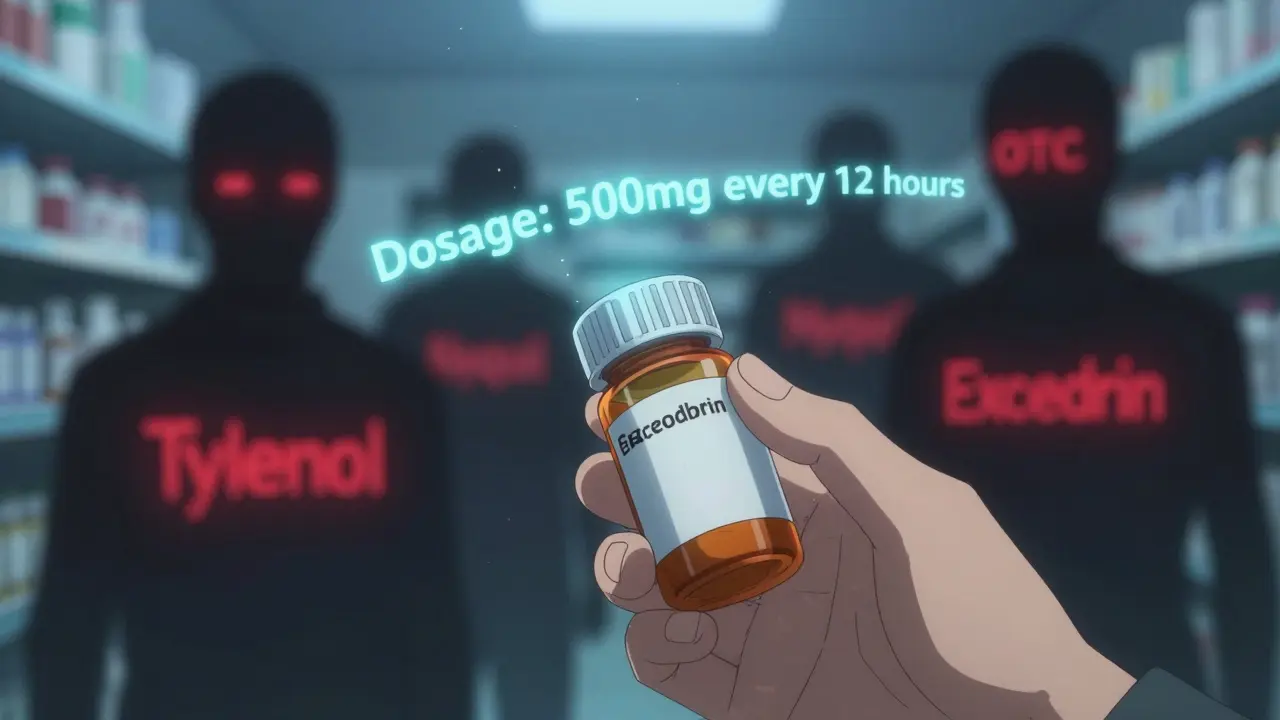
Every time you pick up a bottle of medicine-whether it’s from the pharmacy, the grocery store, or your medicine cabinet-you’re holding a life-or-death instruction manual. Yet most people glance at the label, see a few numbers, and assume they know what to do. That’s where things go wrong.
Over 1.5 million preventable medication errors happen in the U.S. every year. Half of all hospital admissions tied to drugs come from patients not understanding their own prescriptions. And it’s not because people are careless-it’s because labels are confusing, packed with jargon, and designed for experts, not everyday users.
Here’s how to read your medication labels the right way. Not just to follow the rules, but to stay safe.
What’s on the Label? Prescription vs. OTC
Prescription drugs and over-the-counter (OTC) medicines follow different labeling rules, but both have one goal: tell you exactly what to take, when, and how.
For prescription meds, the label must include 16 standardized sections under the FDA’s Highlights of Prescribing Information a structured format required by 21 CFR 201.57(c)(2)(ii) for all prescription drug labels. The most important section is Dosage and Administration. This isn’t just "take one pill a day." It tells you the exact dose, how often, how long to take it, and what to do if you have kidney or liver problems. It even includes warnings about other drugs that might interact with it.
OTC meds, like pain relievers or cold medicines, follow the Drug Facts a standardized label format mandated by the FDA in 1999 for all non-prescription medications. It has seven clear sections: Active Ingredients, Uses, Warnings, Directions, Other Information, Inactive Ingredients, and Questions.
Don’t assume one is simpler than the other. OTC labels often hide the biggest risks-like multiple drugs with the same active ingredient.
Active Ingredients: The Hidden Danger
"Active ingredient" sounds technical, but it’s the real deal-the chemical that actually does the work. The problem? Many OTC products have the same one.
Take acetaminophen. It’s in Tylenol. It’s in Excedrin. It’s in NyQuil. It’s in dozens of cold and flu combos. If you take two of them thinking you’re getting "extra help," you could hit a toxic dose. The safe limit for adults is 3,000 to 4,000 mg per day. One Extra Strength Tylenol tablet has 500 mg. Four of them? You’re at the max. Add a cold medicine with acetaminophen? You’re in danger of liver failure.
Always check the "Active Ingredient" line. If you’re taking more than one medicine, compare the list. If two have the same name, don’t take them together unless your doctor says so.
Dosage: It’s Not Just "Take One"
"Take one tablet by mouth twice daily" sounds simple. But what if you’re 110 pounds? Or 75? Or have kidney disease? The label doesn’t say "for most people." It says "recommended dose." That’s the starting point-not the rule.
For kids, dosage is often based on weight. If your child weighs 20 kg, the label might say "5 mL for 15-25 kg." If they weigh 18 kg? You’re in the gray zone. Don’t guess. Call your pharmacist. They’ll tell you the right amount.
For adults, dosage can change based on age, liver function, or other medications. A label might say: "Reduce dose in patients with hepatic impairment." If you drink alcohol daily or have fatty liver disease, that warning applies to you-even if you feel fine.
And never assume "more is better." Taking double the dose won’t make pain go away faster. It just increases your risk of side effects.
Directions: How Often? How Long?
"Take every 4 to 6 hours" means you can take it up to six times a day. But if you take it at 8 a.m., 12 p.m., 4 p.m., 8 p.m., and midnight? That’s five doses. You’re close to the limit. If you take one more at 2 a.m.? You’ve gone over.
Some labels say "take as needed." That sounds flexible-but it’s not. "As needed" still has a daily cap. For ibuprofen, it’s usually 1,200 mg per day (three 400 mg tablets). If you take two every time you have a headache, you might hit 2,400 mg without realizing it.
Also, watch the duration. "Take for 7 days" means stop after seven. If you keep going because "it still hurts," you’re risking stomach bleeding, kidney damage, or high blood pressure.
Concentration: Liquid Medicines Are Tricky
Here’s where most parents-and many adults-mess up.
A liquid antibiotic might say: "250 mg per 5 mL." That means every 5 milliliters has 250 mg of medicine. If your doctor says to give 500 mg, you need two 5 mL doses-not one full bottle.
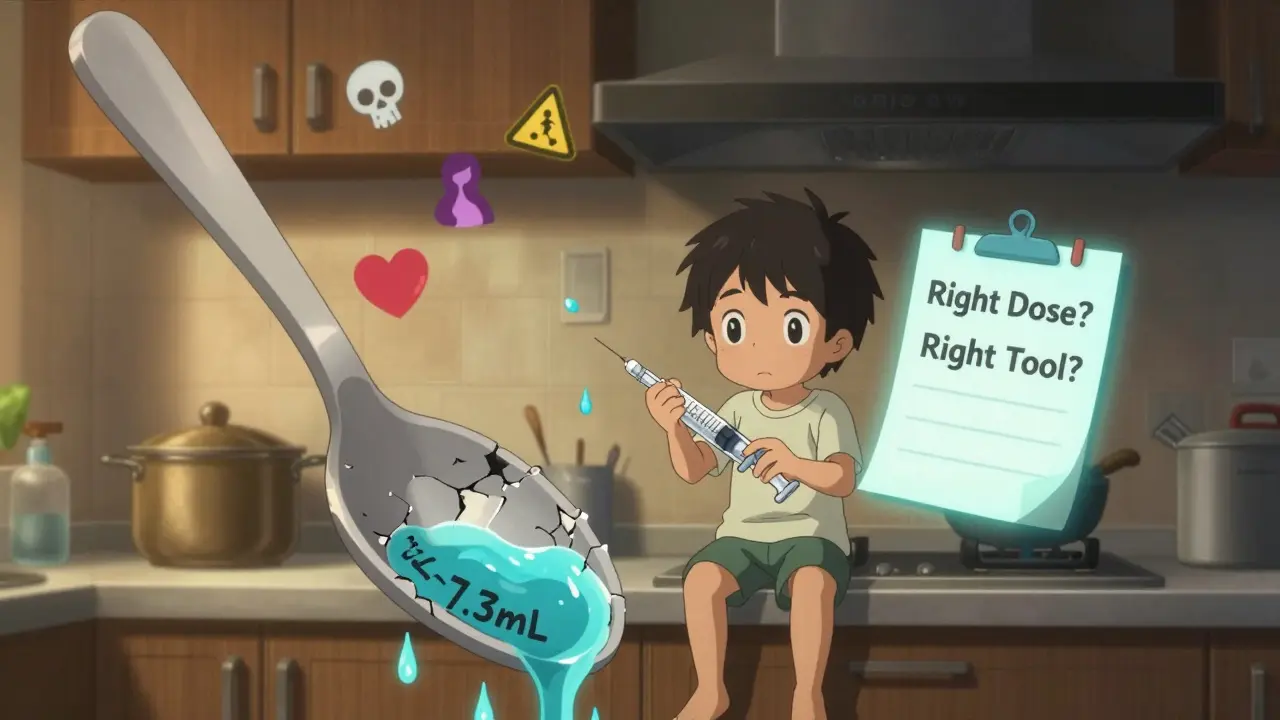
One common mistake? Using a kitchen spoon. A teaspoon isn’t 5 mL. It can be as small as 2.5 mL or as big as 7.3 mL. That’s a 200% difference. A tablespoon? Even worse. The American Academy of Pediatrics says household spoons are unsafe for measuring medicine.
Use the tool that came with the bottle: an oral syringe or a dosing cup with metric markings. If it didn’t come with one, ask the pharmacist for one. They’ll give it to you free.
Warnings: The Part Everyone Skips
According to the Express Scripts 2021 report, 47% of people never read the warnings. That’s dangerous.
Warnings aren’t just "may cause drowsiness." They say things like:
- "Do not use if you have glaucoma."
- "May increase risk of heart attack."
- "Avoid alcohol while taking this drug."
- "May cause severe skin reaction."
Some warnings are specific to you. If you’re on blood thinners and take ibuprofen, you could bleed internally. If you’re pregnant and take isotretinoin (Accutane), your baby could be born with serious birth defects.
Don’t skip this section. If you don’t understand a warning, ask. Write it down. Say it out loud: "This medicine can cause X. I have Y condition. Should I take it?"
The Five Rights of Medication Safety
The American Nurses Association teaches nurses a simple rule called the Five Rights of Medication Administration a standard protocol for verifying safe medication use: right patient, right drug, right dose, right route, right time. You can use it too.
- Right patient - Is the name on the bottle yours? Double-check.
- Right drug - Does the name match what your doctor prescribed? "Amoxicillin" isn’t "Amoxicillin-Clavulanate."
- Right dose - Does the number on the label match what your doctor said? If you were told 50 mg and the bottle says 100 mg, ask.
- Right route - Is it meant to be swallowed, injected, or applied to the skin? Never assume.
- Right time - Is it morning, night, with food, or on an empty stomach? Timing affects how well it works.
Use this checklist every time you take a pill. It takes 10 seconds. It could save your life.
What’s Changing? The Future of Labels
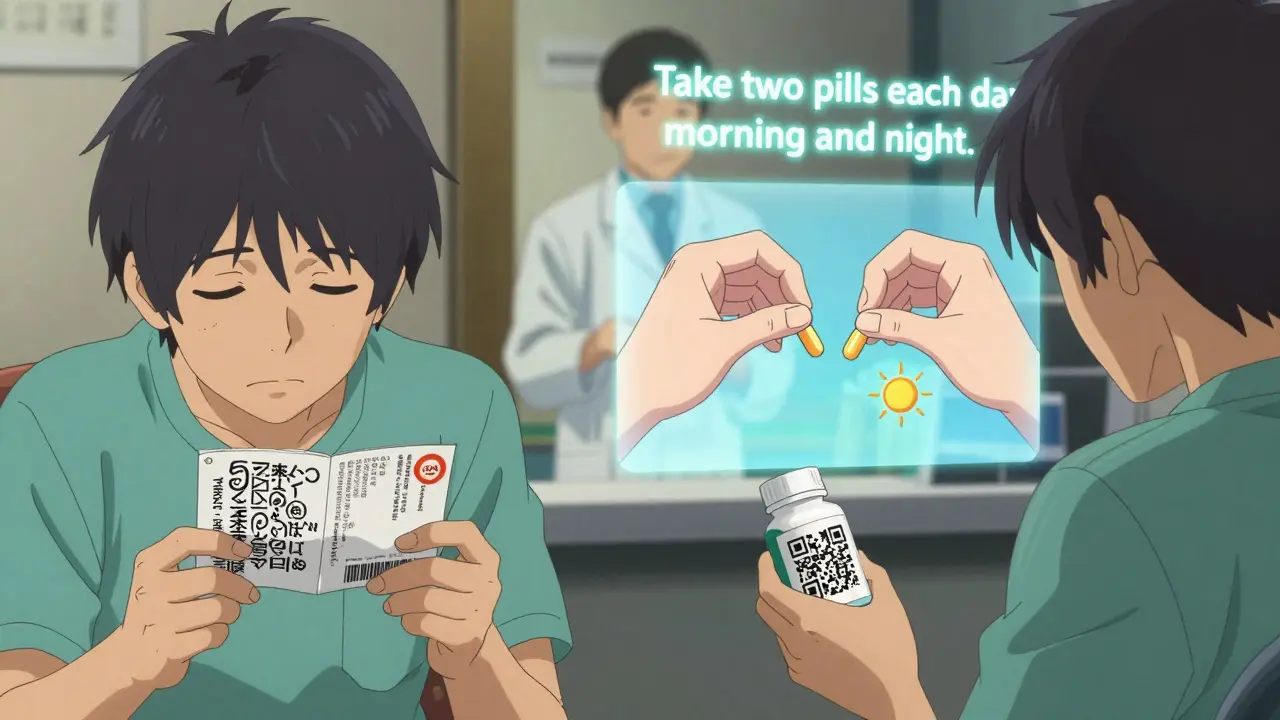
Labels are getting smarter. The FDA is testing QR codes on packaging that link to video instructions. In 2021, a pilot program showed a 37% drop in errors when patients scanned the code and watched a 60-second video on how to take their medicine.
By 2027, many countries plan to use color-coding: red for high-risk drugs like insulin or blood thinners. Icons will show warnings-no reading required. A skull and crossbones for toxicity. A pregnant woman for pregnancy risks.
And plain language is coming. No more "administer orally twice daily." It’ll say: "Take two pills each day, morning and night."
But until then? You still have to read. And understand.
What to Do If You’re Confused
Pharmacists are trained to explain labels. They’re not just dispensers-they’re safety experts. If you don’t understand something:
- Ask them to show you the dose on a syringe.
- Ask them to write it down in simple words.
- Ask if there’s a Medication Guide-a separate sheet that explains risks in plain language.
For high-risk drugs like insulin, opioids, or chemotherapy, a Medication Guide is required by law. If you didn’t get one, ask for it. You’re entitled to it.
And if you’re ever unsure? Don’t take it. Call your doctor. Wait. Ask again. Better to be safe than sorry.
phyllis bourassa
March 6, 2026 AT 22:50Ugh, I used to take two Tylenol and a cold med at night because "it helps me sleep better." Then I ended up in the ER with liver enzymes through the roof. 🤢
Turns out, I wasn’t "being proactive"-I was just dumb. Don’t be like me. Always check the active ingredients. Seriously.
Pharmacists aren’t just there to hand you pills. Talk to them. They’ll save your life before you even realize you’re in danger.
Aaron Pace
March 7, 2026 AT 16:06Yesss!! 🙌 I just told my mom this last week-she was mixing Advil and NyQuil like it was a smoothie. I had to do a whole PowerPoint on acetaminophen toxicity. She’s now a label-reader. 🤓
Also, kitchen spoons? NOPE. I bought my whole family those little syringes. Worth every penny.
Joey Pearson
March 7, 2026 AT 23:44You’re not alone. I used to skip the warnings until my aunt had a reaction. Now I read every line. It’s not scary-it’s empowering. You’ve got this. 💪
Roland Silber
March 8, 2026 AT 18:24Let’s talk about concentration. I’m a nurse, and I’ve seen so many parents give liquid meds with a teaspoon. One time, a kid got 3x the dose because the parent thought "a spoonful" meant a dinner spoon.
That’s why I always hand out syringes-even if they say they "don’t need one."
And yes, the FDA’s new QR code pilot? Genius. A 60-second video showing how to draw up 2.5 mL beats a tiny print label any day.
Also-"take as needed" doesn’t mean "whenever you feel like it." It means "up to the max daily dose, spaced properly."
Most people don’t realize that.
Patrick Jackson
March 9, 2026 AT 12:33Oh my god, this is the most important thing I’ve read all year. 🙏
I used to think labels were just "government red tape." Now I see them as lifelines.
That Five Rights checklist? I printed it. Taped it to my medicine cabinet.
Every time I reach for a pill, I say it out loud: Right patient. Right drug. Right dose. Right route. Right time.
It feels weird. But it feels safer.
And if you’re not doing this? You’re gambling with your body. And I don’t gamble.
Not with my health. Not with my life.
Adebayo Muhammad
March 10, 2026 AT 15:17Let me be blunt: the FDA’s labeling system is a farce. It’s corporate propaganda wrapped in legalese. They "mandate" clarity-but the font size is microscopic, the jargon is dense, and the warnings are buried under 17 disclaimers.
And don’t get me started on "Drug Facts"-it’s not facts, it’s fiction. They list "inactive ingredients" like they matter-but ignore the real culprits: fillers, dyes, preservatives that cause reactions.
Who’s really in charge? The pharmaceutical lobby. Not you. Not me. Not the patient.
So yes-read the label. But don’t trust it. Question everything.
Pranay Roy
March 11, 2026 AT 14:26Did you know? The FDA doesn’t require drug companies to test how well people understand their labels. They just require the text to be there. So if you can’t read it? That’s your problem.
Also-QR codes? That’s just surveillance. They’re tracking who scans what. And what’s next? A fingerprint scan to unlock your pill bottle?
And why are they pushing color-coding? So they can control you easier. Red = fear. Black = danger. It’s behavioral manipulation.
Don’t fall for it. Your body. Your rules.
Jeff Mirisola
March 12, 2026 AT 07:22As a Black man in America, I’ve seen how medication errors hit communities of color harder. We’re less likely to get clear explanations. Less likely to be asked if we understand. Less likely to be given a Medication Guide.
This post? It’s not just helpful. It’s necessary.
Thank you for writing it. I’m sharing this with my church group. We’re doing a "Medication Literacy Night."
Knowledge isn’t power. Applied knowledge? That’s survival.
Ian Kiplagat
March 13, 2026 AT 07:37Agreed. I’ve worked in UK pharmacies for 15 years. The "as needed" confusion is the biggest issue. People think it means "whenever I want."
It doesn’t. It means "within the daily limit, spaced evenly."
And yes-use the syringe. Always. Even if you’re 6’2" and weigh 200 lbs. You’re not immune.
Simple. Effective. Free.
✅
Amina Aminkhuslen
March 14, 2026 AT 04:13Oh honey, you’re not wrong-but you’re also not *quite* right. The real villain? The corporate greed that makes labels look like they were written by a robot on Adderall.
And don’t even get me started on how OTC labels hide the fact that 70% of them contain acetaminophen. It’s like a trap. A sweet, cheerful, over-the-counter trap.
And yet-pharmacists? They’re the unsung heroes. The quiet ones who whisper "Don’t take that with this" while you’re distracted by the candy aisle.
They’re angels in lab coats. And we don’t thank them enough.
amber carrillo
March 15, 2026 AT 15:59Thank you for this clear, essential guide. I will share it with my elderly patients. Safety begins with understanding.