
Every year around late October, the days get shorter, the mornings stay dark, and something shifts inside you. You’re not just tired-you’re heavier. Motivation vanishes. Even simple tasks feel like climbing a hill in snow. If this sounds familiar, you’re not alone. In the UK, nearly 1 in 20 people experience seasonal depression, a real and treatable condition tied to the changing seasons. Unlike regular sadness, this isn’t just a bad mood. It’s a biological response to less sunlight, and it follows a pattern: it comes back every fall, lifts in spring, and can be prevented-if you know how.
Why Seasonal Depression Happens
Seasonal Affective Disorder (SAD) isn’t just "feeling down in winter." It’s a clinical mood disorder with a clear biological cause. When daylight shrinks, your body’s internal clock-your circadian rhythm-gets thrown off. This disrupts two key chemicals: serotonin, which affects mood, and melatonin, which controls sleep. Less sunlight means less serotonin and more melatonin during the day, leaving you sluggish and low. The problem gets worse the farther north you live. In places like Scotland or Norway, up to 10% of adults struggle with winter SAD. Even in Bristol, where winters are mild compared to Alaska, the drop in natural light is enough to trigger symptoms in sensitive people.Light Therapy: The Most Proven Tool
If you want one thing to start with, make it light therapy. It’s not a fancy gadget-it’s science. Since the 1980s, researchers at the National Institute of Mental Health have shown that bright artificial light can mimic the effects of sunrise. The key? Intensity and timing. You need a light box that delivers 10,000 lux, positioned about 16 to 24 inches from your face. Use it for 20 to 30 minutes right after waking up. No need to stare at it-just have it on while you drink coffee, read, or check your phone. Timing matters more than duration. If you use it too late in the day, it can mess up your sleep. Use it too early, and you might not feel the benefit. The best window? Within one hour of waking. Studies show 70% of users see improvement in just one to two weeks. The Center for Environmental Therapeutics recommends starting in early September, before symptoms even show up. That’s prevention, not reaction. Not all light boxes are equal. Avoid ones that emit UV rays-those can damage your eyes. Look for devices that filter out UV and focus on blue light between 460 and 480 nanometers. That’s the exact wavelength that signals your brain to stop making melatonin and start producing serotonin. You don’t need to spend hundreds. Look for models certified by the Center for Environmental Therapeutics. Brands like Lumie and Verilux have been tested and trusted for years.Vitamin D: The Missing Link
Your body makes vitamin D when your skin is exposed to sunlight. In winter, that almost stops. Low vitamin D levels are linked to depression, especially in people with SAD. But here’s the catch: taking vitamin D won’t fix everything if your light exposure and sleep schedule are still broken. Research from UC Davis Health shows that people with vitamin D levels below 20 ng/mL are at higher risk for depressive symptoms. The Endocrine Society recommends 600-2,000 IU daily for prevention. If your levels are below 20, Cleveland Clinic suggests 5,000 IU for three months, then retesting. Don’t guess-get tested. A simple blood test at your GP’s office can tell you where you stand. Don’t just pop pills hoping for a miracle. Vitamin D works best as part of a bigger plan. Food helps too. Fatty fish like salmon, mackerel, and sardines are rich in vitamin D and omega-3s, which support brain health. Eggs, fortified dairy, and mushrooms have small amounts. But in winter, food alone won’t cut it. Supplements are necessary for most people in northern climates.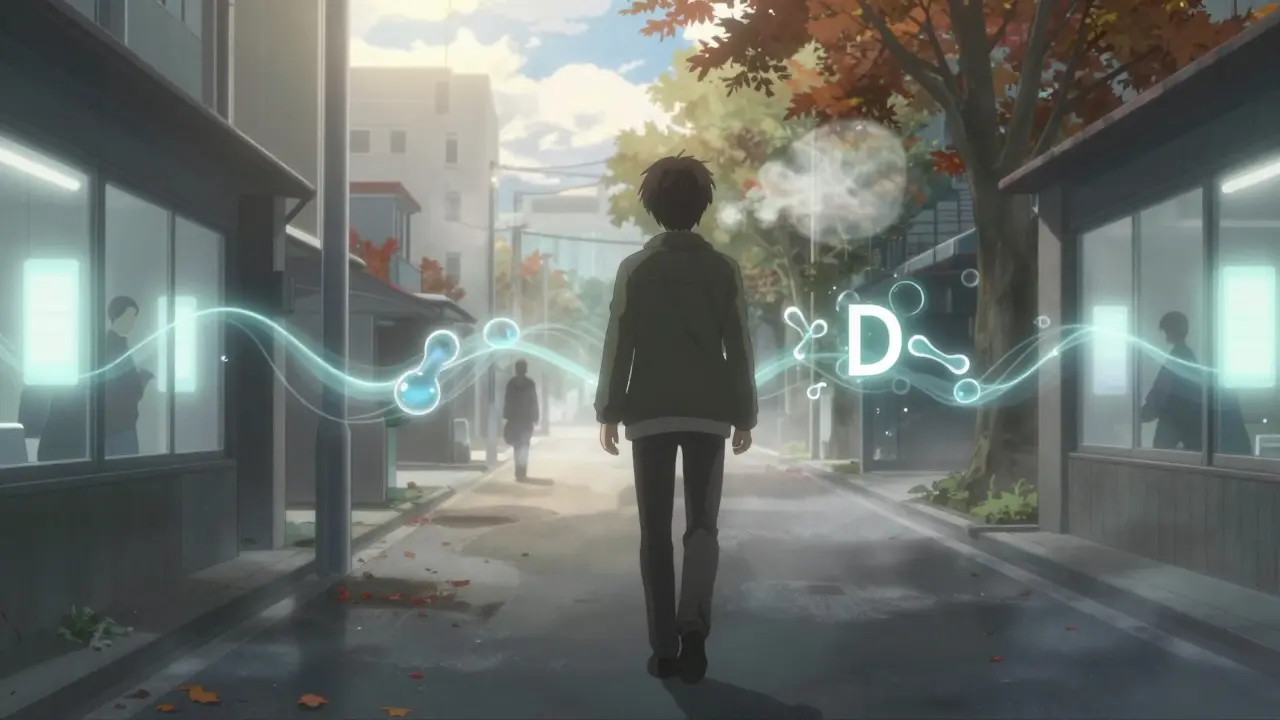
Routine: The Silent Hero
You don’t need to be a morning person to beat seasonal depression. But you do need consistency. Your body thrives on predictability. When your wake-up time, meal times, and bedtime shift every day, your circadian rhythm gets confused. That makes SAD worse. The rule? Wake up at the same time every day-even on weekends. No more sleeping until 10 a.m. because it’s cold and dark. That’s a trap. Even if you feel exhausted, get up at 7 or 8 a.m. and get light exposure within two hours. That’s more powerful than any pill. Combine that with movement. Thirty minutes of walking outside, even on a cloudy day, gives you natural light and gentle exercise. If it’s too dark or rainy, walk indoors near a window or use your light box while pacing. Movement boosts serotonin, reduces stress hormones, and improves sleep quality. Dr. Kelly Rohan’s research at the University of Vermont found that Cognitive Behavioral Therapy for SAD (CBT-SAD) helps people build routines that fight withdrawal. That means scheduling things you enjoy-even small ones. A weekly coffee with a friend. A puzzle. Watching a movie you love. Planning these ahead of time keeps you connected and active when your energy is low.What Doesn’t Work (And Why)
Some people think taking a vitamin D supplement alone will fix everything. It won’t. Studies show it only helps if you’re deficient-and even then, the effect is modest. Light therapy alone works well for many, but about 60% of people relapse the next winter if they stop. CBT-SAD has longer-lasting results. People who learn to recognize negative thoughts and replace them with planned activities are less likely to fall back into depression. But it takes time. Light therapy gives fast relief. CBT gives lasting change. The best approach? Use both. Napping during the day? Avoid it. Oversleeping? That’s a red flag. Both throw off your rhythm and make symptoms worse. The Mayo Clinic says strict wake-up consistency is more important than bedtime. So if you go to bed at 11 p.m. one night and 2 a.m. the next, your body doesn’t know what to expect. Keep it steady.Real-Life Strategies That Work
Here’s what works for people in the UK:- Set two alarms: one to wake up, one to turn on your light box. Use a smart plug or timer so it turns on automatically.
- Walk to work or school-even if it’s just for 15 minutes. If you drive, park farther away.
- Keep a small light box at your desk. Use it during calls or while reading.
- Plan one fun activity each week. Even if you don’t feel like it, go. Your future self will thank you.
- Drink 2 liters of water daily. Dehydration makes fatigue worse, and people forget this.
- Track your mood. Use a simple app or journal. Note your sleep, light exposure, and energy levels. Patterns emerge over time.

What’s New in 2025
This year, the FDA approved the first digital therapy app for SAD prevention: SeasonWell. It delivers CBT-SAD through guided sessions on your phone. In trials, 78% of users stuck with it. That’s higher than most medication regimens. A new dawn simulator, the Bodyclock Start 10000, was released in early 2025. It mimics a real sunrise over 90 minutes, slowly brightening from 1 lux to 250 lux. It’s designed to wake you up naturally, without an alarm. For people who hate waking up abruptly, this is a game-changer. And research is getting smarter. A 2025 study found that not everyone with SAD reacts the same way. Some people are more affected by cold temperatures, others by light loss. Personalized prevention is the future. If you’ve tried things before and they didn’t work, it might not be you-it might be the approach.When to See a Professional
If you’ve tried light therapy, vitamin D, and routine for four weeks and still feel flat, exhausted, or hopeless, talk to your doctor. SAD can be mistaken for chronic depression. In fact, 65% of cases are misdiagnosed because doctors don’t ask about seasonal patterns. You don’t need to suffer in silence. In Sweden, the government gives free light therapy boxes to diagnosed patients. In the UK, some NHS clinics offer them on prescription. Ask your GP. If they say no, ask for a referral to a mental health service that understands SAD.Final Thought: Prevention Is Possible
Seasonal depression isn’t something you just have to live with. It’s one of the few mental health conditions where you can predict when it’s coming-and stop it before it starts. Light, vitamin D, and routine aren’t magic. But together, they’re powerful. Start in September. Be consistent. Track your progress. You don’t need to be perfect. Just show up, every day, with a little more light and a little more structure. That’s how you take back your winter.Can seasonal depression be prevented before it starts?
Yes. Starting light therapy in early September, before symptoms appear, reduces the severity of winter depression by 50-60% in people with a history of SAD. Combining this with vitamin D and a consistent sleep-wake schedule makes prevention even more effective.
Do I need a prescription for a light therapy box?
No. Light therapy boxes are available over the counter. But make sure they meet clinical standards: 10,000 lux intensity, UV-free, and emitting blue light between 460-480 nm. Look for certification from the Center for Environmental Therapeutics. Some NHS clinics in the UK will prescribe them if you have a confirmed diagnosis.
How much vitamin D should I take for seasonal depression?
For prevention, 1,000-2,000 IU daily is generally safe and effective. If your blood level is below 20 ng/mL, your doctor may recommend 5,000 IU for 3 months, then retest. Don’t take more than 4,000 IU daily without medical supervision. Vitamin D works best when paired with light exposure and routine.
Is walking outside enough if I can’t use a light box?
Yes, but timing matters. Get at least 20-30 minutes of natural light within two hours of waking, even on cloudy days. A walk at 8 a.m. in winter still delivers more light than sitting indoors all day. It’s not as strong as a 10,000-lux box, but it’s better than nothing-and it also gives you movement and fresh air.
Why does my mood improve in spring even if I don’t change anything?
Because your body responds to increasing daylight. As days get longer in spring, your circadian rhythm naturally resets. Serotonin rises, melatonin drops, and your brain chemistry shifts back to normal. That’s why prevention works-you’re trying to mimic that spring shift before winter hits.
Can I use a regular bright lamp instead of a light therapy box?
Not reliably. Most household lamps don’t reach 10,000 lux, and many emit harmful UV rays or the wrong light spectrum. A desk lamp might help a little, but it won’t give you the clinical benefits proven in studies. For real results, use a device designed specifically for SAD prevention.
James Rayner
December 15, 2025 AT 09:40It’s funny… I’ve been using a light box for three winters now, and it’s the only thing that keeps me from turning into a human slug. I used to think it was just laziness-until I started tracking my mood. Now I set it to turn on at 7 a.m. automatically. No excuses. It’s not magic, but it’s science-and science doesn’t care how tired you feel. 🌞
Cassandra Collins
December 17, 2025 AT 07:45Wait… so you’re telling me the government isn’t secretly controlling our moods with streetlights? 😏 I mean, why else would they make all the bulbs blue in the winter? They want us docile. I read this one guy on TruthFeed who said the WHO is pushing SAD to make people buy more antidepressants. Coincidence? I think not. 🤔
Mike Smith
December 18, 2025 AT 02:36Thank you for this comprehensive and clinically grounded piece. I’ve been a practitioner in behavioral health for over fifteen years, and I can attest that the combination of phototherapy, circadian regulation, and vitamin D repletion remains the gold standard for seasonal affective disorder intervention. The emphasis on prevention-rather than reaction-is particularly noteworthy. Many patients underestimate the power of routine; consistency in wake time, even on weekends, is more predictive of symptom mitigation than pharmacological intervention alone. I recommend this protocol to every patient who presents with winter-related depressive symptoms.
Ron Williams
December 19, 2025 AT 17:46Just wanted to say-this hit different. I’m from Minnesota, and I used to think I was just ‘a grumpy winter person.’ Then I got a light box after my therapist mentioned it. Didn’t believe it at first. But after two weeks of using it while eating breakfast? I started noticing I wasn’t dreading Mondays anymore. Didn’t fix everything, but it gave me back something I didn’t know I’d lost: the ability to feel like myself before the snow came. Thanks for writing this.
Kitty Price
December 21, 2025 AT 13:43Light therapy + walking outside = my winter survival kit. 🌿 I don’t even need the vitamin D anymore-I get my 20 minutes in the morning, coffee in hand, headphones on, just… being. It’s not about fixing myself. It’s about showing up for myself. And that’s enough. 😊
Aditya Kumar
December 21, 2025 AT 15:14Too much effort. I just sleep more. It’s easier.
Colleen Bigelow
December 23, 2025 AT 04:28Oh please. Light therapy? Vitamin D? You’re all being manipulated by Big Pharma and the WHO’s global mood-control agenda. Real Americans don’t need gadgets to feel happy-we have faith, family, and freedom. And if you’re depressed because the sun sets at 4 p.m., maybe you need to move to Texas. Or better yet-stop being so weak. My grandma survived the Great Depression with no light box and still baked pies every Sunday. You’re not broken-you’re just entitled.
Andrew Sychev
December 24, 2025 AT 00:16Okay but what if your light box breaks? What if your vitamin D is fake? What if your routine is ruined because your roommate plays Call of Duty at 3 a.m.? WHAT THEN? This whole thing is a fragile house of cards built on expensive gadgets and privileged schedules. Meanwhile, I’m in a basement apartment with no windows, working two jobs, and the only ‘light’ I get is from my phone screen. So yeah-tell me again how ‘simple’ this is.
Kim Hines
December 24, 2025 AT 14:42I tried the light box. Didn’t work. Tried vitamin D. Didn’t work. Started walking every morning anyway. Still didn’t feel amazing. But… I didn’t feel worse. And sometimes, that’s the win.
Joanna Ebizie
December 24, 2025 AT 18:44Y’all are overthinking this. Just go outside. Eat salmon. Don’t nap. Done. Stop buying $300 boxes and start living. 😒
Elizabeth Bauman
December 26, 2025 AT 11:25As a former NHS nurse, I’ve seen this firsthand. The UK’s free light box program saved lives. I gave one to my neighbor-she hadn’t left her house in three weeks. After two weeks on the box? She started gardening again. No meds. No therapy. Just light. And yes, I’m still mad that the FDA doesn’t make this mandatory in schools and offices. It’s a public health issue, not a luxury. 🇺🇸
Dylan Smith
December 26, 2025 AT 15:14I’ve been using SeasonWell for a month now and honestly it’s way better than I expected. The CBT sessions are short but they stick with you. I used to think I was just lazy but now I realize I was avoiding things because I felt hopeless. The app reminds me to schedule small things-even just making tea. And I’m not saying it’s perfect but it’s the first thing that made me feel like I wasn’t broken. I’m still figuring it out but I’m trying. And that’s new for me.