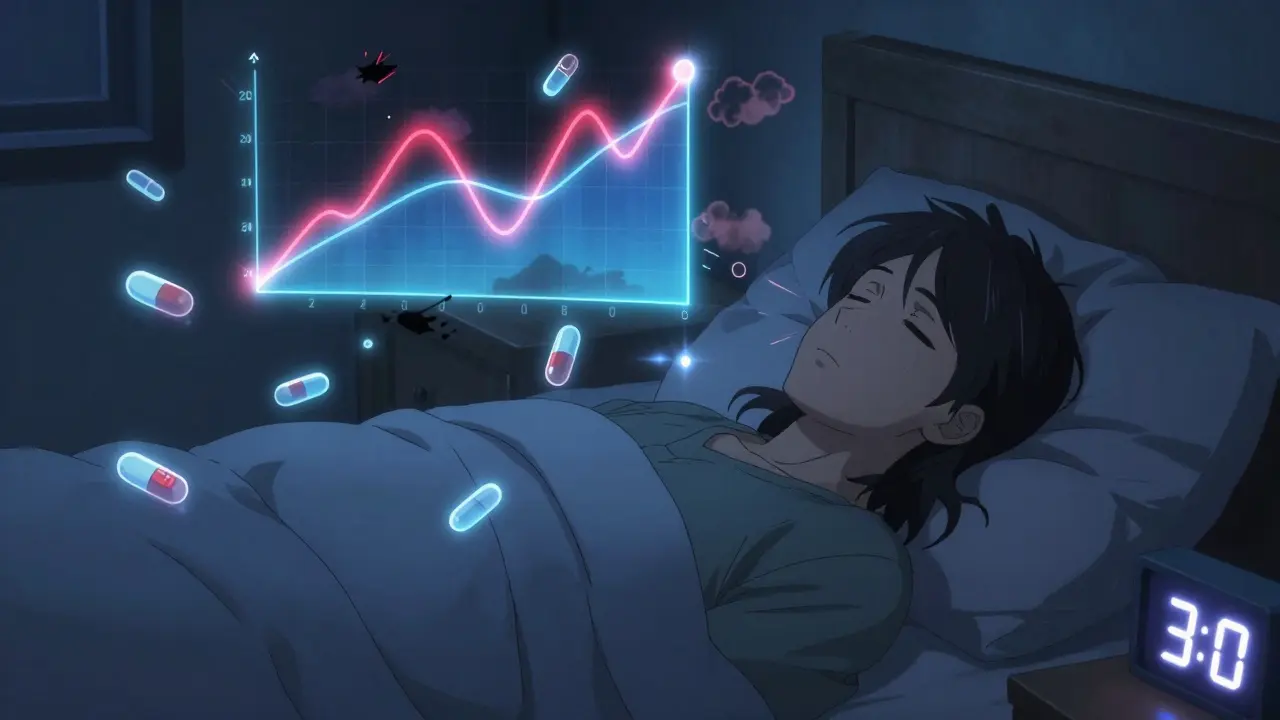
Medication Sleep Diary Tracker
Track Your Sleep & Medications
This tool helps you identify if your medications might be causing insomnia. Track your sleep patterns and medication timing for 14 days to get a clear picture.
More than one in five adults in the U.S. say their sleep problems come from something they’re taking - not stress, not screens, not life chaos. It’s a medication. And most people don’t realize it until they’re wide awake at 3 a.m., heart racing, mind spinning, wondering why they can’t shut off after taking their usual pills.
What’s Really Going On When Medications Ruin Your Sleep
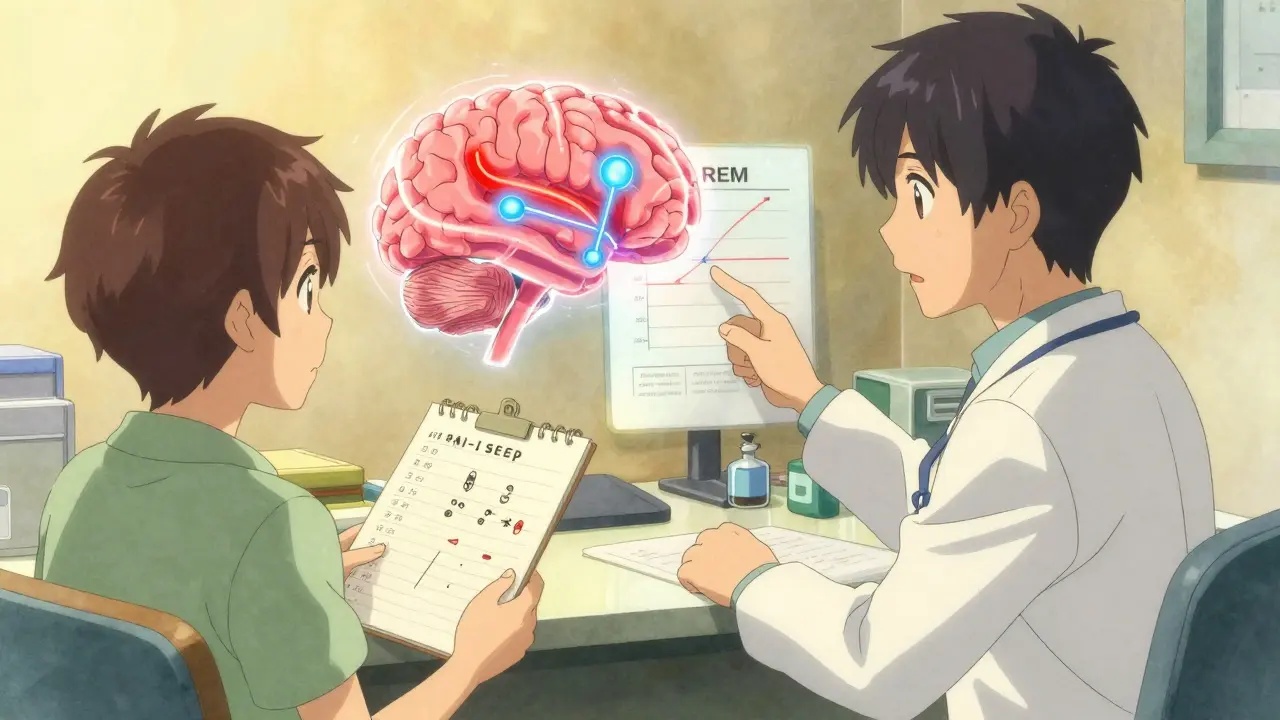
It’s not just caffeine. It’s not just too much screen time. Some of the most common prescriptions and even over-the-counter drugs are quietly sabotaging your sleep architecture. SSRIs like fluoxetine (Prozac), beta-blockers like metoprolol (Lopressor), and corticosteroids like prednisone don’t just treat your condition - they alter your brain’s sleep signals. These drugs interfere with melatonin, spike cortisol at night, or overstimulate wakefulness centers in your brain. The result? You might fall asleep fine, but you wake up every hour. Or you sleep for eight hours but feel like you didn’t rest at all.Take SSRIs, for example. They’re great for depression, but they increase serotonin in your brain by 80-90%. That sounds good - until you realize serotonin blocks melatonin production. So even if you take your pill at night, your body doesn’t get the signal to sleep deeply. Studies show users of these drugs spend 18.7% more time in light sleep and lose nearly a quarter of their REM sleep - the stage where your brain processes emotions and memories. No wonder you feel tired all day.
Top Medications That Sabotage Sleep - And Why
Some drugs are obvious culprits. Others sneak in under the radar.- SSRIs (Prozac, Zoloft, Lexapro): Cause frequent nighttime awakenings and reduce deep sleep. Up to 30% of users report this.
- Beta-blockers (Metoprolol, Propranolol): Cut melatonin production by 42%. That’s why you wake up with nightmares or feel like your heart is pounding at night.
- Corticosteroids (Prednisone, Dexamethasone): Turn your body’s cortisol rhythm upside down. Taking them after noon can slash deep sleep by 47% and triple nighttime wake-ups.
- ADHD stimulants (Adderall, Vyvanse): Keep dopamine and norepinephrine high. If you take them after noon, you might not fall asleep until 2 a.m.
- Decongestants (Pseudoephedrine): Found in Sudafed and cold meds. They’re stimulants disguised as nasal sprays. 15% of users can’t sleep after taking them.
- Non-drowsy antihistamines (Loratadine, Cetirizine): You think they’re safe because they don’t make you sleepy - but they actually block the very pathways that help you fall asleep.
- St. John’s Wort and Glucosamine-Chondroitin: Yes, even supplements. St. John’s Wort is supposed to help mood - but it disrupts sleep in 15% of users. Glucosamine? About 7% of people report insomnia after starting it.
And here’s the kicker: if you’re over 65, you’re at higher risk. First-generation antihistamines like diphenhydramine (Benadryl) are still sold as sleep aids, but they’re on the American Geriatrics Society’s list of drugs to avoid in older adults. They don’t help you sleep better - they just make you foggy, unsteady, and more likely to fall.
When to Suspect Your Pill Is the Problem
You didn’t have sleep issues before. Then you started a new medication. Now you’re tossing and turning. That’s not coincidence - it’s correlation. But how do you know it’s the drug and not just stress?Use the 3-3-3 Rule, recommended by sleep experts: If your sleep problems have lasted more than 3 weeks, happened 3 or more nights a week, and left you feeling impaired during the day on 3 or more days, it’s time to talk to your doctor. Don’t wait. Don’t assume it’ll pass.
Keep a simple sleep diary for two weeks. Write down:
- What you took and when
- When you went to bed and woke up
- How many times you woke up
- How rested you felt in the morning
This isn’t fluff - it’s data. Doctors use sleep diaries to confirm medication-related insomnia with 82% accuracy. Without it, they might blame you for “poor sleep hygiene” when the real issue is your blood pressure pill.
What You Can Do - Right Now
You don’t have to quit your meds. You don’t have to suffer. There are proven fixes.1. Change the Timing
This is the easiest fix - and it works.- Corticosteroids: Take them before 9 a.m. Doing so cuts insomnia risk by 63%. The earlier you take them, the less they mess with your cortisol rhythm.
- SSRIs: Move your dose to the morning. A 2022 study showed this reduces sleep problems by 45%. Don’t take them at night - your brain doesn’t need extra serotonin when it’s trying to wind down.
- Stimulants: Never take them after noon. Even if you think you’re “used to it,” your brain still reacts. Adderall XR can delay sleep by over an hour - even if you don’t feel wired.
- Decongestants: Take them in the morning. Avoid them entirely if you’re already struggling to sleep.
2. Talk to Your Doctor About Alternatives
Some drugs have sleep-friendly versions.- If you’re on propranolol (a fat-soluble beta-blocker), ask about switching to atenolol (water-soluble). It’s less likely to disrupt melatonin - and users report 37% fewer nighttime awakenings.
- If SSRIs are wrecking your sleep, ask about mirtazapine (Remeron). It’s an antidepressant that actually helps people sleep. In clinical trials, it resolved insomnia in 68% of people who switched.
- If you’re on a non-drowsy antihistamine for allergies, ask about a drowsy one like diphenhydramine - but only if you’re under 65. For older adults, even drowsy antihistamines are risky.
3. Try Melatonin - But Do It Right
If you’re on a beta-blocker and your body isn’t making enough melatonin, a small supplement can help. But don’t take 10 mg. That’s too much. Studies show 0.5 to 3 mg, taken 2-3 hours before bed, restores sleep quality by 52% in people on beta-blockers. Take it too early or too late, and it won’t work.4. Avoid Quitting Cold Turkey
If you’re on a sleep aid like zolpidem (Ambien) and want to stop, don’t just quit. You’ll get rebound insomnia - and it’s worse than before. The American Academy of Sleep Medicine says taper slowly: reduce your dose by 25% every two weeks under medical supervision. That cuts rebound risk from 65% down to 18%.What Doesn’t Work - And Why
You’ve probably tried these already:- Drinking alcohol to “help” you sleep: It might knock you out, but it destroys deep sleep and REM. You wake up more tired.
- Using Benadryl as a sleep aid: It’s outdated. For anyone over 65, it increases dementia risk and causes next-day confusion. The Beers Criteria says avoid it.
- Just “trying harder” to sleep: The more you stress about sleep, the worse it gets. That’s not weakness - it’s biology.

The Bigger Picture: Don’t Go It Alone
A 2023 Consumer Reports survey found 34% of people stopped taking their meds because of sleep issues. And 61% of them didn’t tell their doctor. That’s dangerous. You might be treating one problem - and creating another.Instead, partner with your doctor. Bring your sleep diary. Ask: “Could this medication be affecting my sleep?” Then ask: “Is there a better option?”
And if your doctor dismisses you? Go to a sleep specialist. Studies show 40-50% of people who think their insomnia is drug-related actually have an underlying sleep disorder - like sleep apnea or restless legs. Treating the wrong problem makes things worse.
Cognitive Behavioral Therapy for Insomnia (CBT-I) is the gold standard. It’s not pills. It’s not herbs. It’s a structured program that rewires how you think about sleep. Studies show it works in 65-75% of cases - even when meds are the cause. And it lasts longer than any pill.
Final Thought: Sleep Isn’t a Bonus - It’s Medicine
You wouldn’t skip your blood pressure pill because you didn’t feel like it. Don’t skip your sleep either. Poor sleep weakens your immune system, raises your blood pressure, and makes every other condition harder to manage. If a medication is stealing your rest, it’s not just an annoyance - it’s a health risk.Start with your sleep diary. Adjust your timing. Talk to your doctor. Don’t assume it’s normal. You deserve to sleep - even if you’re taking medicine to stay healthy.
Can any medication cause insomnia?
Yes. Many common medications - including antidepressants, blood pressure pills, steroids, ADHD stimulants, decongestants, and even some supplements - can interfere with sleep. It’s not rare. About 22% of adults say their sleep problems come from medications. The risk goes up with age and the number of pills you take.
How do I know if my sleep problem is from a medication?
Track your sleep for two weeks. Note when you started the medication and when sleep problems began. If they started within days or weeks of beginning a new drug, it’s likely connected. Use the 3-3-3 Rule: if it’s happening 3+ nights a week, for 3+ weeks, and affecting your days, it’s time to talk to your doctor.
Should I stop taking my medication if it’s causing insomnia?
Never stop a prescribed medication without talking to your doctor. Stopping suddenly can be dangerous - for example, quitting beta-blockers too fast can raise your heart rate dangerously. Instead, ask about timing changes, alternatives, or dose adjustments. Your doctor can help you find a solution that protects your health and your sleep.
Is melatonin safe to take with my meds?
Melatonin is generally safe for most people, including those on beta-blockers or SSRIs. Studies show 0.5-3 mg taken 2-3 hours before bed helps restore sleep in people with medication-induced insomnia. But if you’re on blood thinners, immunosuppressants, or have epilepsy, check with your doctor first. Avoid high doses - more than 3 mg doesn’t help and can cause grogginess.
Can CBT-I help if my insomnia is caused by meds?
Yes - and it’s one of the most effective treatments. CBT-I doesn’t remove the medication, but it teaches your brain to sleep again despite it. Studies show it works in 65-75% of people with medication-related insomnia. It’s especially helpful if you’ve developed anxiety around sleep or rely on pills to fall asleep.
Why do some people sleep fine on meds while others don’t?
Everyone’s brain chemistry is different. Genetics, age, liver function, and other medications you take all affect how your body processes drugs. Someone on the same beta-blocker might sleep fine because their pineal gland still makes enough melatonin. You might not - and that’s normal. It doesn’t mean you’re broken. It means you need a personalized solution.
Are there any new treatments for medication-induced insomnia?
Yes. Emerging research shows timed light exposure - getting bright light in the morning and avoiding blue light at night - can improve sleep efficiency by 28% in people on sleep-disrupting meds. This is called chronotherapy. It’s not widely offered yet, but it’s being studied in clinics. Some sleep centers now combine it with CBT-I for better results.
Beth Cooper
January 31, 2026 AT 22:16Okay but have you ever considered that Big Pharma is deliberately designing drugs to keep us awake so we buy more coffee, sleep aids, and therapy? I mean, think about it - if we slept well, we wouldn’t be profitable consumers. They don’t want us resting. They want us scrolling, buying, and complaining. It’s all connected. The FDA? Controlled. The sleep study? Paid for by Pfizer. Wake up. 🤔
Katie and Nathan Milburn
February 1, 2026 AT 22:43It is, indeed, a matter of considerable clinical significance that pharmacologically induced sleep architecture disruption represents a frequently underrecognized iatrogenic phenomenon. The temporal correlation between initiation of pharmacotherapy and onset of insomnia warrants systematic evaluation via polysomnographic monitoring and circadian rhythm assessment, particularly in polypharmacy populations. A structured sleep diary, as referenced, constitutes a valid and empirically supported diagnostic adjunct.
Marc Bains
February 2, 2026 AT 14:00Look, I get it - meds mess with sleep. But let’s not turn this into a panic fest. I’ve been on propranolol for 8 years, took it at night, slept like a rock. My cousin? Same pill, same dose, couldn’t sleep a wink. Our bodies are different. Don’t assume your experience is universal. Talk to your doc, try timing changes, maybe add melatonin - but don’t ditch your meds because you read a blog. We’re all different, and that’s okay.
kate jones
February 3, 2026 AT 20:40It’s critical to differentiate between pharmacokinetic and pharmacodynamic contributors to medication-induced insomnia. SSRIs elevate synaptic serotonin, which directly inhibits the suprachiasmatic nucleus’s regulation of melatonin synthesis via 5-HT2C receptor agonism. Beta-blockers, particularly lipophilic agents like propranolol, cross the blood-brain barrier and suppress pineal gland activity. The 0.5–3 mg melatonin protocol is evidence-based for this subset, but must be timed to coincide with the dim-light melatonin onset (DLMO) - typically 2–3 hours pre-sleep. Misalignment reduces efficacy by up to 60%. Additionally, CBT-I remains first-line due to its neuroplastic remodeling of hyperarousal pathways.
Natasha Plebani
February 4, 2026 AT 18:29Isn’t it strange how we’ve outsourced our biology to chemistry? We’re told to take pills to fix our minds, then surprised when those same pills break our sleep - the very mechanism that allows our minds to heal. We’ve turned rest into a problem to be managed, not a natural rhythm to be honored. Maybe the real illness isn’t depression or high blood pressure - maybe it’s the belief that every imbalance must be chemically corrected. What if the cure was silence? Stillness? Not another pill - but a pause? We’ve forgotten how to be still. And now we’re paying for it with every sleepless night.
Yanaton Whittaker
February 6, 2026 AT 12:07AMERICA IS SLEEPING LESS BECAUSE LIBERALS WANT YOU WEAK AND DEPENDENT ON DRUGS! 🇺🇸💊 This isn't science - it's socialism in a pill bottle. Take back your sleep! Stop taking the government's chemicals! Wake up, patriots! ☕️🇺🇸
Carolyn Whitehead
February 6, 2026 AT 12:34I’ve been on Lexapro for 3 years and honestly? I just took it in the morning and started sleeping way better. No magic, just timing. Also, I stopped checking my phone at night and now I don’t feel so wired. Just small things, you know? Not a huge deal but it helped. You got this 😊
Amy Insalaco
February 7, 2026 AT 04:22While the article offers a serviceable layperson’s overview, its conceptual framework remains disappointingly reductionist. The conflation of pharmacological perturbation with circadian dysregulation obscures the epistemological hierarchy of causality. One must interrogate not merely the pharmacodynamic profile of SSRIs, but the ontological implications of medicalizing sleep - a phenomenon historically understood as a state of somatic surrender, not a biochemical malfunction to be corrected. The reliance on melatonin supplementation, for instance, reflects a neoliberal imperative to optimize bodily function through pharmacological augmentation, thereby pathologizing natural variability. One wonders: is the real pathology not the drug, but the cultural expectation of uninterrupted, 8-hour, REM-optimized slumber - a construct as artificial as the corporate-sponsored sleep industry it purports to serve?
Kimberly Reker
February 8, 2026 AT 23:10Y’all are overcomplicating this. I was on prednisone for 3 weeks after surgery - couldn’t sleep at all. Took it at 8 a.m. instead of 2 p.m.? Slept like a baby. No supplements. No therapy. Just moved the damn pill. Sometimes the fix is that simple. Don’t let anyone make you feel crazy for asking your doctor about timing. You’re not broken. Your meds just need a schedule adjustment. 💪
Sarah Blevins
February 9, 2026 AT 22:22There is a significant selection bias inherent in self-reported sleep data. The cohort described in the article likely represents individuals with preexisting anxiety disorders, heightened somatic awareness, and elevated health literacy - all of which confound the causal attribution of insomnia to pharmacological agents. Without controlled, blinded, longitudinal polysomnography, the assertion that 22% of insomnia is medication-induced remains statistically unsupported. Furthermore, the promotion of melatonin as a therapeutic agent lacks regulatory rigor, given its unregulated status as a dietary supplement in the United States. Caution is advised.
Kathleen Riley
February 11, 2026 AT 21:45Perhaps the true insomnia is not in the body, but in the soul’s refusal to surrender to the rhythm of the earth. We have replaced the moon’s guidance with the clock’s tyranny. We take pills to fix what we have broken by our own haste. Sleep is not a problem to be solved - it is a sacred pause in the dance of existence. To seek control over it through dosage and timing is to misunderstand its nature. Let go. Be still. The body knows. It always has.