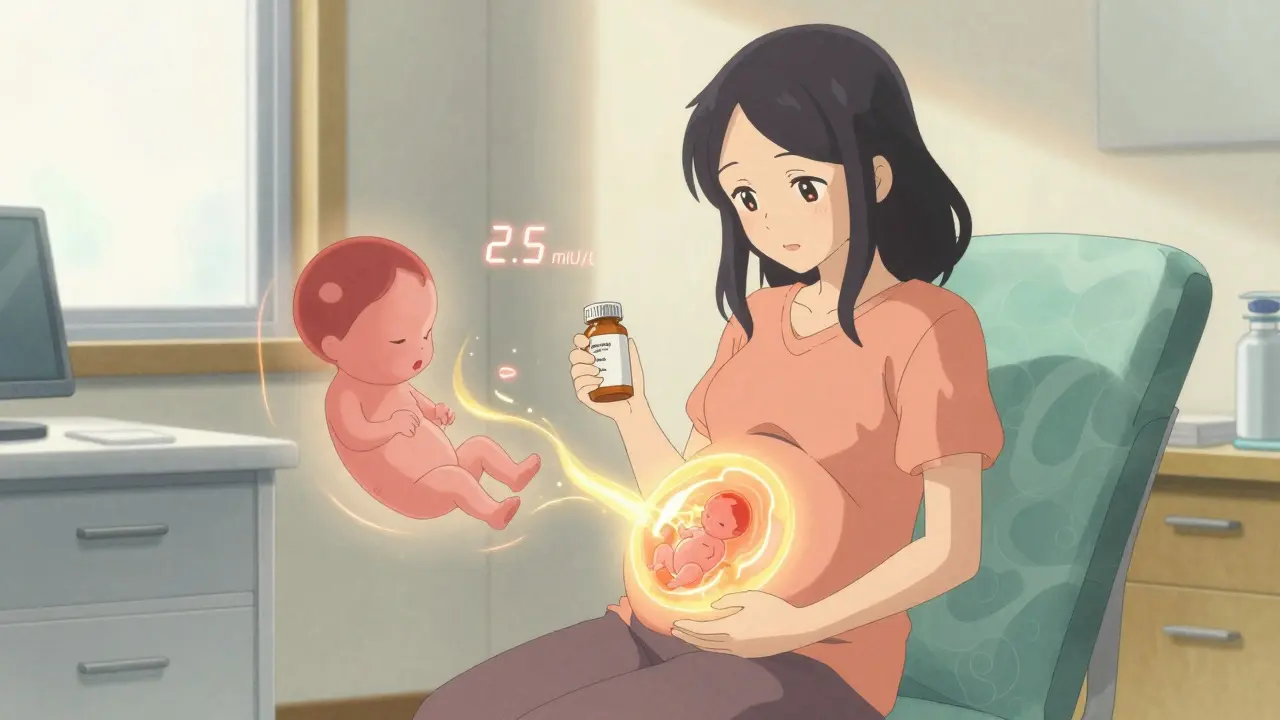
Why Thyroid Medication Matters in Pregnancy
When you’re pregnant, your body doesn’t just need more food or rest-it needs more thyroid hormone. That’s because your baby relies entirely on your thyroid hormones during the first 10 to 12 weeks of development, before its own thyroid even starts working. If your thyroid isn’t producing enough-especially if you have hypothyroidism-your baby’s brain and nervous system can be affected. Studies show that untreated or poorly managed hypothyroidism during pregnancy can lower a child’s IQ by 7 to 10 points and increase the risk of miscarriage by nearly 70%. The good news? With the right medication and monitoring, those risks drop dramatically.
Levothyroxine, the synthetic form of thyroid hormone, is the only medication recommended for hypothyroidism during pregnancy. Brands like Synthroid® are commonly used, but the generic version works just as well if taken consistently. The goal isn’t just to feel better-it’s to keep your TSH (thyroid-stimulating hormone) tightly controlled. And that’s not as simple as taking your usual dose. Most women need more medication once they’re pregnant-sometimes a lot more.
How Much More Medication Do You Need?
If you were already on levothyroxine before getting pregnant, chances are you’ll need to increase your dose as soon as you find out you’re pregnant. The American Thyroid Association recommends boosting your daily dose by 20% to 30% right away. That might sound like a big jump, but your body’s demand for thyroid hormone spikes within days of conception-even before you miss your period.
For example, if you were taking 75 mcg per day before pregnancy, you’d likely need to increase to about 90 to 95 mcg. Some doctors suggest adding two extra doses per week (like taking your pill on Monday and Thursday instead of just Monday), while others recommend a flat increase of 25 to 50 mcg per day. The American College of Obstetricians and Gynecologists (ACOG) even suggests jumping straight up by 50 mcg for women with known hypothyroidism. There’s no one-size-fits-all, but the consensus is clear: don’t wait. Delaying the increase can hurt fetal development.
For women newly diagnosed with hypothyroidism during pregnancy, dosing depends on how high your TSH is. If it’s above 10 mIU/L, start with 1.6 mcg per kilogram of body weight per day. If it’s between 5 and 10, start with 1.0 mcg/kg/day. A 2021 NIH study of 280 pregnant women found that on average, their levothyroxine dose went up by 14.3 mcg per day-about a 17% increase-by the first trimester. That’s not unusual. About 85% of women with pre-existing hypothyroidism need a dose increase during pregnancy, and 75% of those changes happen in the first 12 weeks.
When and How to Monitor Your TSH
Checking your TSH isn’t a one-time thing. It’s a rolling process that needs to happen every few weeks. The American Thyroid Association says to test your TSH every 4 weeks after any dose change, and again once you hit a stable level. But many experts recommend even more frequent checks early on. AAFP guidelines suggest testing at 4 to 6 weeks, then every 4 to 6 weeks until 20 weeks, and then again at 24 to 28 weeks and 32 to 34 weeks.
Why so often? Because your hormone needs keep changing. Your body’s demand for thyroid hormone rises steadily through the first half of pregnancy and then levels off. If your TSH is too high-above the target range-you’re not giving your baby enough hormone. If it’s too low, you might be overmedicating, which can also be risky. The target ranges vary slightly by guideline, but most agree on this:
- First trimester: TSH ≤ 2.5 mIU/L
- Second trimester: TSH ≤ 3.0 mIU/L
- Third trimester: TSH ≤ 3.0 mIU/L
Some organizations, like the Endocrine Society, say keep TSH under 2.5 throughout pregnancy if you have thyroid antibodies. Others, like Dr. Peter Laurberg from Denmark, argue that up to 4.0 mIU/L in the second trimester is safe. But the majority of clinical data supports tighter control. One study found women with TSH over 2.5 in the first trimester had a 69% higher risk of miscarriage than those with levels below that threshold.

How to Take Levothyroxine Correctly
It’s not enough to take the right dose-you have to take it the right way. Levothyroxine is easily disrupted by food, supplements, and even other medications. For best absorption, take it on an empty stomach, at least 30 to 60 minutes before eating. Many people find it easiest to take it first thing in the morning, before coffee or breakfast.
Iron and calcium supplements-common during pregnancy-can block up to 50% of the drug’s absorption if taken within 4 hours. That includes prenatal vitamins with iron or added calcium. If you take them, space them out. Take your thyroid pill in the morning, and your prenatal vitamin at lunch or dinner. Same goes for antacids, soy products, and high-fiber foods. Even switching brands (generic to Synthroid® or vice versa) can cause small variations in absorption, so stick with the same one unless your doctor advises otherwise.
Real Challenges Patients Face
Guidelines are clear, but real life isn’t always so straightforward. Many women report being told by their OB/GYN to "wait and see" before adjusting their dose-even though the ATA says to act immediately. One patient on Reddit shared that her doctor didn’t check her TSH until 10 weeks, and by then, her levels were already high. "I panicked for weeks thinking I’d damaged my baby," she wrote.
Another issue is the "weekend effect." Some doctors tell patients to take two extra pills on the weekend to hit a 30% increase. But that can cause spikes and dips in hormone levels. A 2018 study found that spreading the extra doses across the week-like adding one extra pill on Tuesday and Thursday-leads to more stable TSH levels than loading it on weekends.
And not all doctors are up to speed. A 2019 survey of 150 OB/GYNs found that 68% didn’t routinely check TSH at the first prenatal visit for women with known thyroid disease. That’s a huge gap. If you have hypothyroidism, don’t wait for your doctor to bring it up. Bring your pre-pregnancy dosage and recent lab results to your first appointment. Ask for a TSH test right away.

What Happens After Baby Is Born?
Once your baby is born, your thyroid hormone needs drop back down quickly. Most women return to their pre-pregnancy dose within 4 to 6 weeks postpartum. But don’t just guess-get your TSH checked again around 6 weeks after delivery. Some women develop postpartum thyroiditis, an inflammation that can cause temporary hyperthyroidism or hypothyroidism. If you’re breastfeeding, levothyroxine is safe. Only tiny amounts pass into breast milk, and it won’t affect your baby’s thyroid.
Many women worry about long-term effects. The good news? When managed properly, children born to mothers with controlled hypothyroidism develop normally. One mother on HealthUnlocked shared that her daughter scored in the 90th percentile for development at 18 months after her TSH stayed in range throughout pregnancy. That’s not luck-it’s careful monitoring and timely adjustments.
What’s New in 2025?
Thyroid care in pregnancy is getting smarter. In 2023, the American Thyroid Association reversed its old stance and now recommends universal TSH screening for all pregnant women in the first trimester-not just those with symptoms or a history of thyroid disease. That’s a big shift.
AI is also stepping in. The 2022 ENDO trial used machine learning to predict individual dose needs based on pre-pregnancy TSH, weight, and antibody status. Women using AI-guided dosing had 28% better TSH control than those on standard protocols. Trials like TRUST (NCT03186773) are now testing whether personalized algorithms can become standard care. Within the next 5 to 7 years, we may see genetic markers and digital tools guiding dosing decisions in real time.
But access remains unequal. In low-income countries, only 22% have consistent access to levothyroxine. That’s why the WHO added it to its Essential Medicines List for maternal health in 2023. Thyroid care isn’t just a personal health issue-it’s a global public health priority.
What You Should Do Now
- If you’re pregnant and on levothyroxine: Call your doctor today. Ask for a TSH test and discuss increasing your dose by 20-30%.
- If you’re newly pregnant and have hypothyroidism: Don’t wait for your first OB appointment. Get your TSH checked as soon as possible.
- If you’re planning pregnancy: Get your thyroid levels checked before conceiving. Optimal TSH should be under 2.5 before you get pregnant.
- Take your medication on an empty stomach, 30-60 minutes before food.
- Avoid calcium, iron, and prenatal vitamins within 4 hours of your thyroid pill.
- Track your labs and ask for copies. Keep a log of your doses and TSH results.
Thyroid health in pregnancy isn’t optional. It’s foundational. With the right care, you can have a healthy pregnancy and give your baby the best possible start-no matter what your starting point was.
mike swinchoski
January 14, 2026 AT 06:00jefferson fernandes
January 15, 2026 AT 02:09Acacia Hendrix
January 17, 2026 AT 01:05Adam Rivera
January 17, 2026 AT 15:24lucy cooke
January 17, 2026 AT 21:40John Tran
January 19, 2026 AT 20:30Pankaj Singh
January 20, 2026 AT 22:20Kimberly Mitchell
January 21, 2026 AT 12:35