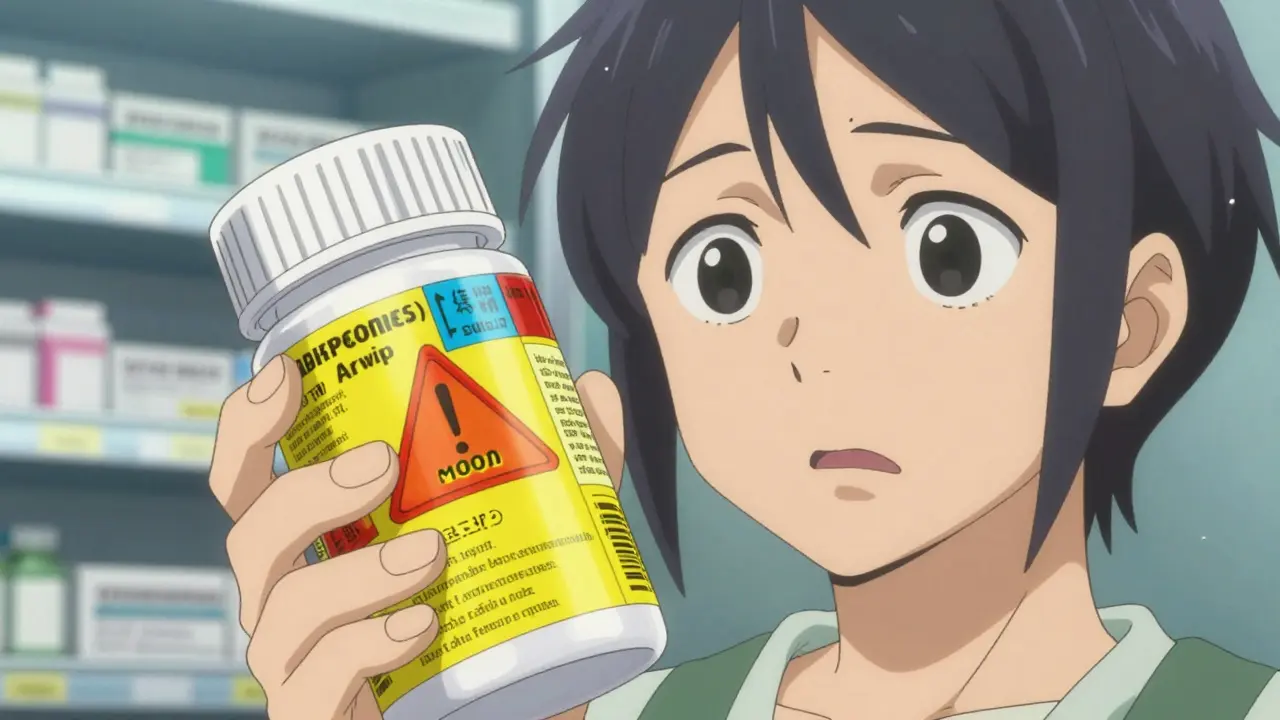
Have you ever picked up a new prescription and felt overwhelmed by the stickers plastered all over the bottle? You are not alone. Those small, colorful labels with symbols and bold text are not just decorative; they are critical safety tools designed to keep you from making dangerous mistakes. But here is the catch: if you do not know what those icons mean, they might actually be causing more confusion than clarity.
Medication errors are a serious issue. In the United States alone, these errors contribute to thousands of deaths every year. The Institute for Safe Medication Practices (ISMP) has been pushing for standardized warning labels since the 1990s to help fix this. Today, about 90% of prescription containers in the U.S. feature these visual cues. Yet, despite their widespread use, many patients still misinterpret them. Understanding these icons is not just about reading fine print; it is about protecting your health.
The Purpose Behind the Stickers
Why do pharmacies put so many stickers on your medicine bottles? The primary goal is speed and clarity. When you are tired, stressed, or dealing with a complex medical condition, reading long paragraphs of instructions can be exhausting. Visual icons act as quick-reference guides. They highlight the most critical safety information, such as whether a drug makes you drowsy or needs to be taken with food.
These labels were developed through collaboration between pharmacy associations, regulatory bodies like the Food and Drug Administration (FDA), and safety organizations. The idea is to create a universal language that transcends literacy levels and language barriers. For example, a symbol showing a sleeping person instantly communicates sedation risk without needing to read English fluently. However, the system is not perfect. Research shows that while color-coding helps some people, it confuses others. A yellow label might mean "caution" to one person but simply signal a specific drug class, like beta-blockers, to another.
Common Warning Icons and What They Really Mean
Let’s break down some of the most frequent warnings you will see. Knowing these can save you from unpleasant side effects or worse.
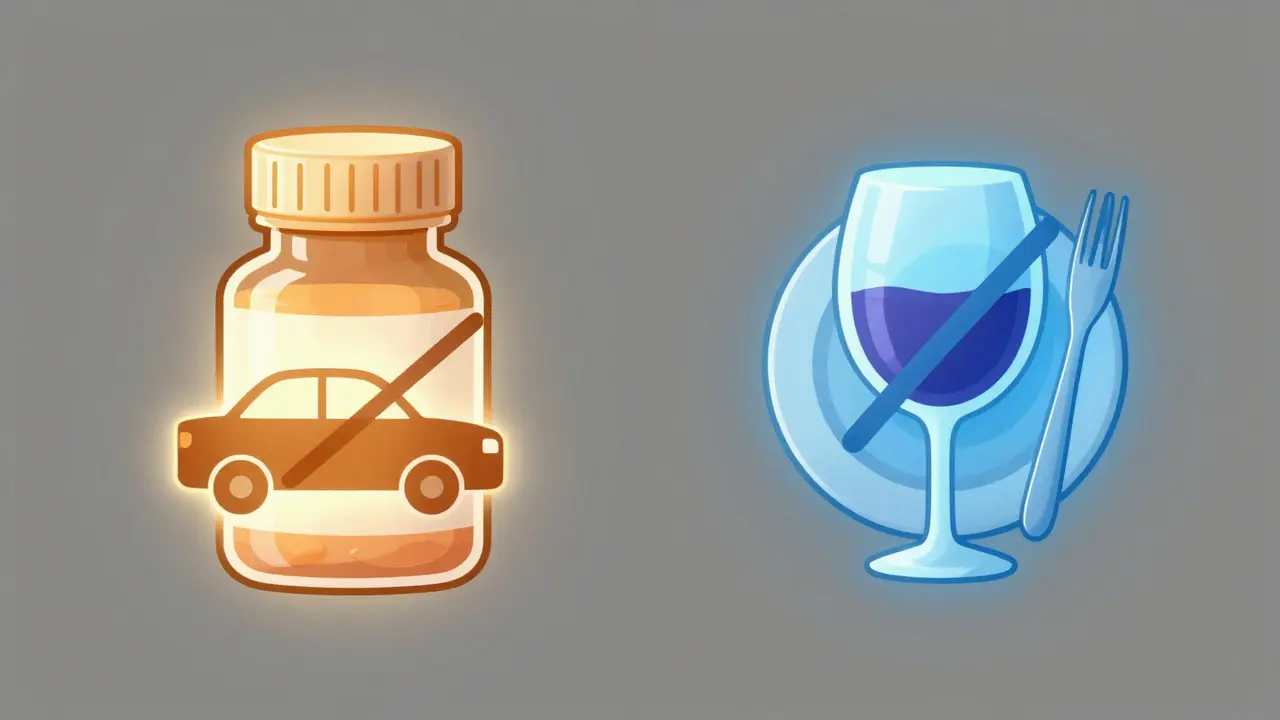
- Drowsiness / Do Not Drive: This icon usually features a car or a sleeping face. It warns that the medication may impair your reaction time. The FDA notes that combining verbal explanation with this symbol improves comprehension by 63%. If you see this, do not drive or operate heavy machinery until you know how the drug affects you.
- Take With Food: Often depicted with a plate or fork and knife. Some medications irritate the stomach lining if taken on an empty stomach, while others need fat to be absorbed properly. Misinterpreting this can lead to nausea or reduced effectiveness.
- External Use Only: This is a high-risk category. The symbol often looks like a radioactive hazard sign or an eye drop bottle. Shockingly, studies show that nearly 70% of patients with limited health literacy misinterpret this icon. There have even been cases where patients took eye drops orally because they misunderstood the dropper symbol. Always double-check this one.
- Avoid Alcohol: Usually shown with a crossed-out wine glass. Mixing alcohol with certain antibiotics or painkillers can cause severe reactions, including liver damage or extreme dizziness.
- Do Not Crush or Chew: This applies to extended-release tablets. Crushing them releases the entire dose at once, which can be toxic. The icon often shows a pill with a slash through it.
It is important to remember that text alone is not always enough. A study published in U.S. Pharmacist found that "For external use only," written at a first-grade reading level, was still misunderstood by over 90% of participants. That is why the visual icon matters so much-but only if you know what it represents.
The Problem With Lack of Standardization
Here is where things get tricky. Unlike the UK, which uses a nationally standardized system of nine warning labels, the U.S. lacks a single federal standard. This creates a patchwork of systems depending on where you buy your medicine.
| Provider/System | Number of Standard Labels | Consistency Level |
|---|---|---|
| CVS Health | 14 | High (Proprietary) |
| Walgreens | 17 | High (Proprietary) |
| Independent Pharmacies | Average 23 | Low (Varies widely) |
| United Kingdom (National) | 9 | Very High (Regulated) |
This fragmentation means the same medication could have different warning icons at two different pharmacies. A patient who understands CVS’s "drowsiness" icon might be confused by Walgreens’ version if the design differs slightly. Dr. Robert Field, a health policy professor, has pointed out that this lack of standardization creates dangerous inconsistencies across the massive U.S. prescription drug market. The FDA recognized this gap and released draft guidance in September 2022 proposing national standardization of 12 core warning icons. While final rules were expected in 2024, we are still waiting for full implementation. Until then, variability remains a risk.
Color-Coding: Helpful or Confusing?
You might notice that warning labels often come in specific colors. Yellow, tan, red, and blue are common. Many patients assume these colors indicate severity-red for danger, yellow for caution. However, this is not always the case. In some systems, yellow simply denotes beta-blockers, while tan indicates anti-infectives.
A 2019 study found that 42% of patients correlate label color to message severity. This assumption can be misleading. If you see a red label, you might panic, thinking it is life-threatening, when it might just be a reminder to take the drug with water. Conversely, a green label might seem safe but contain a critical instruction about avoiding sunlight. The key takeaway? Never rely on color alone. Always read the accompanying text and look at the symbol.
How to Improve Your Comprehension
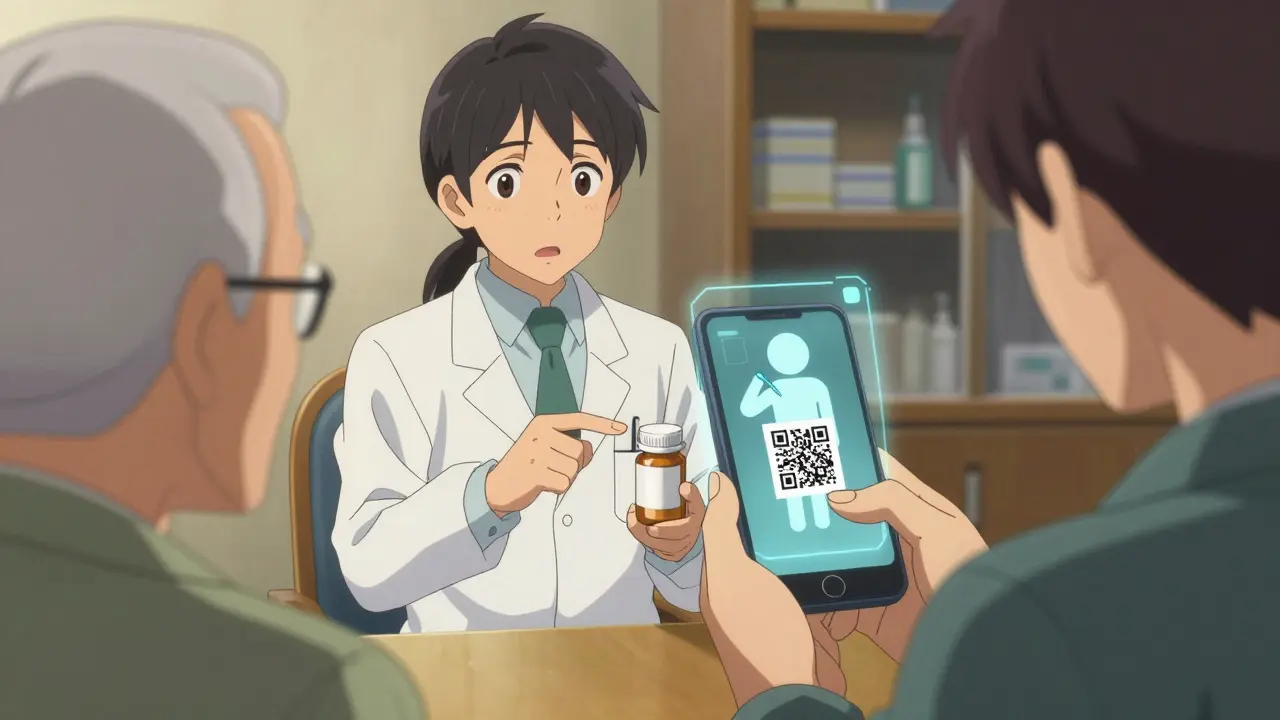
So, what can you do to ensure you understand your medication warnings? First, ask questions. Pharmacists are trained to explain these labels, but they often assume patients understand them. If an icon looks unfamiliar, point to it and ask, "What does this mean for me?"
Second, limit the clutter. Some pharmacists apply excessive warnings, which can dilute the importance of critical messages. A 2021 study showed that 38.7% of pharmacists apply too many labels. If your bottle is covered in stickers, ask the pharmacist to prioritize the top three most relevant warnings for your specific situation.
Third, leverage technology. Many pharmacies now include QR codes on labels that link to video explanations or digital patient leaflets. Scanning these codes can provide clear, visual demonstrations of how to take your medication. This is especially helpful for complex instructions like "swallow whole" or "use only in eyes."
Finally, consider your personal context. Are you elderly? Do you have low vision? Are you not fluent in English? These factors increase your risk of misinterpretation. Tell your pharmacist about these challenges. They can provide larger font labels, braille options, or translated materials.
The Future of Medication Warnings
The landscape of pharmacy warning icons is evolving. We are moving toward more personalized and digital-augmented systems. AI-driven label customization is being tested to improve adherence for high-risk medications. Imagine a label that changes based on your age, other medications, and health conditions. This could reduce errors significantly.
Augmented reality (AR) labels are also in pilot stages. Kaiser Permanente tested AR labels that increased warning comprehension from 58% to 89% in early trials. By pointing your smartphone at the label, you could see an animation demonstrating proper usage. While exciting, these technologies raise concerns about accessibility for seniors who do not use smartphones regularly.
Despite these advancements, the core principle remains the same: clear communication saves lives. Whether through traditional stickers or futuristic AR, the goal is to ensure every patient understands how to take their medication safely. As regulations tighten and technology improves, we can hope for a future where misunderstanding a warning icon is a thing of the past.
Why are there so many different warning icons at different pharmacies?
The U.S. lacks a single federal standard for pharmacy warning labels. Major chains like CVS and Walgreens have their own proprietary systems, while independent pharmacies often use even more variations. This fragmentation leads to inconsistency, which is why the FDA has proposed national standardization to unify these icons.
Does the color of the warning label indicate how dangerous the side effect is?
Not necessarily. While many patients assume red means "danger" and yellow means "caution," colors are often used to categorize drug types (e.g., yellow for beta-blockers). Relying solely on color can be misleading. Always read the text and interpret the symbol alongside the color.
What should I do if I don't understand a warning icon on my prescription?
Ask your pharmacist immediately. Do not guess. Point to the specific icon and request a clear explanation. Pharmacists are required to counsel patients, and clarifying these symbols is a crucial part of ensuring your safety. You can also scan any QR codes on the label for digital resources.
Are warning labels effective in preventing medication errors?
Yes, but with limitations. Studies show standardized warning labels can reduce certain medication errors by up to 28%. However, they are not foolproof. Without proper patient counseling, many icons are still misinterpreted. Combining visual icons with verbal explanations yields the best results.
Will pharmacy warning icons become standardized in the near future?
Efforts are underway. The FDA released draft guidance in 2022 proposing 12 core standardized icons. Major pharmacy chains are already aligning with these proposals. While full implementation takes time, the trend is moving toward greater consistency to improve patient safety nationwide.
Nicholas Bowling
June 5, 2026 AT 06:34you guys really think these stickers are the problem? its the people who cant read basic instructions. stop blaming the label and start taking responsibility for your own damn health. nobody owes you a cartoon to tell you not to drive drunk on pills
Jay Foreman
June 6, 2026 AT 16:01I mean honestly it is just so lazy of these big chains to have different systems. It feels like they are trying to confuse us on purpose so we make mistakes and go back for more meds. Its morally bankrupt if you ask me. We deserve better than this patchwork nonsense that puts lives at risk because CVS decided their yellow sticker means something totally different than Walgreens.
Cathy N
June 7, 2026 AT 18:27i get frustrated when my bottle looks like a confetti cannon but i always ask the pharmacist to point out the top three things i need to know. saves so much time and headache later
Adelaide Motata
June 8, 2026 AT 15:20look im from australia and we have nine standard labels and everyone knows what they mean. you americans are just too chaotic to agree on anything even when it comes to not dying from your meds. its pathetic really. why do you need seventeen different ways to say take with food?
Mike Crump
June 9, 2026 AT 11:27Hey folks, I actually work in a community pharmacy and let me tell you, the sticker clutter is a real nightmare for us too! We want to help, but sometimes the software forces us to slap on every possible warning just to cover our liability. It’s like wrapping a present in fifty layers of tape. If you ever feel overwhelmed, just wave us down and say 'help me prioritize'-we’d rather spend two minutes talking than have you guess!
Samantha Arbuckle
June 9, 2026 AT 23:01the qr codes are a game changer 🙌 i scanned one last week and it showed me exactly how to use my eye drops without getting them all over my face. technology saving the day again ✨
Stephanie Francis
June 11, 2026 AT 22:46(y) While I appreciate the effort to educate patients, the lack of federal regulation is frankly unacceptable. The FDA has had years to act on the 2022 draft guidance. Until there is a unified national standard, patients remain vulnerable to preventable errors due to inconsistent visual cues across providers. This is not merely an inconvenience; it is a systemic failure in healthcare communication.
Daniel Tremblay
June 12, 2026 AT 17:00oh sure blame the icons. maybe if people paid attention instead of scrolling through phones while picking up prescriptions we wouldnt need pictures of sleeping faces. classic american exceptionalism right there
Henri-Paul Soulodre
June 14, 2026 AT 15:50The moral decay of our society is evident in how we treat medication safety as an afterthought. We allow corporations to profit from confusion while families suffer the consequences of misinterpreted labels. It is a tragedy that we must rely on color-coded guesses rather than clear, standardized truth. We owe it to the vulnerable to demand immediate action from regulators.
Mark Hogan
June 16, 2026 AT 08:13hey mike thanks for the tip about asking to prioritize. i tried that yesterday and the pharmacist took off half the stickers. made it way easier to understand what i was supposed to do. good stuff