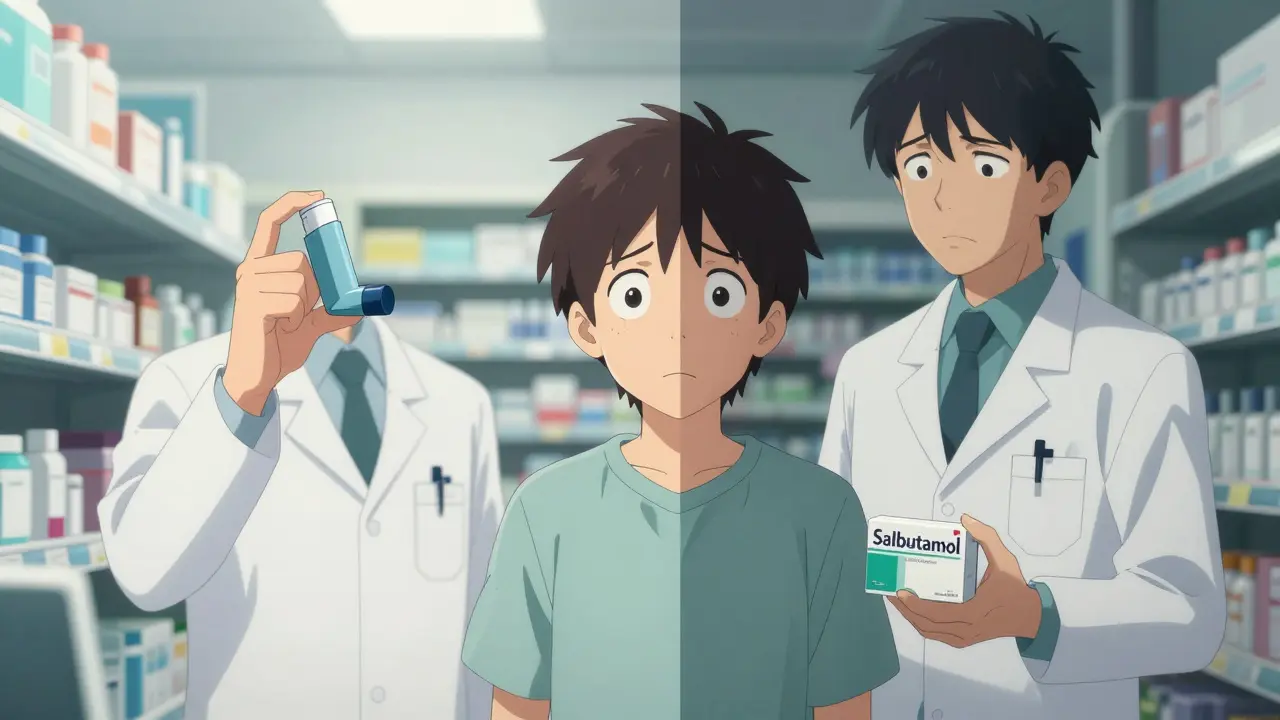
Imagine walking into a pharmacy with a prescription for albuterol. The pharmacist hands you an inhaler. You go to Europe for vacation, get sick, and ask for the same medication. The local pharmacist looks confused because they only know it as salbutamol. It’s the exact same medicine, but the name is different. This isn’t just a minor inconvenience; in healthcare, confusion over names can lead to serious errors. That is why systems like USAN and INN exist.
We often think of drugs by their catchy brand names-Lipitor, Viagra, or Tylenol. But behind every brand name sits a generic name, a scientific identifier that tells doctors exactly what the drug does. These generic names aren't random. They follow strict rules managed by global bodies to ensure safety and clarity. If you work in pharma, study medicine, or just want to understand your prescriptions better, knowing how these naming conventions work is essential.
The Two Pillars of Generic Naming: USAN and INN
To understand generic naming, you need to know the two main players in the room. First, there is the United States Adopted Name (USAN), which is a nonproprietary naming system established in 1964 by the USAN Council, co-sponsored by the American Medical Association, USP, and APhA. Think of USAN as the gatekeeper for the United States market. When a new drug is developed, the manufacturer applies to the USAN Council for a name. The Council checks if the name is unique, safe, and doesn't sound too similar to existing drugs.
The second pillar is the International Nonproprietary Name (INN), managed by the World Health Organization (WHO) since 1950 to create globally recognized nonproprietary names. While USAN focuses on the US, INN aims for global standardization. Ideally, a drug should have one name everywhere. In practice, about 95% of USAN and INN names align perfectly. However, those missing 5% cause the headaches we mentioned earlier with albuterol/salbutamol.
Why do we need both? The FDA requires USAN for marketing authorization in the US, while the European Medicines Agency (EMA) relies on INN. This dual requirement means multinational companies must navigate both systems simultaneously during development. The goal is patient safety. Distinctive names prevent medication errors, which cost the US healthcare system approximately $2.4 billion annually according to IMS Institute data.
Decoding the Code: How Stems Work
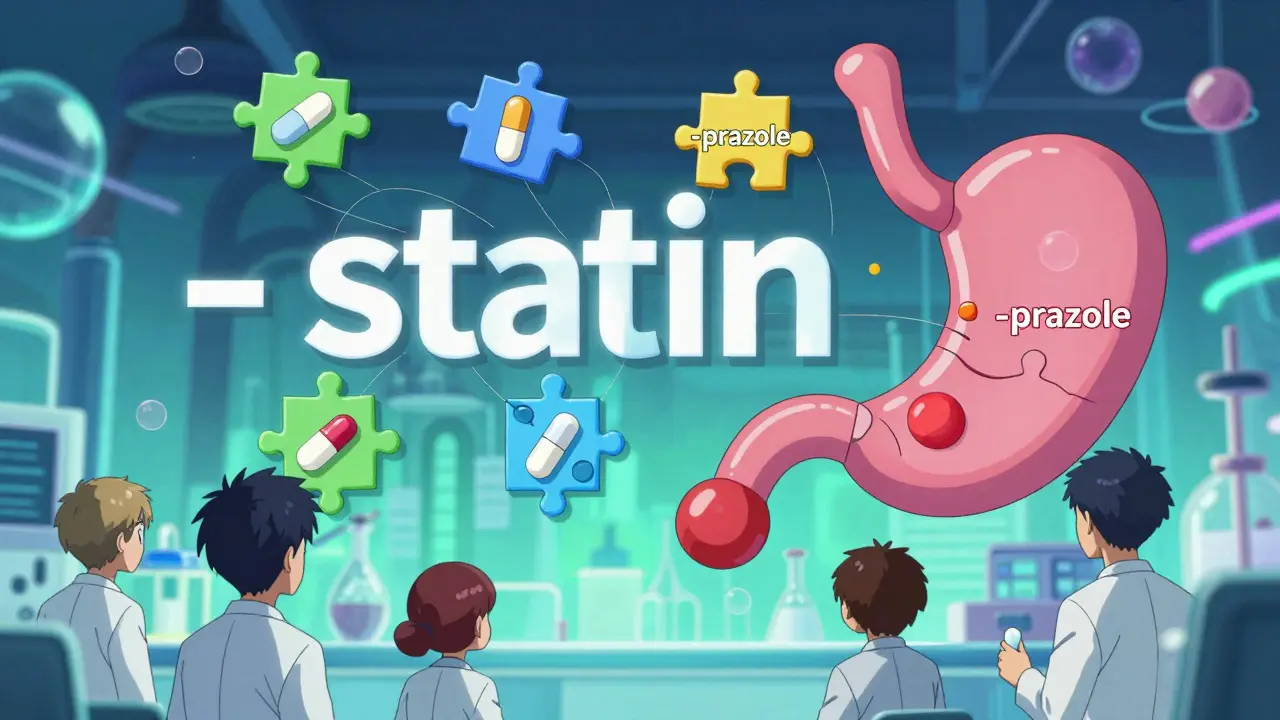
You might notice that many generic names end in similar ways. Omeprazole, esomeprazole, and pantoprazole all end in "-prazole." This isn't a coincidence. Both USAN and INN use a systematic "stem"-based convention. The stem usually appears at the end of the word (the suffix) and identifies the drug's mechanism of action, therapeutic class, or chemical structure.
- -statin: Indicates HMG-CoA reductase inhibitors, used for lowering cholesterol (e.g., atorvastatin).
- -prazole: Denotes proton pump inhibitors, used for acid reflux and ulcers (e.g., omeprazole).
- -mab: Identifies monoclonal antibodies. Sub-stems tell you more: -ximab is chimeric, while -zumab is humanized.
- -feron: Points to interferon-related compounds.
- -virdine: Signals non-nucleoside reverse transcriptase inhibitors for HIV treatment.
The prefix-the first part of the name-is usually a "fantasy" element. It’s a euphonious letter combination deliberately devoid of specific meaning, chosen just to make the name sound distinct and pleasant. For example, in atorvastatin, "ator-" is the fantasy prefix, and "-statin" is the functional stem. This system allows healthcare professionals to instantly recognize a drug class without memorizing thousands of unique names.
The Naming Process: From Lab to Label
Getting a generic name approved is not quick. It typically begins when a manufacturer initiates the application during Phase 1 or early Phase 2 clinical trials. Why so early? Because the approval process takes about 18 to 24 months. If you wait until late-stage trials, you risk delays in bringing the drug to market.
- Submission: The pharmaceutical firm submits up to six proposed names in ranked order of preference to both USAN and INN bodies.
- Verification: USAN Program staff verify the chemistry and search databases for conflicts with existing generic or proprietary names.
- Balloting: A ballot is prepared with the firm’s proposals alongside any alternative suggestions from the council.
- International Review: Once USAN accepts a name, it goes to WHO’s INN Programme. The WHO committee reviews it and either accepts it or offers an alternative.
- Objection Period: Accepted names are published for public viewing with a mandatory four-month objection period. Objections are rare but possible.
This rigorous process ensures that names are distinctive enough to prevent prescription misinterpretation. Dr. Sarah Thompson, a Senior Nomenclature Specialist at the USAN Council, notes that the primary goal is always patient safety. Companies often discard 15 to 20 name candidates before finding one that passes all linguistic and phonetic checks.
Brand Names vs. Generic Names: The Critical Difference
It is crucial to distinguish between generic (nonproprietary) names and brand (proprietary) names. Generic names like ibuprofen or metformin belong to the public domain. No one owns them. Any company can manufacture and sell ibuprofen under that name. They cannot be trademarked.
Brand names, like Advil or Glucophage, are proprietary. They are owned by specific companies and protected by trademarks. Companies spend millions creating brand names that are short, memorable, and legally distinct. However, regulators scrutinize brand names heavily to ensure they don't look or sound too much like generic names or other brands, which could confuse patients.
| Feature | Generic Name (USAN/INN) | Brand Name |
|---|---|---|
| Ownership | Public Domain | Private Company (Trademarked) |
| Purpose | Scientific identification, safety, classification | Marketing, brand recognition |
| Structure | Systematic stems indicating drug class | Creative, often unrelated to function |
| Regulation | Managed by USAN Council / WHO | Managed by FDA/EMA and Trademark Offices |
| Example | Lisinopril | Zestril |

Challenges in Modern Pharmacology
As science advances, naming becomes harder. Traditional stems worked well for small molecules like statins. But what about complex biologics? Monoclonal antibodies now represent a huge chunk of the market. The WHO updated its guidelines in 2021 to handle newer antibody formats, adding sub-stems to differentiate chimeric, humanized, and fully human antibodies.
Newer therapies pose even bigger challenges. Antibody-drug conjugates, gene therapies, and RNA-based therapeutics don't fit neatly into old categories. Their mechanisms are nuanced. Some experts, like Dr. Michael Chen from Harvard Medical School, argue that the traditional stem system may struggle to capture these complexities. The USAN Council acknowledges this, stating they will create new stems only when existing ones fail to accurately represent a compound and substantial data supports the change.
Another issue is regional divergence. Despite efforts to harmonize, differences persist. Acetaminophen (USAN) is paracetamol (INN). Rifampin (USAN) is rifampicin (INN). These discrepancies can lead to international medication errors. The FDA emphasizes the importance of distinctive names to prevent such errors, acknowledging the practical challenges of achieving perfect global consistency.
Why This Matters to You
If you are a patient, understanding these basics helps you read labels and discuss treatments with confidence. Knowing that "-statin" means cholesterol drug helps you understand why your doctor prescribed it. If you are in the industry, navigating the 18-to-24-month naming timeline is critical for product launch strategies. With 65% of named compounds failing during clinical development, having a secure name early protects your investment.
The system works because it prioritizes safety over convenience. It forces manufacturers to slow down, check for conflicts, and ensure clarity. In a world where medication errors cost billions and lives, that slowness is a feature, not a bug.
What is the difference between USAN and INN?
USAN (United States Adopted Name) is the official nonproprietary name used in the United States, managed by the USAN Council. INN (International Nonproprietary Name) is the global standard managed by the World Health Organization (WHO). While they aim to be the same, historical and regional differences sometimes result in different names for the same drug, such as albuterol (USAN) vs. salbutamol (INN).
How long does it take to get a generic drug name approved?
The entire process from initial application to final adoption typically spans 18 to 24 months. This includes verification, balloting, international review by the WHO, and a mandatory four-month public objection period. Manufacturers usually start this process during Phase 1 or early Phase 2 clinical trials.
Can a generic drug name be trademarked?
No. Generic names (USAN/INN) must be entirely in the public domain. They cannot be subject to trademark rights. Only brand names (proprietary names) like Tylenol or Lipitor can be trademarked by specific companies.
What do the endings (stems) in generic drug names mean?
Stems indicate the drug's class or mechanism of action. For example, '-statin' indicates cholesterol-lowering drugs, '-prazole' indicates proton pump inhibitors for acid reflux, and '-mab' indicates monoclonal antibodies. This helps healthcare providers quickly identify the type of medication.
Why are some drug names different in the US compared to Europe?
While USAN and INN align about 95% of the time, historical usage and regional medical practices have led to exceptions. Examples include acetaminophen (US) vs. paracetamol (international) and albuterol (US) vs. salbutamol (international). These differences persist due to legacy usage and regulatory independence.